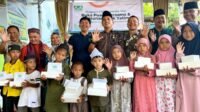


PALMOILMAGAZINE, BENAI, RIAU — The sun had barely risen when the courtyard of the PN-1 Sei Kuko Polyclinic in Benai, Kuantan Singingi, Riau, began to fill with children accompanied by their parents, alongside dozens of elderly residents. The early-morning gathering marked the closing chapter of Agrinas Palma Nusantara Regional I Riau’s first anniversary celebrations, held on Saturday (January 31, 2026).
The final day of activities featured mass circumcision services, free medical check-ups for senior citizens, and a community market—rounding out a series of social programs that had been running since Friday (January 30). The initiatives drew an overwhelmingly positive response from local residents, reflecting strong community engagement and a spirit of shared care.
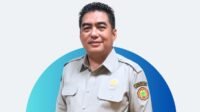
General Manager of District IV, Regional Office I Riau, Brig. Gen. (Ret.) Carlan Effendy, said the smooth execution of the activities reflected both gratitude and the company’s commitment to delivering tangible benefits to surrounding communities.
Also Read: Prabowo Stresses Food–Energy Independence, Positions Palm Oil as Key “Miracle Crop”
“May God continue to grant us blessings, smooth operations, and good intentions from our leadership so that we can share gratitude together with the community,” Effendy said in a statement issued on Sunday (February 1, 2026).
The social outreach programs followed a day earlier after a formal anniversary ceremony that included the planting of 1,000 trees and a community market. All first-anniversary events in Regional I Riau were organized by the company’s TJSL and ESG Division and attended by the division’s General Manager, Gatut Mukti Wirawan, underscoring Agrinas Palma Nusantara’s commitment to sustainable development and social responsibility.
A warm and lively atmosphere marked the activities. Parents patiently accompanied their children, while healthcare workers attended to elderly residents undergoing medical check-ups. Among the children participating in the mass circumcision, nine-year-old Aidan appeared cheerful as he teased an older boy beside him.
“I’m braver, even though I’m only in third grade,” he said with a laugh, drawing smiles from the waiting mothers.
Parents expressed gratitude for the program, citing both accessibility and cost savings. “If we had to arrange circumcision on our own, it would cost hundreds of thousands of rupiah and require traveling to a clinic in the city,” said Despirianti, Aidan’s mother.
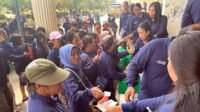
Similar scenes unfolded at the Cerenti-1 Plantation, where social services were held at the Central Plasma of Division II, accompanied by a low-cost community market. Basic food packages—containing rice, two liters of cooking oil, and one kilogram of sugar—were sold at less than half of prevailing market prices.
Also Read: Prabowo Calls Palm Oil a “Miracle Crop,” SPKS Urges Farmer Ownership of Palm Oil Mills
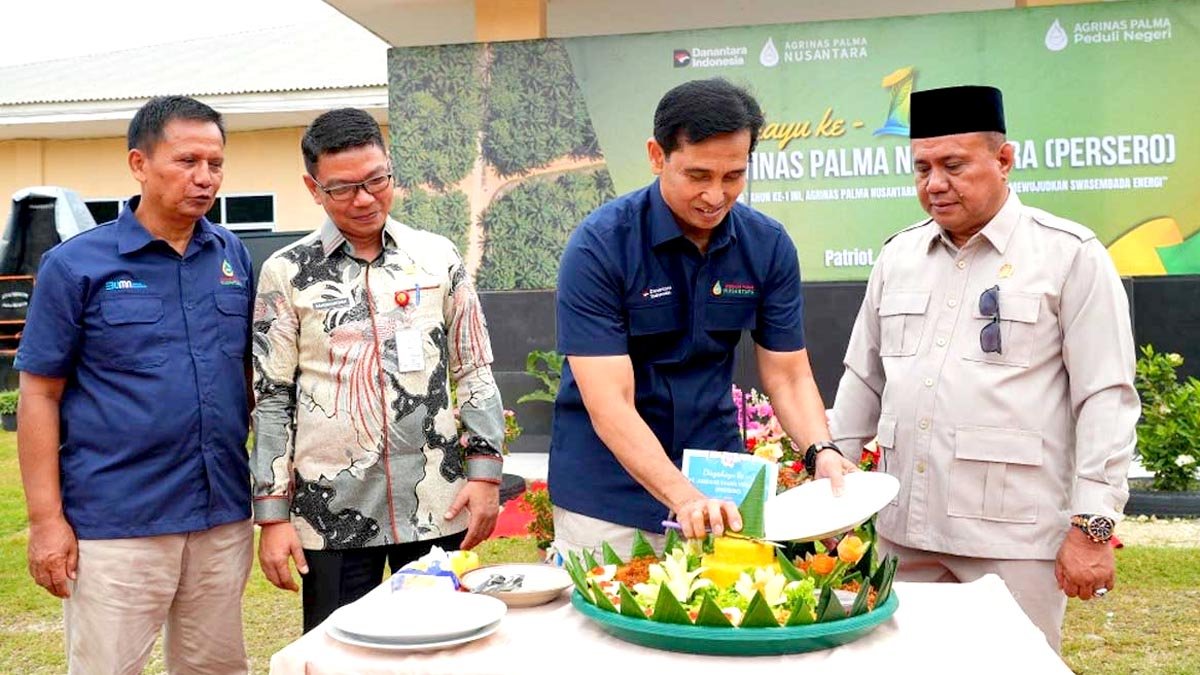
A day earlier, Agrinas Palma Nusantara’s first anniversary ceremony took place at the grounds of SMK Negeri 1 Sentajo Raya, Kuantan Singingi, attended by hundreds of residents, students, traditional and religious leaders, security officials, and representatives of local government and the regional legislature.
Among those present were Agrinas Palma Nusantara’s Head of the Sumatra Region, Maj. Gen. (Ret.) Djoko Andoko; District IV General Manager Brig. Gen. (Ret.) Carlan Effendy; representatives of the Kuantan Singingi Regent; and the Chair of the Kuantan Singingi Regional House of Representatives.
From the outset, the anniversary was framed as a large-scale social initiative, encompassing aid for 100 orphans, the planting of 1,000 trees, a community market distributing 1,000 food packages, mass circumcision for 100 children, and free health services for hundreds of residents.
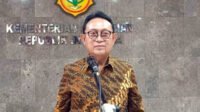
In his remarks, Djoko Andoko emphasized that sustainable palm oil can no longer be measured solely by production figures.
“In integrating productivity, business responsibility, and social commitment, we believe sustainable palm oil is not just about output,” he said. “It is about the values we uphold, the environment we protect, and the communities we empower.”
He described the company’s first year as a foundational phase. Established under a state mandate on January 16, 2025, Agrinas Palma Nusantara currently manages approximately 1.7 million hectares of oil palm plantations across strategic regions nationwide. Such scale, he said, demands rigorous governance, strengthened human resources, refined standard operating procedures, and consistent implementation of good corporate governance principles.
In Regional I Riau, the company manages around 84,000 hectares of former Duta Palma plantations spread across Indragiri Hulu, Pelalawan, Kuantan Singingi, and Kampar. About 96 percent of the workforce consists of former Duta Palma employees. However, the transition process remains ongoing as legal proceedings related to the assets have yet to reach final legal standing.
Representing the local government, Kuantan Singingi Regional Secretariat Assistant I, Dr. Fahdiansyah, said the arrival of a new operator offers an opportunity to open a new chapter in palm oil management in the region.
“We hope this marks a revival of local aspirations for a palm oil industry that is fair and truly benefits the community,” he said.
Echoing the sentiment, Kuantan Singingi DPRD Chair Juprizal expressed hope that Agrinas Palma Nusantara’s presence would help reverse past challenges and deliver tangible positive impacts for local residents.
The anniversary celebrations concluded with the planting of 1,000 tree seedlings along riverbanks, low-cost community markets, free healthcare services, and mass circumcision programs at two separate locations. From Benai, the message was clear and resonant: state-managed palm oil is expected to serve not only as a source of energy, but also as a source of life for surrounding communities. (P2)