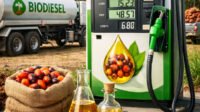
PALMOILMAGAZINE, BOGOR – Edi Wibowo, Director of Bioenergy at the Directorate General of New, Renewable Energy, and Energy Conservation (EBTKE) of the Ministry of Energy and Mineral Resources (ESDM), reaffirmed the government’s commitment to strengthening national energy security through the accelerated adoption of palm oil-based biodiesel. This aligns with President Prabowo Subianto’s directive to achieve self-sufficiency in food, energy, and the blue economy, as outlined in Presidential Decree No. 1 of 2025 on National Energy Security.
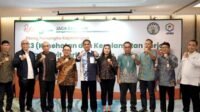
“We are focusing on three key pillars: reducing fossil fuel imports, increasing the use of palm oil-based renewable energy, and promoting a green economy by cutting greenhouse gas emissions,” Edi stated during the Palm Oil Downstream Industry Journalist Workshop in Bogor on Saturday (Feb 22, 2025).
Palm Oil Biodiesel Strategy and Progress
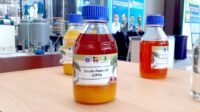
Edi outlined Indonesia’s biodiesel program, which has made significant strides since its launch in 2008. From 2008 to 2015, the country conducted trials on B2.5 to B10 blends. Between 2016 and 2020, the program advanced to B20 and B30, followed by an upgrade to B35 in 2022-2024, with production reaching 13.5 million kiloliters (KL) in 2023, of which 13.93 million KL were allocated for domestic needs. The next target is B40 by 2025, with preparations for B50 underway.
“Currently, 93% of biodiesel production is allocated for domestic use. This proves that palm oil is not just an export commodity but a backbone of national energy security,” he emphasized.
Also Read: BPDP Supports Food and Energy Self-Sufficiency for Indonesia Emas 2045
The biodiesel program is backed by various regulations, including government regulations (PP), presidential decrees (Perpres), and ministerial decrees (Kepmen ESDM). Production facilities are spread across 22 provinces. Edi highlighted that every increase in biodiesel blend levels (e.g., B30 to B35) undergoes rigorous technical feasibility tests, including diesel engine and vehicle trials since 2016.
“Road and laboratory tests confirm that palm oil biodiesel is engine-friendly and reduces emissions by up to 50% compared to fossil diesel,” he added.
Challenges Ahead
To achieve the B40 target by 2025, Edi acknowledged the need for synergy with the Ministries of Agriculture and Industry, as well as private sector players. The 2025 biodiesel allocation has been set at 16.46 million KL, with distribution handled by Pertamina and PT AKR Corporindo.
Also Read: Pertamina Patra Niaga Highlights Two Key Challenges in Implementing the Palm Oil Biodiesel Mandate
“We must also expand into non-traditional markets, including exporting bio-based gasoline (green gasoline) to Europe and the U.S., as well as palm oil derivatives for the chemical industry,” he stated.
The biodiesel program contributes significantly to the economy by:
- Saving up to IDR 165 trillion ($10.5 billion) in foreign exchange (2023) by replacing diesel imports.
- Creating 1.6 million jobs across the palm oil value chain.
- Reducing CO₂ emissions by 25.6 million tons in 2023.
“This is not just about energy but also sustainable development. Palm oil is Indonesia’s green asset for the global energy transition,” Edi concluded.
With strong government policies and Indonesia’s vast palm oil potential, the Ministry of Energy and Mineral Resources (ESDM) is confident that the country can become a key player in the global renewable energy landscape, realizing the vision of Indonesia Emas 2045. (P2)