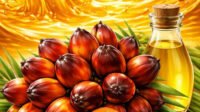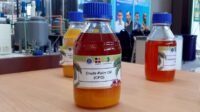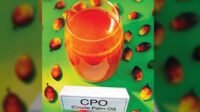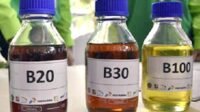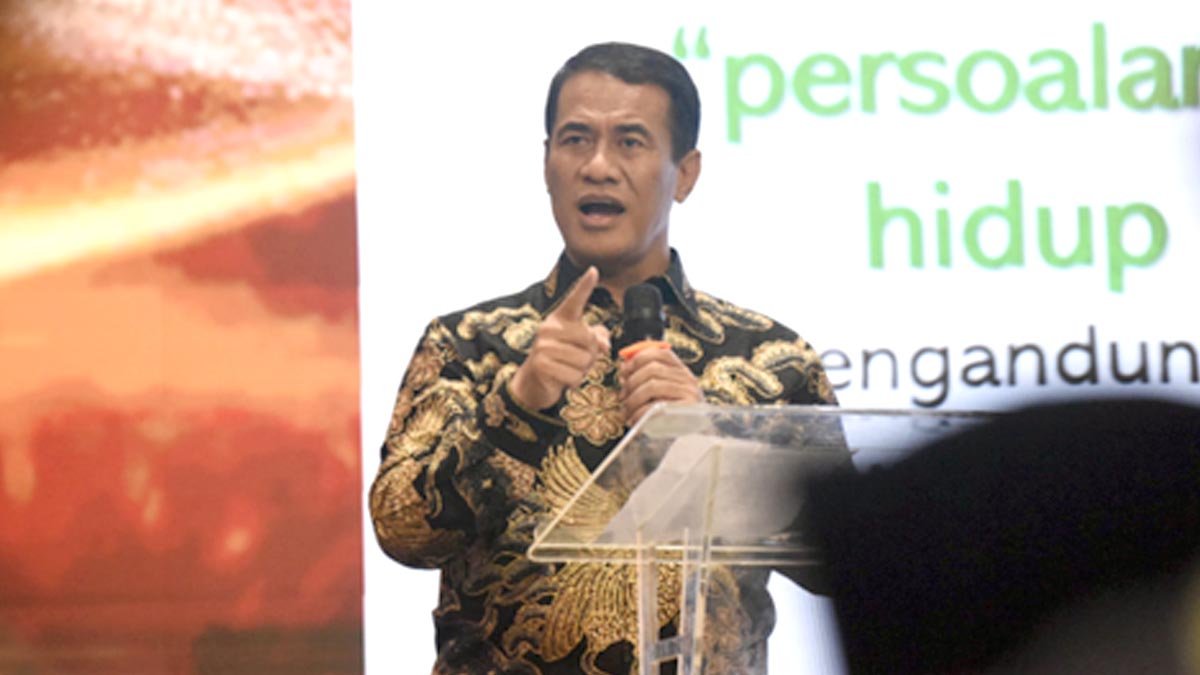
PALMOILMAGAZINE, JAKARTA — Minister of Agriculture Andi Amran Sulaiman reaffirmed the government’s major strategy to strengthen national energy security through the downstreaming of Crude Palm Oil (CPO) for the B50 biodiesel program. This initiative, he said, will not only eliminate Indonesia’s dependence on imported diesel but also give the country greater influence over global CPO prices.
“If we divert 5.3 million tons of CPO for B50, Indonesia can stop importing diesel and save foreign exchange reserves. Moreover, since 60 percent of global CPO production comes from Indonesia, we’ll gain the ability to stabilize international prices,” Amran declared confidently during a press conference at the Presidential Office, Jakarta, Thursday (Oct 9, 2025).
He emphasized that Indonesia has long exported most of its CPO in raw form, allowing other countries to capture the added value. By advancing CPO downstreaming and converting part of it into biofuel, Indonesia will not only strengthen its energy sector but also boost farmer welfare and national revenue.
Also Read:
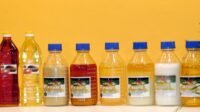
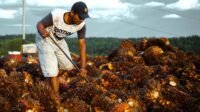
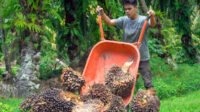
“For years, we’ve been selling raw materials. Yet, fresh fruit bunches can be processed into FAME (biodiesel), cooking oil, margarine, and butter. The added value must stay in Indonesia,” he stressed.
The allocation of 5.3 million tons of CPO for biodiesel marks a new phase of agricultural development focused on downstreaming and industrialization. Amran noted that with national food security now on track, the government can move forward toward achieving energy self-sufficiency based on agricultural products.
“Food security is on the right path. The next phase is downstreaming in plantations, horticulture, and livestock. We want agricultural products to be processed domestically into high-value goods,” he said.
Also Read: Government Regulation No. 45 of 2025: A New Challenge for Palm Oil Businesses
Amran also highlighted the immense potential of other commodities such as coconuts and gambir. Indonesia exports around 2.8 million tons of coconuts annually, valued at Rp24 trillion. If processed into derivative products like coconut milk, the value could rise up to 100 times, reaching Rp2,400 trillion.
“That’s just coconut. We also supply 80 percent of the world’s gambir, which can be used in election ink, shampoo, and natural dyes. All of this is part of our large-scale downstreaming program,” he explained.
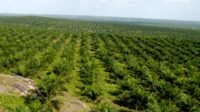
To accelerate these efforts, the Ministry of Agriculture has prepared an Additional Budget (ABT) of Rp9.95 trillion to provide free seeds and seedlings to farmers across the country. The program covers 800,000 hectares of plantations and is projected to create 1.6 million new jobs over the next two years.
Amran further stated that this downstreaming agenda receives full support from the President, particularly in simplifying regulations. “Previously, there were 145 fertilizer regulations. Now, it’s simplified into three stages — from producers directly to farmers,” he noted.
With the move toward green energy and agricultural industrialization, Amran expressed optimism that Indonesia will soon enter a new era of both food and energy sovereignty.
“This is our big dream — for Indonesia to become not only the world’s food barn but also a global hub for agriculture-based energy. God willing, within three years, we’ll achieve it together,” he concluded. (P2)