PALMOILMAGAZINE, JAKARTA — The government has reaffirmed a new direction for national fertilizer policy with the issuance of Perpres No. 113/2025, revising Perpres No. 6/2025 on the governance of subsidized fertilizers. The regulation marks a major milestone in reforming fertilizer trade and distribution, aimed not only at improving accuracy and efficiency in subsidy allocation for farmers, but also at revitalizing Indonesia’s fertilizer industry through a gradual shift toward a more sustainable subsidy framework.
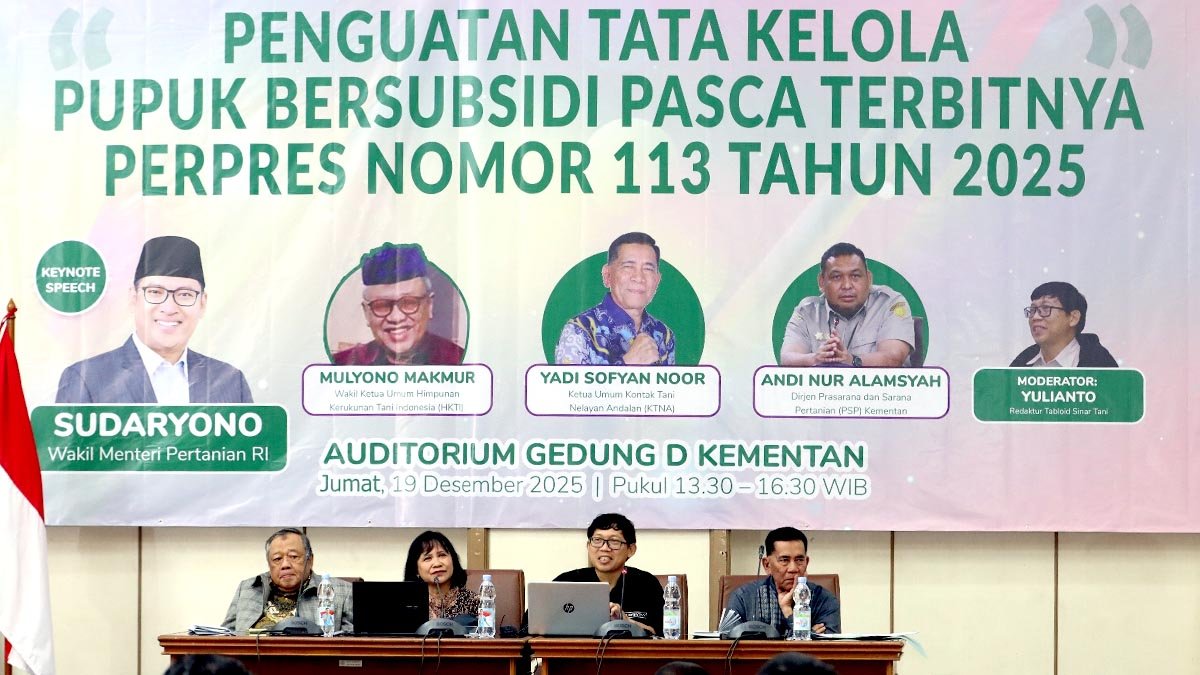
The government’s commitment was highlighted during a discussion hosted by the Agricultural Journalists Forum (Forum Wartawan Pertanian/Forwatan) titled “Penguatan Tata Kelola Pupuk Bersubsidi Pasca Terbitnya Perpres 113 Tahun 2025,” held at the Ministry of Agriculture in Jakarta on Friday, December 19, 2025.
Representing the Directorate General of Agricultural Infrastructure and Facilities (Direktorat Jenderal Prasarana dan Sarana Pertanian/PSP) at the Ministry of Agriculture, Head of the Subsidized Fertilizer Section, Ir. Yustina Retno Widiati, explained that the key differences between Perpres No. 113/2025 and the previous Perpres No. 6/2025 lie particularly in Articles 14 and 148. One of the most significant breakthroughs is the opening of export opportunities for non-subsidized fertilizers.
Also Read:
“In the past, exports were not allowed. Now they are permitted. This serves as a positive incentive for the national fertilizer industry,” Yustina said at the forum, attended by Palmoilmagazine.com.
She added that while Perpres No. 6/2025 was more focused on farmers as end users, Perpres No. 113/2025 also provides greater certainty and encouragement for fertilizer producers. From a governance perspective, Yustina emphasized that the current system for data collection and distribution of subsidized fertilizers is already well-structured and functioning effectively.
The process begins with fertilizer demand assessments conducted by field agricultural extension officers, which are then entered into an application system, verified in stages up to the regency and city levels, and finalized as Electronic Definitive Group Needs Plans (e-RDKK).
The government set the allocation of subsidized fertilizers on December 6, 2025, at 9.5 million tons for the agricultural sector and around 297,000 tons for fisheries. The total fertilizer subsidy budget for 2026 reaches Rp46 trillion.
Also Read: Fertilizer Prices Drop 20%, But Oil Palm Smallholders Still Excluded from Subsidy Scheme
For 2026, the allocation for agricultural fertilizers remains at 9.5 million tons. As of December, registered beneficiaries total approximately 14.1 million national identification numbers (NIKs) in agriculture and around 101,000 NIKs in fisheries.
Yustina said the issuance of Perpres No. 113/2025 is expected to address long-standing inefficiencies within Indonesia’s fertilizer industry. Through stronger governance and clearer incentives, the government aims to prevent inefficiencies previously highlighted in audits by the Supreme Audit Agency (BPK).
She stressed that Perpres No. 113/2025 holds strategic importance as the foundation for transitioning from output-based subsidies to input-based subsidies. “So far, the condition of some national fertilizer companies has been less than ideal. The government wants to rebuild and revitalize fertilizer plants. Through the input subsidy scheme, starting in 2029, the domestic fertilizer industry is expected to become much stronger,” she said.
However, the implementation of input subsidies is still under inter-ministerial discussion, particularly with the Ministry of Finance, as input subsidies differ fundamentally from conventional goods and services subsidies. Until a complete legal framework is in place, the existing subsidy scheme will continue to apply. Meanwhile, the implementing regulation under the Ministry of Agriculture is being finalized, and technical guidelines at the directorate-general level have already been prepared.
Also Read: Minister Amran Revokes Licenses of 190 Fertilizer Distributors for Price Violations
Distribution Becomes More Conducive
Meanwhile, Chairman of Kontak Tani Nelayan Andalan (KTNA) Yadi Sofyan said current fertilizer policies are on the right track and reflect a tangible transformation process. “The current fertilizer situation is good. With Perpres No. 113/2025, we are talking about real transformation. The impact is visible, with fertilizer production increasing from around 30.5 million tons to 34.77 million tons,” he said.
Yadi noted that among roughly 30 KTNA regional offices, there have been virtually no complaints regarding the distribution of subsidized fertilizers. “This means there are almost no problems on the ground. If there are any issues, they usually relate to farmers who are not yet registered in the e-RDKK,” he explained.
He also welcomed the simplification of fertilizer redemption procedures, which now require only a national ID card, making access easier for farmers. In principle, Perpres No. 113/2025 refines the previous regulation, including a shift toward a more market-to-market subsidy mechanism.
Also Read: Indonesian Government Cuts Subsidized Fertilizer Prices by 20%, Marking a New Era for Farmers
Nevertheless, Yadi emphasized the importance of collaborative policy oversight to ensure optimal benefits for farmers. “We call it stewardship, not just supervision. The product itself is relatively problem-free,” he said.
KTNA also outlined three key recommendations to support the successful implementation of Perpres No. 113/2025. First, improving data accuracy and digitalization by involving farmer groups in verifying and validating beneficiaries at the village level, while still providing manual options for farmers with limited access to technology. Second, enhancing outreach and education, with the government and PT Pupuk Indonesia expected to actively engage farmers to explain policy changes, especially regarding subsidy schemes and fertilizer categories. Third, strengthening participatory oversight by granting farmer groups an official mandate to help monitor fertilizer distribution and reinforcing sanctions against misuse.
Separately, Vice Chairman of the Indonesian Farmers Harmony Association (Himpunan Kerukunan Tani Indonesia/HKTI) Mulyono Makmur described Perpres No. 113/2025 as part of a broader revolution in fertilizer trade governance. Although further strengthening is needed at the implementation level, he said the overall policy direction is positive.
Mulyono expressed hope that stronger village cooperatives, including the Merah Putih Village Cooperatives, would become key drivers of a modern agricultural ecosystem, supported by financial institutions, village cooperative units, offtakers, and agricultural extension services.
“This aligns with the catur sarana concept that once enabled Indonesia to achieve food self-sufficiency in 1984. We are optimistic that with better governance, fertilizers can become a strong pillar of national food security,” he said.
He concluded by underscoring the crucial role of agricultural extension officers in socializing the new fertilizer governance policies. “Agricultural extension workers are the frontline in efforts to achieve food self-sufficiency,” Mulyono said. (P3)