PALMOILMAGAZINE, JAKARTA — The Indonesian government is reinforcing collaboration in agricultural research and innovation through a joint agreement involving the Ministry of Agriculture, the Ministry of Higher Education, Science and Technology, and the National Research and Innovation Agency (BRIN). The initiative aims to accelerate sustainable food self-sufficiency while promoting downstream development of agricultural commodities.
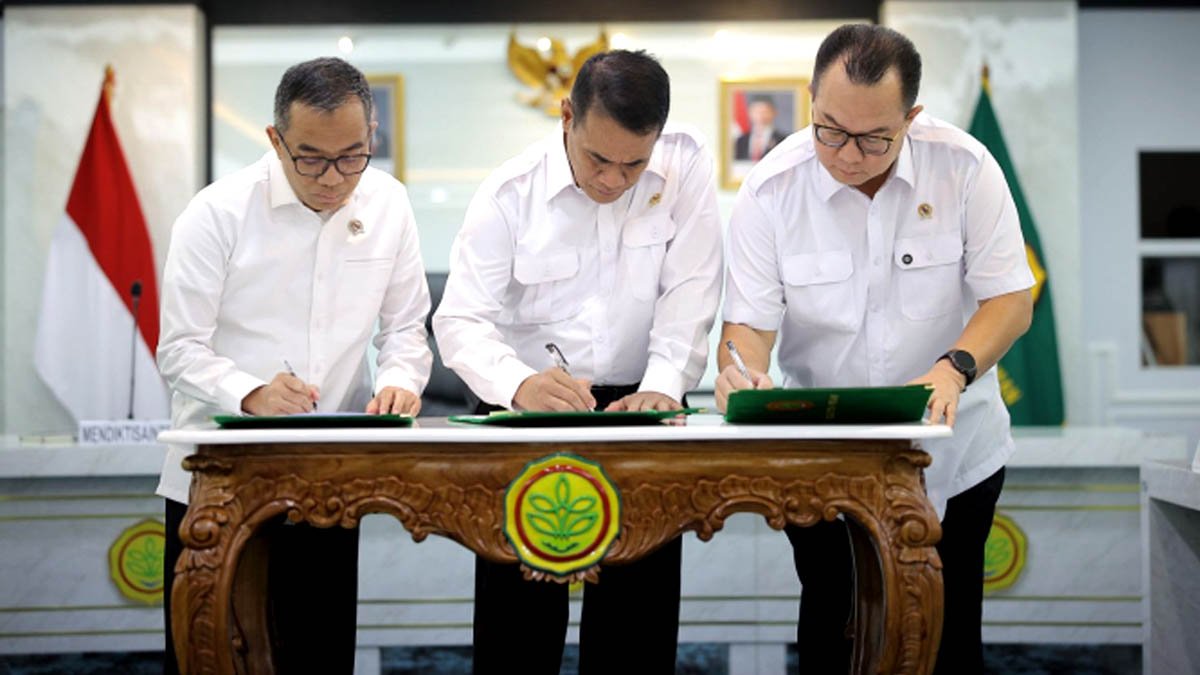
The agreement was signed at the Ministry of Agriculture headquarters in Jakarta on Thursday (12/3/2026). The partnership represents a strategic step to strengthen coordination between government agencies, research institutions, and universities in developing innovations that can be directly applied in the agricultural sector while supporting the growth of industries based on national food commodities.
Minister of Agriculture Andi Amran Sulaiman emphasized that the advancement of agriculture depends heavily on strong research and innovation support. He said collaboration between the government, academia, and industry is essential to ensure that research findings move beyond academic publications and are translated into policies and real-world applications.
“Food agriculture cannot progress without innovation. Many excellent studies are produced by universities, but if they are not translated into policy and adopted by industry, they will remain only on paper,” Amran said, as quoted by Palmoilmagazine.com from the ministry’s official statement on Friday (13/3).
He added that synergy between research and policy can generate significant impacts on national agricultural development. Many strategic agricultural policies, he noted, originate from innovative ideas that are later translated by the government into concrete programs.
“When innovation enters government policy, its impact can be far-reaching for society. This is the type of collaboration we want to continue strengthening,” he said.
Also Read: SPKS Promotes Smallholder Replanting Program in Aceh Utara Through Partnership with PTPN IV
At the same event, Minister of Higher Education, Science and Technology Brian Yuliarto stated that the collaboration marks an important opportunity for universities to contribute more actively to Indonesia’s food self-sufficiency agenda.
He noted that many academic research outputs have yet to reach the commercialization stage due to limited collaboration with government and industry.
“More than 90 percent—almost 99 percent—of academic research never reaches the commercial market. That is why collaboration with government and industry is crucial so that innovation can be truly utilized,” he explained.
According to him, the ministry will also coordinate universities across Indonesia to focus more on research related to strategic commodities that support national food independence.
Meanwhile, BRIN Head Arif Satria highlighted that agriculture is a fundamental pillar of national development and must be supported by well-directed research and technological innovation. He said BRIN has prepared a national food research roadmap to ensure that research activities among institutions and universities are aligned and avoid overlapping efforts.
Currently, BRIN has produced around 188 patents in the food sector, along with a range of innovations that are ready to be adopted by industry.
“We want BRIN to connect more closely with industry and stakeholders, including the Ministry of Agriculture, so that research results can be implemented directly in the field and deliver real impact,” Arif said.
The joint agreement between the Ministry of Agriculture, the Ministry of Higher Education, Science and Technology, and BRIN covers coordination and synchronization of research and innovation programs for various strategic commodities. These include rice, corn, soybeans, wheat, sorghum, garlic, palm oil, coconut, coffee, cocoa, gambier, pepper, nutmeg, poultry, as well as agricultural machinery, fertilizers, and post-harvest processing technologies.
The collaboration also includes research activities, technology development and engineering, strengthening modern agriculture, and shared utilization of research facilities.
Involving at least 18 universities across Indonesia, the partnership will focus on improving human resource capacity in agriculture, facilitating data and information exchange, and accelerating the commercialization of research to increase the value of national agricultural commodities.
Through this synergy, the government expects agricultural innovation and technology to develop more rapidly, strengthen national food independence, and enhance the global competitiveness of Indonesia’s agricultural products. (P3)