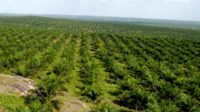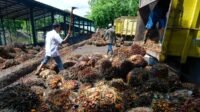
PALMOILMAGAZINE, JAKARTA — Environmental advocacy group Sawit Watch has officially filed a judicial review with the Constitutional Court against Articles 12A, 17A, and 110B of Law No. 18 of 2013 on the Prevention and Eradication of Forest Destruction (UUP3H), as amended by Law No. 6 of 2023 on the enactment of the Job Creation Government Regulation in Lieu of Law. The petition seeks clarity regarding the legal status of communities managing oil palm plantations located within designated forest areas.
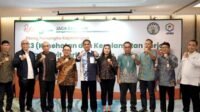
Sawit Watch Executive Director Achmad Surambo stated that palm plantation governance in forest zones remains legally ambiguous. “The government often uses two terms: keterlanjuran sawit (illegal yet tolerated plantations) and pemutihan sawit (legalization). These imply different legal consequences and must be clearly defined,” he said during a webinar titled “Awaiting the Constitutional Court’s Decision: What Future Awaits Palm Oil Farmers in Forest Areas?” on Thursday (July 24), attended by Palmoilmagazine.com.
According to Surambo, existing government programs such as Social Forestry, TORA (Agrarian Reform Land), and Conservation Partnerships are often cited as solutions, yet no specific legal norms are clearly set out in the contested articles. “This is not just about legalizing land, but about ensuring constitutional justice for communities who have lived there for generations,” he emphasized.
He also raised field-level concerns, particularly in Sumatra, where fires have occurred in oil palm areas lacking legal clarity. “In Riau, we found fire outbreaks in plantations within forest zones. This is deeply ironic — land status remains unresolved, yet environmental disasters have begun. The government cannot just look the other way,” Surambo said.
Jondamay Sinurat, Sawit Watch’s legal counsel, warned that the challenged provisions risk violating the constitutional rights of communities. “Many farmers have occupied and cultivated their lands long before those areas were designated as forests — even prior to Indonesian independence,” she explained.
She added that these communities are not temporary settlers but have developed full-fledged social infrastructure, including schools, health clinics, places of worship, and village governments. “They’ve participated in elections for years, yet their land rights remain unrecognized — this contradicts basic principles of justice,” she stressed.
From a legal academic perspective, Grahat Nagara, S.H., M.H., of Jentera Indonesian Law School, highlighted that the contested articles could be used to criminalize local communities. “There’s a tendency toward repressive enforcement, especially by the Forest Destruction Prevention Task Force. Many community lands are being seized without proper legal process,” he said.
Grahat emphasized three critical issues at stake in this review:
- Recognition of customary and local land rights as a core component of citizenship.
- Continued reliance on colonial-era criminal laws in forest governance.
- The need for land tenure recognition to be declarative, not merely administrative.
He also warned that failure to address these issues seriously could lead to mass relocations, such as those seen in Tesso Nilo, Riau. “These legal provisions directly influence how the state acts in the field. If implementation strays from constitutional principles, we must ask: Who is the state really serving?”
Grahat concluded that this legal challenge is not merely about land legality but reflects how the state treats its people — particularly those long marginalized in forest areas. (P2)