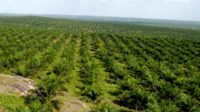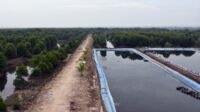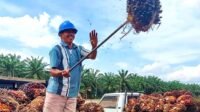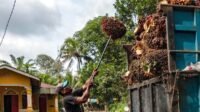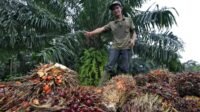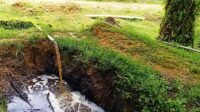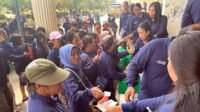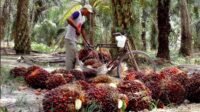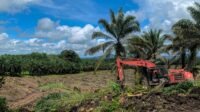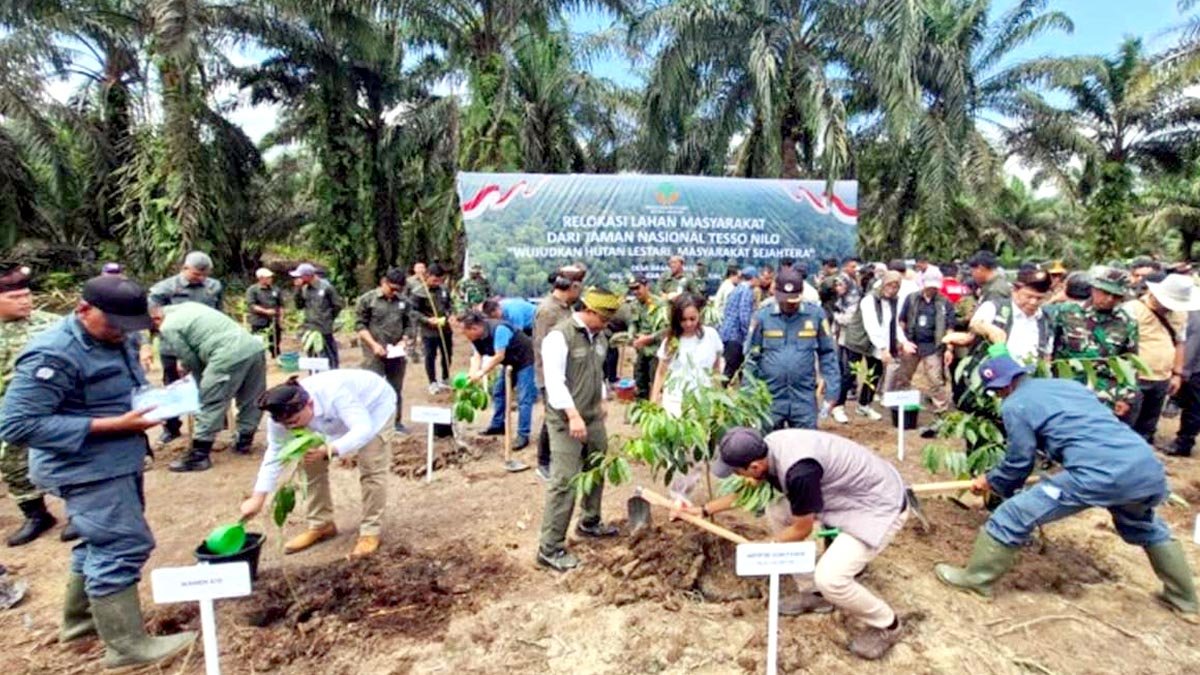
PALMOILMAGAZINE, PELALAWAN — Efforts to relocate land use and restore the ecosystem of Tesso Nilo National Park (TNTN) have entered a concrete phase. The central government, together with the Riau Provincial Government, marked the start of the process through the clearing of oil palm trees and tree-planting activities in Bagan Limau Village, Ukui Sub-district, Pelalawan Regency, on Saturday.
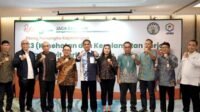
The event was attended by Minister of Forestry Raja Juli Antoni, Deputy Minister of Agrarian Affairs and Spatial Planning/National Land Agency (ATR/BPN) Ossy Dermawan, and Acting Governor of Riau SF Hariyanto, along with regional leaders and law enforcement officials.
Minister Raja Juli Antoni emphasized that the state’s presence in Tesso Nilo National Park is not intended to confront local communities. Instead, the government is prioritizing a persuasive and dialog-based approach in relocating residents who have long cultivated land within the national park.
Also Read: Prabowo Praises Forest Task Force: 4 Million Hectares Reclaimed, IDR 6.6 Trillion Recovered
“We are all here to witness a historic moment: the state is present in Tesso Nilo National Park not to oppose the community, but to persuade and facilitate the relocation of residents who have plantations inside the park,” Raja Juli Antoni said, as quoted by Palmoilmagazine.com from the Riau Media Center, Monday (22/12/2025).
He explained that relocation is being carried out to areas outside the national park to ensure TNTN’s conservation function remains intact. This approach is expected to allow ecosystem recovery to proceed gradually and sustainably.
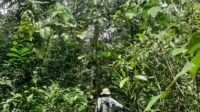
“We are relocating communities to areas outside Tesso Nilo so the national park can be protected and its ecosystem restored. The forest must once again become a safe and comfortable home for elephants, tapirs, deer, and other wildlife,” he said.
Also Read: Article 33, Palm Oil, and the Limits of State Power
While conservation remains a priority, the government stressed that community interests are equally important. The relocation scheme is designed to ensure residents can continue their livelihoods and build a more secure and sustainable future.
“At the same time, communities can continue to work, raise their families, and plan their future in a safer and more dignified way,” he added.
During the event, Raja Juli Antoni revealed that the government has prepared several schemes for communities affected by the relocation. One mechanism involves the return of old land certificates to the state, followed by the issuance of community forestry permits for three farmer groups.
“Earlier, the Deputy Minister of ATR/BPN received old certificates that were returned to the state, and we immediately issued community forestry permits for three farmer groups. Going forward, as conditions improve, this scheme will continue to be expanded,” he explained.
In addition, the government is implementing the Land Object for Agrarian Reform (TORA) mechanism. Land released from the forest area will be handed over to ATR/BPN to be legally certified as community-owned plantations.
“Today, around 600 hectares of land involving 228 households have been handed over. God willing, the people of Bagan Limau Village will become a positive example for other communities to follow,” he said.
Raja Juli Antoni underlined that a win-win solution is the cornerstone of TNTN’s restructuring policy. The state aims to safeguard biodiversity without neglecting the social and economic balance of local communities.
“If violations persist, law enforcement will be applied. But our main principle is persuasion and continuous dialogue,” he stressed.
Meanwhile, Acting Governor of Riau SF Hariyanto expressed full support from the provincial government for the central government’s efforts to reorganize and restore Tesso Nilo National Park. He also called on the Forest Area Enforcement Task Force (PKH Task Force) to support the provision of replacement land in the next stages.
“The Riau Provincial Government requests full support from the PKH Task Force, particularly in providing replacement land in the upcoming phases,” SF Hariyanto said.
He reaffirmed the province’s commitment to ensuring the relocation process is completed thoroughly, providing legal certainty for communities, and promoting sustainable ecosystem restoration in Tesso Nilo.
“We are committed to completing the relocation, ensuring legal certainty for communities, and restoring the Tesso Nilo ecosystem in a sustainable manner,” he concluded. (P2)