PALMOILMAGAZINE, JAKARTA — The Chairman of the South Sumatra Regional Board of APKARINDO, H. Supartijo, has raised concerns over what he describes as a growing imbalance in government policies toward Indonesia’s plantation commodities. In recent years, he said, the state has aggressively promoted the expansion and strengthening of the palm oil industry, while rubber—long a backbone of rural livelihoods—has been increasingly sidelined.
“People can clearly see how strongly palm oil has been pushed through policies, licensing facilitation, and the strengthening of financing institutions. Palm oil has been positioned as a pillar of foreign exchange earnings, energy security, and downstream industrial development,” Supartijo said in a statement to Palmoilmagazine.com on Friday (2/1/2026).
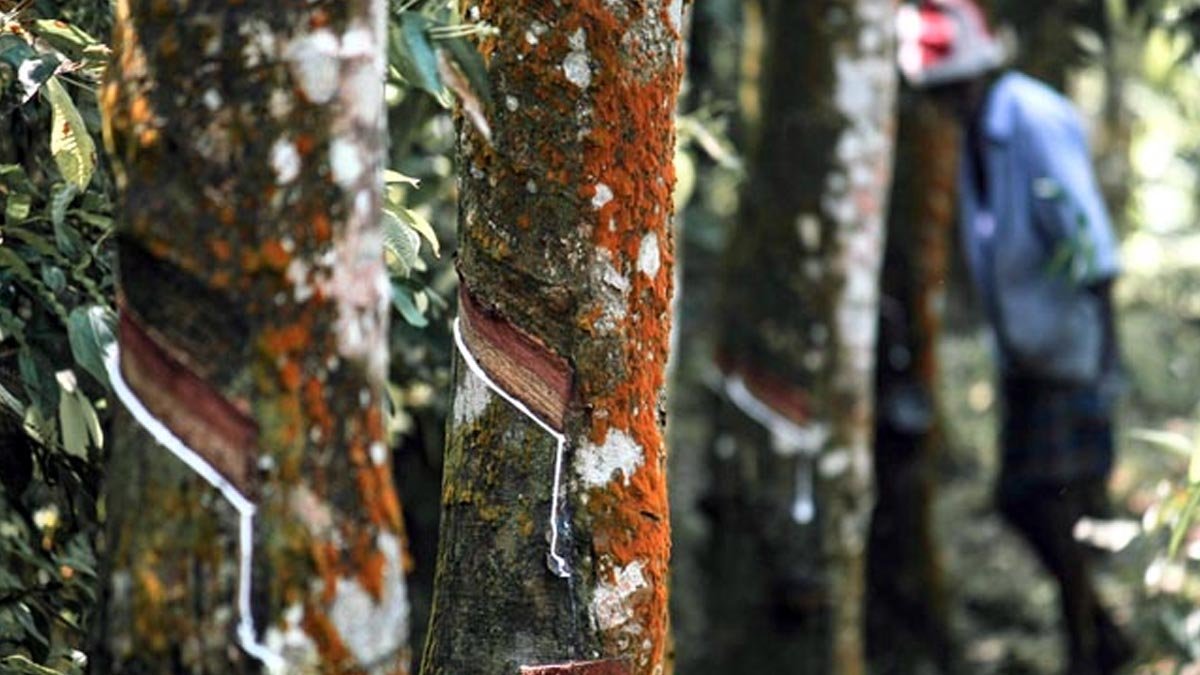
Behind the strong support for palm oil, he argued, the government appears to have turned a blind eye to the deteriorating condition of rubber farmers. Rubber, he stressed, is not a marginal commodity. Millions of farming families across Sumatra and Kalimantan still depend on rubber, which for decades has supported village economies and domestic industry.
Also Read:
Palm Oil Strengthened by the State, Rubber Left to Survive Alone
Supartijo explained that the palm oil sector benefits from comprehensive policy backing, ranging from dedicated financing institutions and industrial incentives to guaranteed market absorption and consistent policy protection from upstream to downstream.
By contrast, the situation faced by smallholder rubber farmers is starkly different. Persistently low and volatile prices, rising production costs, and minimal state intervention have forced farmers to fend for themselves.
“Most smallholder rubber plantations are old and no longer productive. Replanting is urgently needed, but it is difficult due to limited financing and regulations that are not accompanied by realistic technical solutions,” he said.
Also Read:
The problems extend beyond prices. In recent years, rubber plantations have been hit by widespread disease outbreaks, including severe leaf fall, which have significantly reduced output. Yet, Supartijo said, there has been no visible, structured national movement to rescue smallholder rubber.
“Plant diseases are spreading, production is falling, but there is no serious national program for control. Farmers are left to bear the risks on their own,” he added.
He also criticized the ban on land clearing by burning. While acknowledging its environmental importance, he said it becomes problematic when not accompanied by adequate equipment support, financial assistance, and technical guidance.
“The state comes with regulations, but is absent with solutions. In the end, what happens is not environmental protection, but the impoverishment of farmers,” Supartijo stressed.
Farmers Forced to Shift to Palm Oil
Under these pressures, Supartijo believes the state is indirectly pushing rubber farmers to convert to palm oil. Without affirmative policies for rubber, farmers’ rational choice is to follow the commodity most facilitated by the government.
“Farmers do not lack loyalty to rubber. But when palm oil is fully supported and rubber is neglected, farmers’ economic options become extremely limited,” he said.
He warned that overreliance on a single commodity carries major economic and ecological risks. Large-scale palm monoculture has significant social and environmental implications, while rubber—which is relatively more environmentally friendly and deeply rooted in smallholder systems—is losing its place in the national development agenda.
Also Read: IPOSS Outlook 2026: Indonesia’s Palm Oil Industry Enters Transition, Productivity Takes Centre Stage
According to Supartijo, this issue goes beyond a debate between palm oil and rubber. It reflects the broader direction of agricultural policy and the question of development justice.
Rubber farmers, he said, need concrete policy support, including facilitated replanting programs, national-scale disease control, fairer price mechanisms, access to subsidized fertilizers, and consistent technical assistance.
“The real question is whether agricultural development is only for commodities that benefit the state, or also for farmers who for decades have safeguarded villages and the environment,” he concluded.
Without serious intervention, Supartijo warned, rubber risks “dying slowly” amid the rapid expansion of other commodities. “If it is not rescued now, we will lose a highly strategic people’s commodity,” he said. (P2)