PALMOILMAGAZINE, JAKARTA — Indonesia’s Ministry of Agriculture is stepping up efforts to restore agricultural production across northern and central Sumatra after hydrometeorological disasters struck the region in late November 2025. The government has earmarked IDR 1.49 trillion in the 2026 state budget and is seeking an additional IDR 5.1 trillion to ensure a comprehensive recovery across the three hardest-hit provinces.
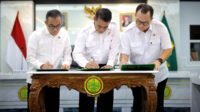
The commitment was delivered by Agriculture Minister Andi Amran Sulaiman during a working session with House of Representatives Commission IV on Wednesday (Jan 14, 2026). He stressed that the government’s response goes beyond emergency relief, focusing on long-term rehabilitation so farming activities can return to normal as quickly as possible.
“The Ministry of Agriculture is fully committed to helping farmers in Aceh, North Sumatra, and West Sumatra recover, both by optimizing the 2026 state budget and by proposing additional funding where needed,” Amran said, as quoted Palmoilmagazine.com from the ministry’s official statement on Thursday (Jan 15).
From the existing allocation, the ministry has prepared IDR 1.49 trillion for initial recovery programs. These funds will be used to address urgent needs, including the rehabilitation of damaged rice fields, restoration of plantation areas, and support for essential agricultural inputs.
The budget breakdown includes IDR 736.21 billion for rehabilitating lightly and moderately damaged rice fields and irrigation systems, IDR 68.6 billion for food crop seeds, IDR 50.46 billion for plantation rehabilitation, and approximately IDR 641.25 billion for farm machinery, fertilizers, and pesticides.
Amran said the first priority is restoring lightly and moderately damaged rice land so farmers can resume planting as soon as possible. For severely damaged areas, the ministry is pushing for cross-ministerial coordination, particularly with the Ministry of Agrarian Affairs and Spatial Planning (ATR/BPN) on land restructuring and the Ministry of Public Works and Housing (PUPR) on irrigation and infrastructure repairs.
Beyond the current budget, the ministry estimates that IDR 5.1 trillion in additional funding is needed to support a full-scale recovery. According to Amran, this would allow rehabilitation efforts to proceed simultaneously across all affected regions without disrupting national agricultural priority programs.
The proposed additional funding would include approximately IDR 3.4 trillion for further rice field rehabilitation, IDR 456.4 billion for plantation recovery, IDR 19.1 billion for horticultural seeds, IDR 262.8 billion for animal feed, IDR 674.7 billion for agricultural facilities and infrastructure, and IDR 291 billion for rebuilding supporting structures and facilities.
During the meeting, Amran urged lawmakers to support the proposed funding increase to ensure recovery measures can be implemented more rapidly and effectively.
Also Read: GAPKI and PPKS Host Oil Palm Plantation Management Training for Tanzanian Delegation
“We ask for the support of Commission IV so that this additional budget can be considered and approved to accelerate post-disaster agricultural recovery,” he said.
In parallel with budget efforts, the ministry has also mobilized humanitarian assistance. By mid-January, donations collected internally by the Ministry of Agriculture and the Food Care Agency had reached IDR 75 billion, which have been distributed in three phases with support from the Indonesian Armed Forces and the National Police.
The hydrometeorological disasters — including flash floods, river overflows, and landslides — hit multiple areas in Aceh, North Sumatra, and West Sumatra. Among the worst-affected districts were Aceh Tamiang, Agam, Sibolga, North Tapanuli, Central Tapanuli, and South Tapanuli.
Also Read: West Java Lawmakers Highlight Oil Palm Expansion Risks, Push for Environment-Friendly Crop Shift
According to ministry data as of January 13, 2026, total affected rice fields reached 107,324 hectares, comprising 56,077 hectares lightly damaged, 22,152 hectares moderately damaged, and 29,095 hectares severely damaged. Of this total, about 44,600 hectares of rice and corn crops were reported as total crop failure.
Beyond rice fields, the disasters also damaged 29,310 hectares of non-palm plantations, including coffee, cocoa, and coconut. A further 1,803 hectares of horticultural land were affected, while livestock losses exceeded 820,000 head.
Significant damage was also recorded across agricultural infrastructure, including 58 slaughterhouses, the loss of around 2,300 units of farm machinery, damage to 74 agricultural extension centers, three dams, 152 kilometers of irrigation networks, and approximately 820 farm access roads.
“These figures remain dynamic and are being updated daily through close coordination between our central units and local agricultural offices,” Amran concluded. (P3)