PALMOILMAGAZINE, ACEH — Negative campaigns against palm oil have resurfaced in recent weeks, particularly following a series of floods and landslides across parts of Sumatra. As disasters strike, oil palm plantations are once again being swiftly accused of being the primary driver of environmental destruction, often without comprehensive investigation.
This narrative gained traction after flooding and landslides hit several regions, where palm oil was immediately spotlighted as the supposed root cause of ecological damage, oversimplifying what many see as a complex, multi-factor environmental problem.
According to Fadhli Ali, a central board member of the Indonesian Palm Oil Farmers Association (Apkasindo), such accusations frequently ignore the long historical trajectory of forest management, especially in Aceh, where he is based.
Also Read: GAPKI and PPKS Host Oil Palm Plantation Management Training for Tanzanian Delegation
Fadhli explained that many areas now associated with palm oil had already suffered severe degradation long before oil palm was introduced. One example is the Gunung Trans area in Darul Makmur District, Nagan Raya Regency.
“That area used to be a production forest with large trees and diverse species. The deforestation did not begin with palm oil, but with logging activities by forest concession holders, such as PT Asdal and PT Dina Maju,” Fadhli said in a statement received by Palmoilmagazine.com on Friday (9 January 2026).
In theory, production forests are meant to be managed under Indonesia’s Selective Cutting and Replanting System (TPTI). In practice, he said, implementation often fell far short.
Also Read: West Java Lawmakers Highlight Oil Palm Expansion Risks, Push for Environment-Friendly Crop Shift
“Logging was carried out without proper selection, and replanting was almost nonexistent. Locals even joked that TPTI stood for ‘cut selectively, replant if God wills it,’ because trees were felled but never replanted,” he said.
As a result, once-dense forests were gradually transformed into scrubland, abandoned areas, and even pest habitats. Only later, Fadhli noted, did local investors begin to see economic potential in these already-damaged lands.
“Those degraded areas were then proposed to be converted into Right-to-Cultivate (HGU) plantations. So the real question is: who actually cleared the forests? The answer is clear—it wasn’t palm oil. Palm oil came later, making use of land that was already damaged,” he stressed.
He argued that similar patterns can be found across many parts of Aceh and elsewhere in Indonesia. Yet public criticism of palm oil often skips over the earlier phases of deforestation, whether from licensed logging operations or illegal logging by certain groups.
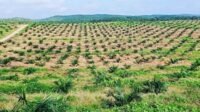
Fadhli acknowledged that improper oil palm development still occurs in some regions, including parts of North Aceh. Opening plantations on steep mountainous terrain, often through terracing, poses serious risks.
“If slopes approach or exceed 45 degrees, that is protected land and must not be opened. Practices like this cannot be justified. But to generalize all environmental problems as the fault of palm oil is a reckless conclusion,” he said.
Also Read: Central Kalimantan Police Tighten Plantation Security After Sharp Rise in Palm Oil Crimes
He also pointed to regional comparisons. Districts such as Aceh Tengah and Gayo Lues have almost no large-scale oil palm estates, yet still experience floods and landslides. Conversely, provinces with Indonesia’s largest oil palm areas, such as Central Kalimantan and Riau, each with more than two million hectares, do not always suffer disasters as severe as those in Aceh or West Sumatra, where oil palm coverage is far smaller.
“This shows that topography, soil types, forest conditions, and spatial governance play major roles in disasters, not merely the type of crop being grown,” Fadhli said.
Globally, pressure on palm oil has also intensified. After becoming the world’s most dominant vegetable oil—surpassing soybean, corn, sunflower, and rapeseed oils—palm oil has faced growing resistance, particularly from parts of Europe.
Yet all vegetable oil crops, he stressed, require land. “No plant grows in the clouds,” he said.
The harshest consequence of persistent negative sentiment, he added, is the downturn in international palm oil prices, which directly affects millions of smallholders across Indonesia.
“It is time for all stakeholders to engage in serious reflection. The central government is often blamed, but permits, recommendations, and supervision also involve local governments down to the village level. Even HGU concessions above 1,000 hectares require local government input,” he said.
Fadhli concluded that palm oil is neither without problems nor the sole culprit.
“Palm oil is not an angel, but it is not the only devil either. Solving environmental challenges requires honesty in reading history, firmness in spatial planning, and courage in enforcing the law—not simply finding a scapegoat,” he said. (P2)