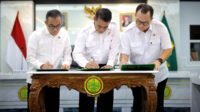
PALMOILMAGAZINE, JAKARTA — Indonesian Agriculture Minister Andi Amran Sulaiman, also serving as Head of the National Food Agency (Bapanas), reaffirmed the government’s full commitment to safeguarding food supply and price stability ahead of Ramadan and Idul Fitri 2026, stressing that there is no justification for any price increases in essential commodities — including palm-based cooking oil.
The government, he said, will strictly maintain both the Retail Price Ceiling (HET) and the Government Purchasing Price (HPP) to ensure balanced protection for producers, traders, and consumers.
“The conclusion is clear: we will maintain the HET throughout Ramadan, and we will also safeguard the HPP. There is absolutely no reason for food prices to rise,” Amran said while leading a high-level coordination meeting on food supply and price stabilization ahead of the national religious holidays, Thursday (22/1/2026).
Also Read: Land Status and Funding Gaps Remain Major Obstacles for Smallholder Palm Replanting
The meeting brought together multiple ministries, law enforcement agencies, and key stakeholders across the food supply chain. Amran emphasized that food stability is not only an economic matter, but also essential to public calm during the fasting month.
“We must protect this together. Do not disturb our brothers and sisters who are observing their fast,” he said, as quoted by Palmoilmagazine.com from the Ministry of Agriculture.
The government confirmed that all major food commodities are currently in a secure position in terms of both supply and stock availability. Strategic commodities under close monitoring include rice, sugar, beef, shallots, chicken meat, eggs, and cooking oil.
Also Read: KPBN Inacom CPO Prices Extend Gains on Wednesday(Jan 21), Malaysian Futures Continue to Climb
For rice, national stocks have reached approximately 3.3 million tons, marking the highest end-of-January level in Indonesia’s history.
“Alhamdulillah, our rice stock today stands at 3.3 million tons. This is the highest ever recorded for late January. Under these conditions, there is no justification for rice prices to exceed the HET,” Amran stressed, adding that accelerated harvesting and rising production are expected to further strengthen supplies in the coming months.
Palm Cooking Oil Supply Declared “Very Secure”
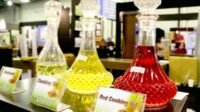
Special attention was also directed toward palm-based cooking oil, a key staple for Indonesian households. Amran confirmed that national cooking oil reserves are in a very strong position, with around 700,000 tons currently managed by Bulog.
“Cooking oil stocks stand at 700,000 tons at Bulog. This means there is also no reason for cooking oil prices to increase,” he said.
Also Read: DHE Retention Policy Seen as Operationally Safe, GAPKI Highlights Compliance Risks
The assurance is aimed at preventing volatility in the palm cooking oil market, particularly ahead of Ramadan, when household consumption typically rises.
Meanwhile, the government is monitoring poultry prices, which are currently below the HPP. Live chicken prices are hovering around Rp23,000 per kilogram, compared to the official HPP of Rp25,000 per kilogram.
“This is one area where prices are still below the government benchmark. We must encourage improvement. God willing, prices will recover during Ramadan,” Amran explained.
Also Read: Indonesia Sues Six Corporations for IDR 4.84 Trillion to Restore Garoga–Batang Toru Watersheds
He added that supplies of eggs, shallots, and other strategic food commodities remain adequate, with distribution operating smoothly.
“Eggs are secure, shallots are secure. Our stocks are sufficient,” he said.
Zero Tolerance for Price Violations
Amran issued a strong warning to businesses nationwide against selling strategic food commodities above the HET, stressing that the government will enforce the rules without compromise.
“No business in Indonesia is allowed to sell above the HET. If violations occur, the Food Task Force will act and enforce the law,” he said.
He added that repeated warnings have already been issued, and enforcement will now be carried out firmly and consistently.
“There will be no more leniency. We have reminded the market many times: food must not be sold above the HET.”
According to Amran, all actors along the food supply chain — from producers and distributors to traders — have agreed to maintain price discipline.
“We are aligned. Producers, traders, distributors — all must ensure strategic food commodities are not sold above the HET.”
He emphasized that balancing HET and HPP is essential to ensure fairness across the supply chain.
“We protect the HPP so producers can smile, traders can operate sustainably, and consumers can observe Ramadan in peace,” he concluded.
The government also reiterated its firm stance against hoarding, speculation, illegal repackaging, and food smuggling, warning that food crimes are humanitarian crimes due to their broad impact on public welfare, health, and economic stability.
With strong cross-sector coordination, the government remains confident that food supply and prices — particularly for essential goods such as palm cooking oil — will remain stable throughout Ramadan and Idul Fitri 2026, allowing the public to observe the holy season safely and peacefully. (P3)