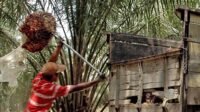
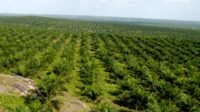
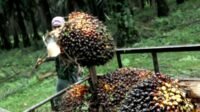
PALMOILMAGAZINE, JAKARTA – Indonesia’s Deputy Minister of Forestry Rohmat Marzuki disclosed that oil palm plantations already developed inside designated forest areas have reached 3.32 million hectares, based on the latest verified government data.
The figure was presented during a working meeting with Commission IV of the House of Representatives (DPR RI) in Jakarta on Monday.
“The area of established oil palm plantations within forest zones stands at 3.32 million hectares,” Rohmat told lawmakers.
Also Read: Agrinas Palma Manages 1.7 Million Hectares, Posts IDR 4.3 Trillion Revenue in First Year
However, he stressed that the data remains dynamic as verification and mapping efforts continue. According to more recent updates, the total area of oil palm plantations identified inside forest zones is now approaching four million hectares, spread across multiple regions of the country.
Rohmat detailed that of the 3.32 million hectares recorded so far, around 680,000 hectares are located in conservation forests, while approximately 150,000 hectares fall within protected forests.
In addition, oil palm plantations were found in permanent production forests covering about 1.48 million hectares, and in limited production forests totaling roughly 500,000 hectares.
Also Read: GAPKI Highlights Productivity Risks, Promotes Advanced Pollination Solutions
Meanwhile, in convertible production forests, the area of established oil palm plantations reached 1.09 million hectares, based on mapping and field verification conducted by the Ministry of Forestry.
During the same session, Rohmat also reported that the Forest Area Enforcement Task Force (Satgas PKH) has successfully reclaimed about 1.5 million hectares of forest land from illegal occupation across various regions.
Of that total, around 688,427 hectares of conservation forest have been formally returned to the Ministry of Forestry for phased and long-term ecosystem restoration.
Also Read: From Palm Oil to Consumer Goods, Indonesian Brands Expand Across Pakistan’s Retail Shelves
“The Ministry of Forestry, together with Satgas PKH, continues to intensify control over illegal land occupation within forest areas,” Rohmat said, as quoted on Wednesday (January 21, 2026).
To strengthen forest governance and monitoring, the ministry is integrating national geospatial data through the Jaga Rimba platform, which serves as a decision-support system.
The platform is equipped with an artificial intelligence–based early warning system designed to detect potential deforestation and forest fires at an early stage across Indonesia.
Also Read: After Sumatra Disaster Audit, Prabowo Strips 28 Companies of Operating Licenses
Going forward, the ministry also plans to collaborate with telecommunications providers to implement WhatsApp-based alerts to regional technical units in locations showing early indications of deforestation or fires.
Beyond digital monitoring, Rohmat said the government has proposed establishing 35 regional forestry coordination centers to strengthen field-level coordination and institutional integration.
The ministry is also seeking to reinforce law enforcement capacity by expanding the number of Technical Implementation Units (UPT) under the Forest Law Enforcement and Fire Control Agency from 10 units to 24 units.
Also Read: From Palm Oil to Consumer Goods, Indonesian Brands Expand Across Pakistan’s Retail Shelves
Rohmat noted that these proposals have been submitted to President Prabowo Subianto and have received a positive response. Further discussions, however, will take into account fiscal capacity and coordination with the Ministry of Administrative and Bureaucratic Reform (PANRB).
“We were instructed to coordinate with Minister of Administrative and Bureaucratic Reform Rini Widyantini, and discussions are now ongoing between our teams,” he said.
In addition, the Ministry of Forestry is proposing a significant increase in the number of forest rangers. Indonesia currently has about 4,800 forest police personnel, consisting of around 3,100 under the ministry and 1,700 within provincial and district forestry agencies.
At present, one officer is responsible for supervising approximately 26,000 hectares, a ratio Rohmat described as far from ideal.
“We are proposing the recruitment of around 21,000 additional forest police officers to achieve a ratio of one officer per 5,000 hectares, supported by expanded use of drones to improve field monitoring,” he said. (P2)