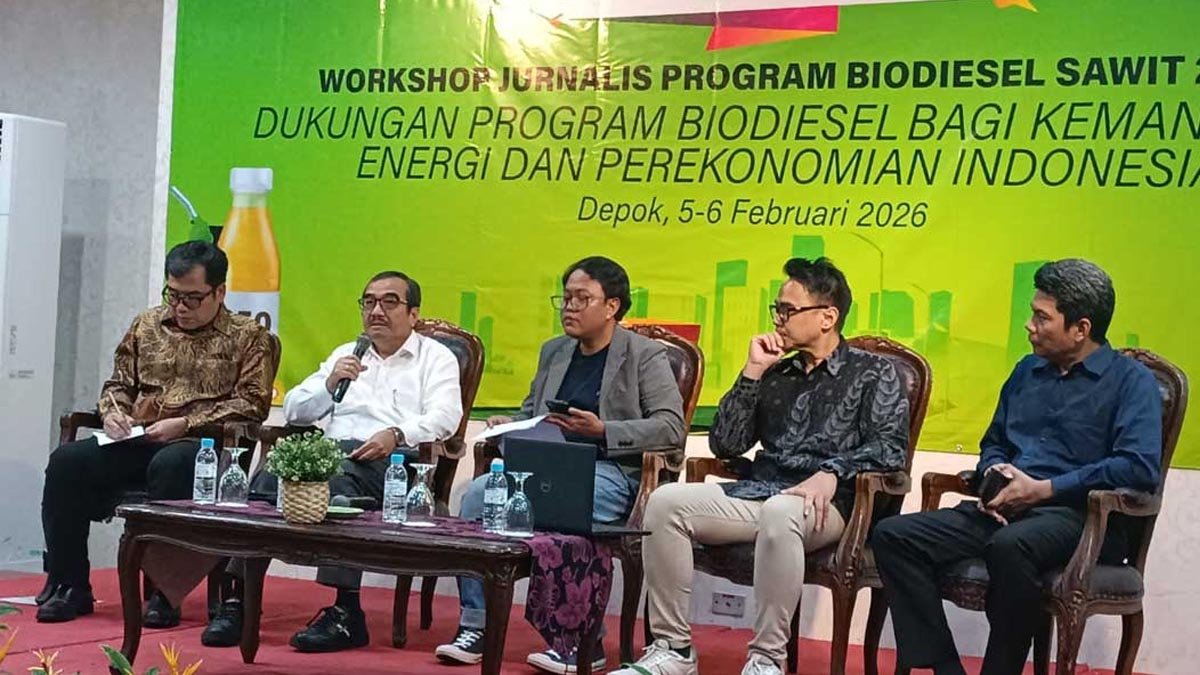
PALMOILMAGAZINE, DEPOK — Palm oil is playing an increasingly strategic role in Indonesia’s National Energy Policy (KEN), particularly as a key pillar supporting the country’s energy transition and supply security, according to Mohamad Fadhil Hasan, a member of the National Energy Council (Dewan Energi Nasional/DEN).
Fadhil made the remarks during the Journalists’ Workshop on the 2026 Palm Oil Biodiesel Program, held on Thursday (February 5, 2026).
In his presentation, Fadhil outlined DEN’s mandate, which includes four core responsibilities: formulating national energy policy, setting the National Energy Plan (RUEN), determining measures to address energy crises and emergencies, and overseeing cross-sectoral implementation of energy policies. DEN also holds strategic authority to regulate the type, volume, timing, and location of national energy buffer reserves.
Also Read: Prabowo Stresses Food–Energy Independence, Positions Palm Oil as Key “Miracle Crop”
Why Government Regulation No. 40/2025 Matters
Fadhil stressed that the issuance of Government Regulation (PP) No. 40 of 2025 on the National Energy Policy, which replaces PP No. 79 of 2014, is a critical step amid rapidly changing domestic and global energy dynamics.
Indonesia faces a range of challenges, including declining domestic oil production alongside rising crude oil and gasoline imports, limited utilization of new and renewable energy, heavy reliance on imported LPG, export pressures on coal, and fragmented gas and electricity infrastructure. At the same time, the energy sector is expected to support ambitious economic growth targets toward Indonesia Emas 2045.
Also Read: Indonesia Allocates 15.6 Million Kiloliters of Biodiesel for 2026, B40 Mandate Moves Forward
“The energy sector’s contribution is essential to achieving greenhouse gas emission reduction targets and Net Zero Emissions by 2060,” Fadhil said.
Within this context, palm oil holds a unique position due to its dual role as both a food and energy resource. Fadhil noted that the President has repeatedly emphasized the importance of palm oil and biofuels as part of Indonesia’s energy security solution.
Targets and Strategy Under the National Energy Policy
The National Energy Policy aims to strengthen energy security while ensuring supply reliability and price affordability. It also seeks to meet energy demand more efficiently to support improvements in the Human Development Index (HDI) and sustain high economic growth as Indonesia advances toward developed-nation status.
At the same time, the policy prioritizes decarbonization and energy transition, targeting peak emissions by 2035 and net-zero emissions by 2060.
Key strategies include diversifying energy sources, reducing energy intensity so that economic growth outpaces energy consumption growth, and strengthening energy conservation and efficiency on both the supply and demand sides.
A Shift in Policy Direction
Fadhil highlighted fundamental differences between the previous policy framework and the new regulation. Under PP No. 40/2025, the government has adopted a grand strategy to enhance energy sovereignty, resilience, and independence through accelerated energy transition.
The policy prioritizes maximizing renewable energy use, minimizing fossil fuel consumption—particularly gasoline—optimizing natural gas as a transition fuel, and considering nuclear energy as a long-term decarbonization option.
The regulation targets a renewable energy mix of 19–23 percent by 2030, rising sharply to 70–72 percent by 2060, in line with Indonesia’s emissions peak and net-zero targets. Financing support will be strengthened through national and regional budgets, complemented by domestic and international funding sources, including incentives for private enterprises and compensation mechanisms for state-owned companies involved in energy transition programs.
Beyond financing, PP No. 40/2025 also emphasizes public participation, human resource development, and stronger international energy cooperation and diplomacy.
“With this new policy direction, palm oil–based bioenergy stands as a key pillar in safeguarding energy security while advancing Indonesia’s decarbonization agenda,” Fadhil concluded. (P2)