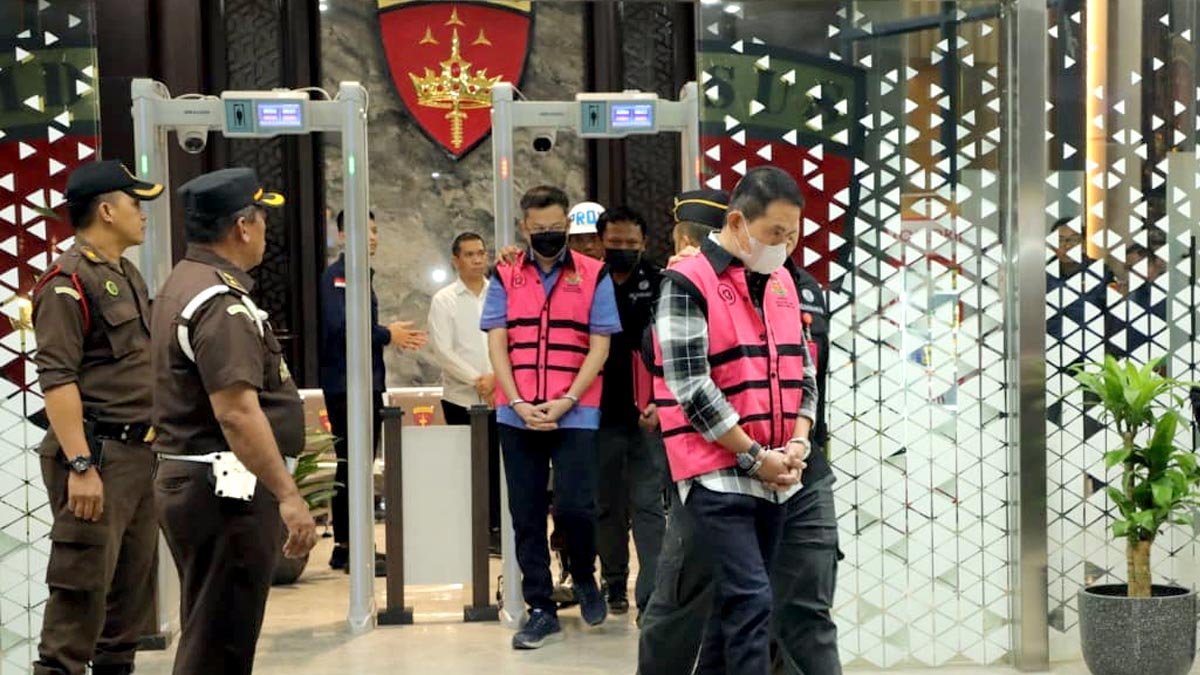
PALMOILMAGAZINE, JAKARTA – The Special Crimes Investigation Team under the Attorney General’s Office (JAM Pidsus) on Tuesday (February 10, 2026) named 11 individuals as suspects in an alleged corruption case involving irregularities in the export of Crude Palm Oil (CPO) and its derivative product, Palm Oil Mill Effluent (POME), during the 2022–2024 period.
The suspects include government officials and private sector executives. From the public sector, those named include LHB, Head of the Sub-Directorate for Non-Food Plantation Products Industry at the Ministry of Industry; FJR, Director of Customs Technical Affairs at the Directorate General of Customs and Excise (currently serving as Head of the Bali, NTB, and NTT Customs Office); and MZ, a civil servant at the Pekanbaru Customs Office.
From the private sector, the suspects comprise several company directors and executives, including ES (PT SMP, PT SMA, PT SMS), ERW (PT BMM), FLX (PT AP), RND (PT PAJ), TNY (PT TEO and shareholder of PT Green Product International), VNR (PT SIP), RBN (PT CKK), and YSR (PT MAS and Commissioner of PT SBP).
Also Read: Indonesia Uncovers Alleged CPO Export Manipulation via Singapore, State Revenue at Risk
“The designation of the 11 suspects was made after investigators obtained sufficient evidence through a series of in-depth, professional, and accountable investigative measures, while upholding the principle of prudence and presumption of innocence,” the Director of Investigation at JAM Pidsus stated in a press release quoted by Palmoilmagazine.com.
Investigators explained that from 2020 to 2024, the Indonesian government imposed export restrictions and controls on CPO to safeguard domestic cooking oil supply and maintain price stability. The policy was implemented through the Domestic Market Obligation (DMO) scheme, export approval requirements, as well as the imposition of export duties and palm oil levies.
CPO is classified as a national strategic commodity under HS Code 1511, regardless of its Free Fatty Acid (FFA) content. This means all forms of CPO, including high-acid CPO, remain subject to export controls and state payment obligations.
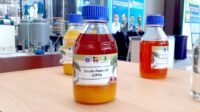
However, investigators uncovered alleged manipulation in export commodity classification. High Acid CPO was allegedly misdeclared as POME or Palm Acid Oil (PAO) under HS Code 2306, which is intended for solid residues or waste products. The practice was allegedly aimed at circumventing export restrictions, DMO requirements, and reducing export duty and levy payments.
Investigators also highlighted the use of a Palm Oil Downstreaming Map that lacked formal legal standing but was allegedly used as a reference in export activities. This mechanism reportedly enabled exports to proceed under improper classifications.
The case also revealed alleged kickbacks paid to certain officials to facilitate administrative processes and export supervision, allowing the improper classifications to pass without correction.
Also Read: Indonesia’s Palm Oil Dominance Strengthens Its Influence in Global Trade
According to investigators, the suspects were not only aware of the prevailing legal provisions but allegedly played active roles in designing, utilizing, and sustaining the irregular mechanisms.
The alleged misconduct has had broad and systemic impacts. The state is believed to have suffered significant losses from unpaid export duties and levies. Moreover, the effectiveness of CPO export control policies was undermined, as commodities that should have been restricted were exported under improper classifications. The practice also weakened governance over strategic commodities and eroded legal certainty.
State financial losses are still being calculated by auditors. However, preliminary estimates by investigators suggest potential losses and/or forgone state revenue ranging from IDR 10.6 trillion to IDR 14.3 trillion, largely linked to export activities by several corporate groups between 2022 and 2024.
The suspects have been charged under multiple provisions, including Article 603 in conjunction with Article 20 letters a or c of Law No. 1/2023 on the Criminal Code, as well as Articles 3 and 18 of Law No. 31/1999 on the Eradication of Corruption Crimes, as amended by Law No. 20/2001.
All suspects have been detained for the next 20 days at the Salemba Detention Center branch of the Attorney General’s Office and the South Jakarta District Prosecutor’s Office. (P3)