PALMOILMAGAZINE, JAKARTA – Oil palm agroforestry is emerging as a promising transition pathway toward more sustainable land-use practices in Indonesia’s forest areas. A recent study published in Agroforestry Systems on Springer highlights significant differences in projected adoption rates and timelines among various crop combinations under the Oil Palm Agroforestry (OPAF) model implemented through the Social Forestry Program.
While monoculture oil palm expansion has contributed substantially to both national and regional economic growth, large-scale development in forest areas has also been associated with deforestation. This has intensified scrutiny from key export markets, particularly the European Union, which is tightening trade restrictions on commodities linked to forest loss.
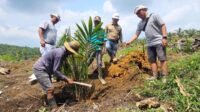
In response, the Indonesian government has introduced a gradual improvement strategy aimed at transforming monoculture oil palm plantations within state forest zones into diversified agroforestry systems under social forestry schemes. The OPAF model is considered more environmentally sound while still maintaining economic returns for smallholders.
Also Read: Malaysia Nears Full MSPO Coverage, Advances Digital Traceability to Meet EUDR Standards
Adoption Peaks Vary by Commodity Pairing
The study applied the Adoption and Diffusion Outcome Prediction Tool to estimate peak adoption levels and timelines, while also identifying factors influencing farmers’ decisions.
Data were gathered through structured interviews and focus group discussions involving 136 smallholders in Jambi. The findings reveal stark contrasts among different OPAF crop combinations:
- Oil palm–Shorea leprosula is projected to reach a peak adoption rate of 39% within 20 years.
- Oil palm–Durio zibethinus (durian) is forecast to reach 95% adoption in 19 years.
- Oil palm–Falcataria moluccana (sengon) is projected to achieve the highest and fastest adoption rate at 98% within just 13 years.
The results suggest that pairing oil palm with fast-growing timber species such as sengon offers stronger economic appeal for farmers compared to combinations involving slower-growing native forest species like Shorea leprosula.
Also Read: India’s Palm Oil Imports Hit Four-Month High as Price Gap with Soyoil Widens
Key Drivers: Upfront Costs and Economic Returns
The study identifies three primary factors influencing the time required to reach peak adoption:
- Trialability – the ease with which farmers can experiment with the system.
- Complexity – how technically difficult the innovation is perceived to be.
- Initial investment costs – the financial burden at the start of adoption.
Meanwhile, the projected peak adoption rate is largely shaped by farmers’ perceptions of current and future economic benefits, as well as the environmental advantages associated with the system.
Socio-economic conditions also play a significant role. Household size and monthly income were found to influence adoption decisions. Farmers with larger family responsibilities and stronger financial capacity are more likely to invest in agroforestry systems perceived as sustainable and profitable in the long term.
Also Read: ASEAN’s Young Leaders Demand Justice at the Heart of Climate Action
Policy Implications for Indonesia’s Palm Oil Competitiveness
Based on the findings, the study recommends several policy measures to accelerate OPAF adoption, including reducing initial costs, simplifying technical implementation, and strengthening access to information and extension services for farmers.
For Indonesia, the transition toward oil palm agroforestry is not solely an environmental issue. It is closely tied to maintaining global competitiveness, particularly as international markets grow increasingly sensitive to sustainability standards.
If supported by evidence-based policies, the OPAF model could serve as a strategic bridge between forest conservation objectives and smallholder economic resilience—offering a practical pathway toward a more sustainable palm oil sector. (P2)