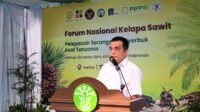



PALMOILMAGAZINE, JAKARTA – The atmosphere in Auditorium Building F, Headquarters of the Ministry of Agriculture of the Republic of Indonesia was notably different that morning. Rows of officials stood in formal formation, their expressions serious yet hopeful. Among them stood a name now drawing attention from palm oil farmers and industry players alike: Dr. Iim Mucharam, S.P., M.P.
A leadership reshuffle within the ministry has once again placed the palm oil sector in the spotlight. Ir. Baginda Siagian, M.Si., who previously served as Director of Palm and Other Palma Crops, has officially been replaced. The baton now passes to Dr. Iim Mucharam, a figure widely recognized for his strength in agricultural planning and policy formulation.
The inauguration ceremony was led directly by Agriculture Minister Andi Amran Sulaiman on Friday (6/2/2026). The event was more than ceremonial. Alongside the confirmation of several Echelon II central officials and heads of regional offices under the Agency for Agricultural Instrument Standardization and Modernization, a key message was emphasized: acceleration.
Also Read: KPBN CPO Prices Rise Slightly on Feb 24, Bursa Malaysia Futures Slip on Weak Export Outlook
In his remarks, Minister Amran underlined that strengthening the ministry’s organizational structure aims to accelerate production, downstream development, and the achievement of national food self-sufficiency.
“This is a legacy. This is the result of our collective hard work. It reflects extraordinary attention from the President to the Ministry of Agriculture and Indonesian farmers,” he stated, as Palmoilmagazine.com quoted from the ministry’s official website.
The word “legacy” lingered in the air—signaling that this change is not merely a rotation of positions but part of a broader strategic direction.
Also Read: Indonesia Sets February 2026 Biodiesel Price at IDR 13,856/Liter
Strong Academic Foundation and Analytical Rigor
Dr. Iim Mucharam is no stranger to Indonesia’s agricultural bureaucracy. He earned his Master’s degree in Agricultural Economics from Universitas Brawijaya with a GPA of 3.69, demonstrating strong academic consistency. His undergraduate degree in Agriculture was obtained from Universitas Muhammadiyah Jakarta.
He later completed his doctoral studies at IPB University, one of Indonesia’s most respected institutions in agricultural sciences.
During his academic years, he served as a teaching assistant for Quantitative Analysis Methods, sharpening his analytical and data-driven approach—skills that are critical in designing evidence-based agricultural policies.
Also Read: North Sumatra FFB Price Inches Up to IDR 3,565.77/kg for February 18–24 Period
From Planning Desk to Strategic Directorate
Dr. Iim began his career in April 2006 as a staff member in the Monitoring and Evaluation Division of the Ministry’s Planning Bureau. He steadily advanced through the ranks, serving as Head of Reporting Subdivision (2014–2016) and later Head of Coordination Materials Subdivision within the Planning Bureau.
His career path has consistently revolved around planning, coordination, and policy synchronization. That trajectory has now culminated in his appointment as Director of Palm and Other Palma Crops.
The challenge ahead is significant. Palm oil remains one of Indonesia’s leading commodities—serving as a backbone of export earnings and a primary source of livelihood for millions of smallholders. Key issues such as production stability, replanting programs, sustainability standards, and downstream industrialization await decisive leadership.
For industry stakeholders across producing regions, this leadership transition brings renewed expectations. They are looking for policies that are not only precise on paper but impactful in the field—from more stable pricing mechanisms to stronger technical support and accelerated smallholder replanting initiatives.
The Ministry of Agriculture has reaffirmed its commitment to strengthening institutional capacity, enhancing bureaucratic performance, and ensuring that strategic programs—including those in the palm and other palma crops sector—are implemented effectively to support Indonesia’s plantation-based economy. (P2)