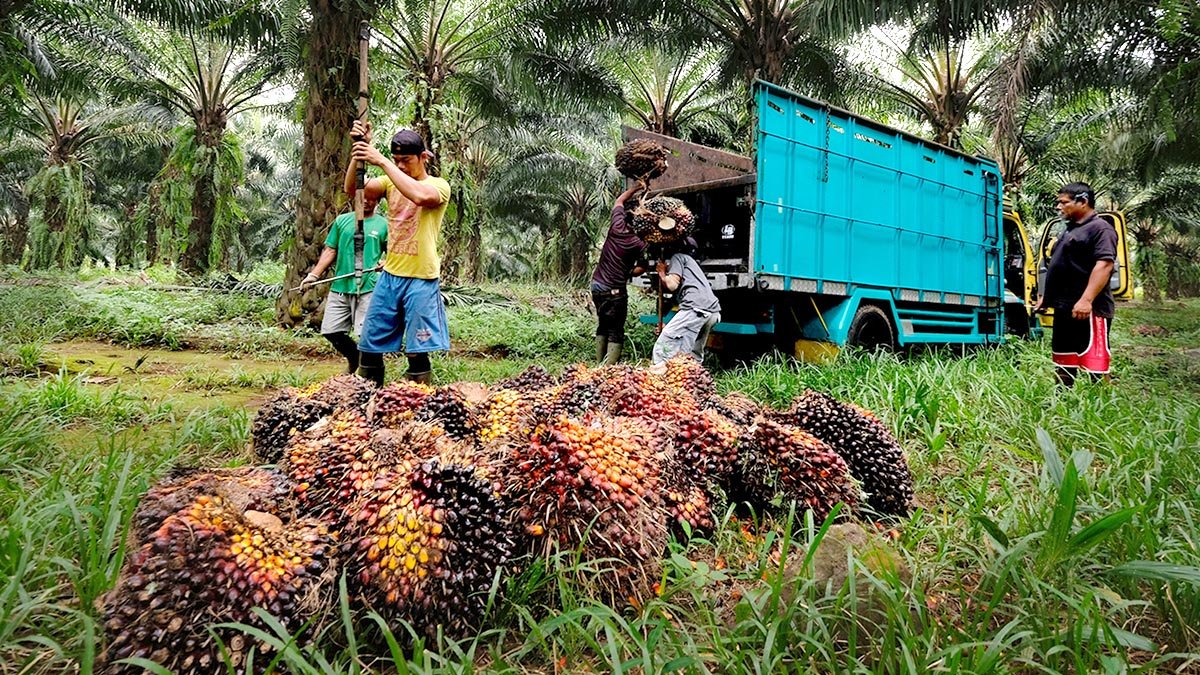
PALMOILMAGAZINE, JAKARTA — The long-standing obligation for palm oil companies to allocate 20% of their plantation area to smallholder “plasma” schemes continues to face serious obstacles on the ground. The Indonesian Palm Oil Association (GAPKI) says the core problem is no longer corporate commitment, but overlapping regulations and conflicting calculation methods between government agencies that have turned implementation into a regulatory maze.
GAPKI Chairman Eddy Martono explained that the mandatory 20% plasma requirement only came into force after 2007. However, many plantation companies had already been operating for decades before the rule existed, and are now being required to comply under conditions that have drastically changed.
“The 20% plasma obligation only applied after 2007. Before that, it was not mandatory,” Eddy said during a recent webinar attended by Palmoilmagazine.com.
Also Read: Land Status and Funding Gaps Remain Major Obstacles for Smallholder Palm Replanting
According to him, confusion arises because different ministries use different benchmarks to calculate the 20% obligation. The Ministry of Agriculture, for example, calculates it based on effective planted area. In a 1,000-hectare concession, land that can actually be planted is reduced by roads, rivers, conservation zones, and unproductive areas. As a result, effective planted land may only reach 700–800 hectares, automatically shrinking the plasma calculation base.
However, the Ministry of Agrarian Affairs and Spatial Planning/National Land Agency (ATR/BPN) often applies a different approach. Eddy said the agency tends to calculate the 20% obligation based on the total area stated in the Right to Cultivate (HGU) title, even though that area also includes conservation buffers, river borders, and zones that are legally prohibited from being cultivated.
“If ATR/BPN calculates it from the total HGU area, the problem is that not all of it can be planted because conservation areas and river borders must be set aside,” he said.
Also Read: KPBN Inacom CPO Prices Extend Gains on Wednesday(Jan 21), Malaysian Futures Continue to Climb
The issue becomes even more complex in cases involving forest area release. Eddy illustrated that when 5,000 hectares are officially released from forest status, the land actually suitable for planting may shrink to 4,000 hectares or less. Reductions typically occur due to the presence of villages, settlements, social zones, and other areas excluded from plantation development.
These discrepancies, he said, create a moving target for companies, where plasma obligations shift depending on which regulatory interpretation is applied.
Eddy also highlighted the historical position of plantation firms established before 2007. Many GAPKI members had already implemented partnership programs at the time, but there was no standardized 80:20 scheme as mandated after March 2007. As a result, older companies that were not originally subject to the plasma rule are now being required to comply, even though land conditions have changed and some areas have since been reclassified as forest.
“Now they are being required to comply, even though when these plantations were developed, the regulatory environment was completely different. Some of those areas are now classified as forest,” he said.
Another complication is the shifting legal status of land over time. Eddy noted that some companies have operated since the 1980s and repeatedly renewed their permits, only to later find parts of their concessions reclassified as forest areas. This creates legal risks, as further land development may be deemed a forestry violation.
“Areas that were once non-forest can later be designated as forest zones. This is one of the biggest bottlenecks,” Eddy said.
Given these challenges, Eddy stressed the need for a firm, cross-sectoral policy resolution so that plasma obligations no longer remain a source of uncertainty for investment and industry development. As long as regulatory interpretations differ between agencies, he warned, companies will remain exposed to legal vulnerability—even when they intend to comply.
Beyond oil palm, Eddy also encouraged broader approaches to strengthening local economies around plantations. He suggested that community empowerment should not rely solely on palm oil, but could be diversified into poultry farming, fisheries, or food production, sectors he believes offer competitive returns and alternative income sources.
He added that such diversification aligns with government programs to improve regional food and protein supply chains, which remain heavily dependent on external sources. However, he emphasized the importance of joint socialization efforts and government backing.
“If we want to develop other productive activities, that’s a good direction. But it requires coordinated outreach and government support,” Eddy concluded. (P2)