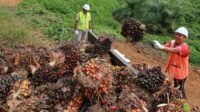
PALMOILMAGAZINE, JAKARTA — The Directorate General of Plantations at the Ministry of Agriculture has reaffirmed that labor protection, gender equality, and workers’ rights are central pillars in developing a sustainable palm oil industry under the Indonesian Sustainable Palm Oil (ISPO) certification scheme.
Baginda Siagian, Director of Palm Oil and Various Palma Crops at the Directorate General of Plantations, emphasized that the palm oil industry is not only a cornerstone of Indonesia’s national economy but also plays a critical role in poverty reduction, job creation, and fostering inclusive growth.
“The industry must be able to address gender equality, decent working conditions, and inequality issues. All these commitments will be realized through ISPO implementation,” he said during a Forwatan discussion titled “Palm Oil Industry Protects Women and Eliminates Child Labor,” attended by Palmoilmagazine.com on Tuesday (2/12/2025) in Jakarta.
Also Read: ISPO Strengthens the Global Competitiveness of Central Kalimantan’s Smallholders
Gender Equality and Worker Conditions Under Spotlight
According to Baginda, labor issues in the palm oil sector continue to require deeper attention—particularly regarding protection for women workers. He highlighted several field practices that often disadvantage women, from placement in high-risk tasks such as pesticide spraying with inadequate protective equipment, to persistent wage disparities compared with male workers.
“The burden on women is heavier. They work in plantations while also carrying domestic responsibilities. Access to healthcare and maternity rights are often insufficient,” he explained.
Child labor also remains a government concern. Baginda clarified that not all children seen in plantations can be categorized as child laborers. Many accompany their parents after school simply because no one is available at home. However, he stressed that if children are involved in paid plantation work, it clearly constitutes a violation.
Companies Must Enforce Non-Discrimination Policies
The Agriculture Ministry is urging all palm oil companies to adopt non-discriminatory labor policies, from recruitment to wage distribution. Companies are also encouraged to provide gender-responsive facilities such as lactation rooms, childcare spaces, and specialized protective gear for women handling chemical exposure.
“The principle is clear: there must be no difference in treatment between male and female workers. Companies must ensure adequate health and safety facilities,” Baginda said.
He added that the latest Presidential Regulation on ISPO strengthens corporate obligations related to labor standards. Labor aspects fall under ISPO’s fourth mandatory category, consisting of 66 criteria and 36 indicators that companies must meet before receiving certification.
These include occupational safety and health (OSH), employment administration (work contracts), worker training and capacity building, welfare enhancement, prohibition of child labor, freedom of association, and establishment of worker cooperatives.
“All of these criteria must be fulfilled. Some indicators can be assessed directly, while others require deeper field verification,” he said.
Expanding BPJS Employment Coverage for Plantation Workers
Baginda also noted that the government, in collaboration with regional administrations, is expanding BPJS Employment coverage—not only for permanent workers but also for family labor within smallholder plantations, including women.
“We don’t categorize them simply as family workers or women workers. Anyone working in a plantation deserves social protection. If a workplace accident occurs, they must be covered,” he stressed. Funding for this expanded coverage may come from regional budgets or palm oil revenue-sharing funds.
The Agriculture Ministry emphasized that strengthening labor standards is an integral part of the country’s sustainable palm oil development strategy. Through ISPO, the government aims to ensure that all palm oil companies adopt higher standards for worker protection and gender justice.
“The palm oil industry cannot rely solely on efficiency and productivity. It must also be fair, inclusive, and protective of all workers,” Baginda concluded. (P2)