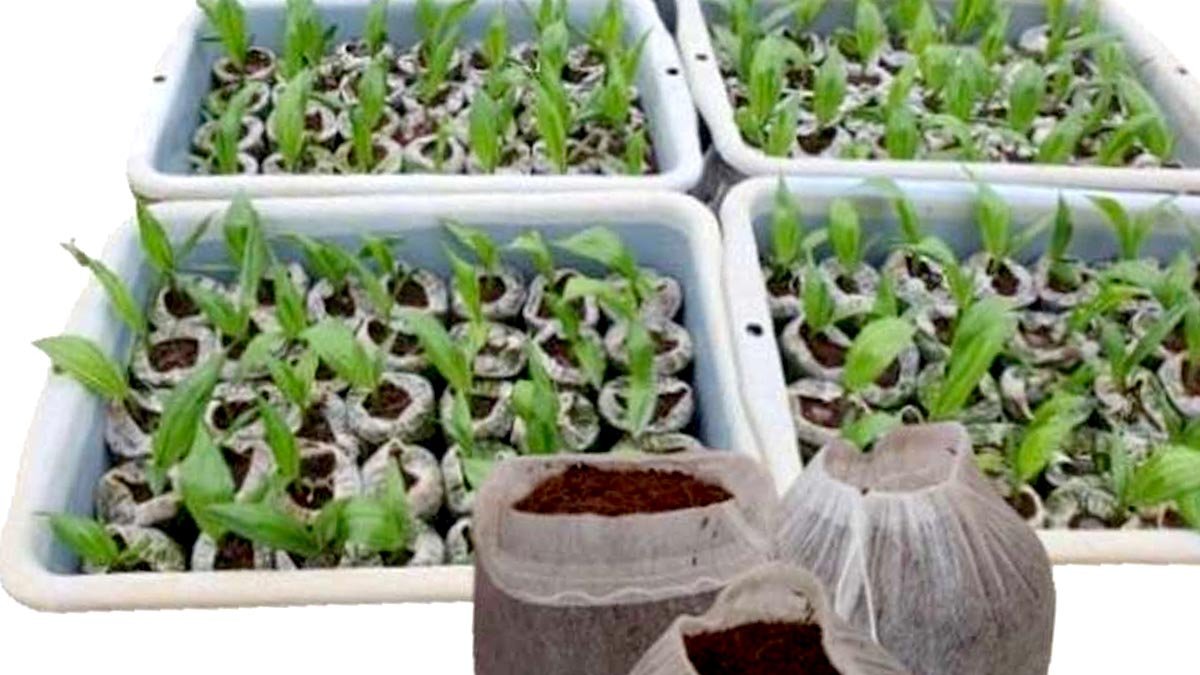
PALMOILMAGAZINE, JAKARTA — At a recent national seminar for oil palm farmers in Kalimantan, my attention was caught by a short opinion piece written by an expert from a professional institution. The article discussed “Controlling Ganoderma and Preventing Seedling Infection with Biodegradable Nursery Bags (BNB)”—a timely topic given that Ganoderma has long been a notorious threat in oil palm cultivation.
The expert recommended BNBs as a method of early disease control, outlining eight advantages that appeared persuasive at first glance. Yet two specific points prompted me to respond, particularly:
- Claim No. 7, which states that biodegradable bags decompose completely within 8–10 months, aligning with sustainability principles.
- Claim No. 4, which suggests that using coco peat as a planting medium reduces the risk of Ganoderma contamination.
Field Experience and Microplastic Research: Where Concerns Begin
My response is grounded in two key experiences:
- my direct observation of ten 2–3-month-old oil palm seedlings grown in BNBs, received in February 2024;
- my work as a microplastic (MP) researcher at Universitas Muhammadiyah Malang (UMM).
My interest in the seedlings emerged after UMM’s finding—published by InfoSAWIT on 16–17 May 2025—that 33 brands of cooking oil circulating in Indonesia were contaminated by microplastics, as were fried snacks sold across Malang City.
These findings were later published in international journals:
- Bio Web of Conference No. 104 (00037), 2024
- Sarhad Journal of Agriculture Vol. 39 (Special Issue 1): 198–207, 2025
As researchers, we naturally ask: Where do microplastics originate?
From the nursery stage? From environmental “microplastic rainfall”? Or during refinery and packaging processes?
Microplastics Found in Leaves, Stems, Roots — and Coco Peat
Using basic light microscopy (40–100×), our team inspected seedlings grown in BNBs. The results were alarming:
- Microplastics were detected in the leaves and young stems of three-month-old seedlings.
- Contamination was much heavier in the roots, where MP accumulation was substantial.
- The coco peat planting medium also contained high levels of microplastics.
These findings were consistent each month as we analyzed two additional BNB-grown seedlings. Contamination continued to rise, especially in the coco peat.
Preliminary results were presented in my paper, “Microplastic Debris on Seed: A Call for Research,” at an international conference in Peshawar, Pakistan, on 26 April 2024.
The research did not continue due to funding limitations, although I had conducted similar bioremediation trials on UMM-produced potato seed—later published in Sarhad Journal of Agriculture Vol. 39 (Special Issue 1): 171–184, 2025.
Questioning the Claim of “Complete Decomposition”
Our research contradicts the assertion that BNBs “decompose completely.”
BNBs are made from synthetic polymer fibers. They do not truly disappear. Instead, they fragment into microplastics and even nanoplastics—tiny fibers that eventually infiltrate the seedling itself.
The phenomenon mirrors:
- plastic particles leaching from tea bags into hot beverages;
- microplastic release from paper cups lined with plastic;
- fragmented residues from biodegradable packaging.
This raises an important question:
Can fragmentation into microplastics be considered sustainable or responsible agronomic practice?
This is worth deeper, collective reflection.
Coco Peat Also Shows High Contamination
On the claim that coco peat reduces Ganoderma transmission: I agree.
But our findings show another risk.
Coco peat itself may already be contaminated with microplastics, likely due to blending with organic fertilizers during production.
This mirrors MP findings in UMM’s potato seed research. When tissue-cultured potato seeds were transferred to a greenhouse using coco peat mixed with goat manure and rice-husk charcoal, MP contamination surged significantly.
These results were published in:
- Bio Web of Conference 104 (00036), 2024
- Environmental Quality Management Vol. 34(2–e70001), 2024
- Bioresource Technology Reports Vol. 31(102199), 2025
The Path Forward: Reducing Plastic Dependency in Oil Palm Nurseries
Avoiding microplastics entirely is nearly impossible. They are widely known as “the new emerging indelible ubiquitous pollutant”—persistent and pervasive.
However, the oil palm industry can still take steps to reduce plastic use, including synthetic-fiber polybags and BNBs.
At UMM, we are developing pots and nursery bags made from coconut fiber, banana pseudostem, and bamboo. The technology requires refinement, but it represents a more sustainable direction.
Yet the problem extends beyond BNBs or polybags. Once planted in open fields, oil palm seedlings continue to be exposed to “microplastic rainfall”—a phenomenon now widely discussed across mainstream media, television, and even TikTok.
As for microplastic rainfall, that deserves a separate discussion—one we will explore in another article. (*)
By: Roy Hendroko Setyobudi – Lecturer, Universitas Muhammadiyah Malang
Disclaimer: This article reflects the author’s personal views and is solely his responsibility.