PALMOILMAGAZINE, JAKARTA — Whenever debates flare over forest-area enforcement and the seizure of oil palm plantations, the government almost invariably closes the discussion with a familiar refrain: this is a mandate of Article 33 of Indonesia’s 1945 Constitution. Citing the same constitutional basis, the state has gone a step further—placing seized plantations under the management of state-owned enterprises (SOEs) such as Agrinas. On paper, the argument appears sound. Yet it is precisely here that serious constitutional and public policy questions begin to surface.
Article 33 indeed grants the state a strong mandate to control natural resources for the greatest possible benefit of the people. But it is not a blank check. It does not justify the state taking over, operating, and commercializing every productive asset deemed problematic—especially without clear benchmarks for public welfare. When constitutional authority is reduced to mere administrative legitimacy, Article 33 risks losing its moral core.
The issue has become more pressing following the issuance of Forestry Minister Regulation No. 20 of 2025, which обновates the framework for forest planning, land-use changes, and forest utilization. The regulation is often positioned as the technical basis to “clean up” oil palm plantations in forest areas—ranging from enforcement and administrative regularization to state or SOE management. This is where public scrutiny is essential: administrative legality does not automatically equal constitutional legitimacy.
Also Read:
Indonesia’s Constitutional Court has long clarified that the phrase “controlled by the state” encompasses regulation, administration, supervision, and oversight. The state is a public trustee, not an absolute owner. Authority is granted so the state can ensure natural resources are managed fairly and sustainably—not so the state becomes the primary business operator replacing communities and private enterprise.
In the context of seized oil palm plantations within forest areas, the state’s authority to enforce the law is not in question. But when seized plantations continue producing, harvesting proceeds, and management is transferred to SOEs like Agrinas, a fundamental constitutional question arises: is this still enforcement, or has it become a takeover of business operations?
Ministerial Regulation 20/2025 provides a planning and zoning framework, including possible changes in forest function and use. However, it does not explicitly mandate that every enforcement or seizure must end with SOE management—especially not indefinitely, without mechanisms to return benefits to affected communities, and without transparent public evaluation.
This is where interpretation of Article 33 becomes critical. Its ultimate objective is public welfare—not state control for its own sake. The question is simple but fundamental: which people benefit? Smallholders whose plots are seized? Plantation workers who lose job security? Or the state that captures revenues from seized assets? Without clear welfare indicators, “the greatest benefit of the people” risks becoming hollow rhetoric.
Also Read: Prabowo Praises Forest Task Force: 4 Million Hectares Reclaimed, IDR 6.6 Trillion Recovered
The problem is compounded by on-the-ground practices that often fail to distinguish between large corporations that knowingly violated the law and small farmers caught in shifting land status, regulatory conflicts, or years of state neglect. When smallholders’ plantations are seized, administratively “regularized,” yet ultimately handed to SOEs, the social justice promised by Article 33 is difficult to discern.
Regularizing oil palm in forest areas should be understood as a governance correction—not a gateway for the state to accumulate productive assets. If regularization ends with SOE management absent partnership schemes, restoration of community economic rights, or a clear transition plan, it effectively becomes legalized expropriation.
SOE management also raises conflict-of-interest concerns. The state, meant to regulate and enforce the law, simultaneously becomes a business operator with a direct stake in production and revenue. This undermines neutrality, contradicts principles of good governance, and risks policy distortions—especially when short-term fiscal interests overshadow environmental recovery and social justice.
Also Read: CPOPC Highlights Palm Oil’s Critical Role in Global Food Security
Moreover, SOE control over seized plantations risks market distortion. SOEs can enter operations without initial investment or permitting risks borne by other businesses, creating unfair advantages. Yet Article 33(4) explicitly promotes economic democracy and rejects concentration of economic power—whether by large private actors or by the state itself.
Ironically, these practices are often framed as part of the Forest Area Enforcement Program (PKH), which claims environmental restoration and governance reform as its goals. But when seized oil palm continues to be produced and managed by the state, ecological recovery becomes blurred. PKH risks devolving into an administrative and economic instrument rather than a genuine structural reform of forestry governance.
Critiquing these practices does not mean rejecting the state’s role or weakening government authority. On the contrary, it aims to prevent Article 33 from being misused to legitimize policies that exceed its mandate. A strong state is not one that takes over everything, but one that regulates, supervises, and ensures justice.
If the government truly intends to anchor oil palm policy in forest areas on Article 33 and Ministerial Regulation 20/2025, the metrics must be clear and measurable: Are smallholders better off? Are workers protected? Is the environment genuinely restored? Are land conflicts reduced? Without affirmative answers, SOE management of seized plantations is constitutionally difficult to defend.
Article 33 is a mandate for welfare—not a tool to normalize business takeovers. Ministerial Regulation 20/2025 is a technical instrument, not absolute legitimacy. Maintaining a healthy distance between the state as regulator and the state as business operator is essential to keep the Constitution alive—not merely as a slogan. (*)
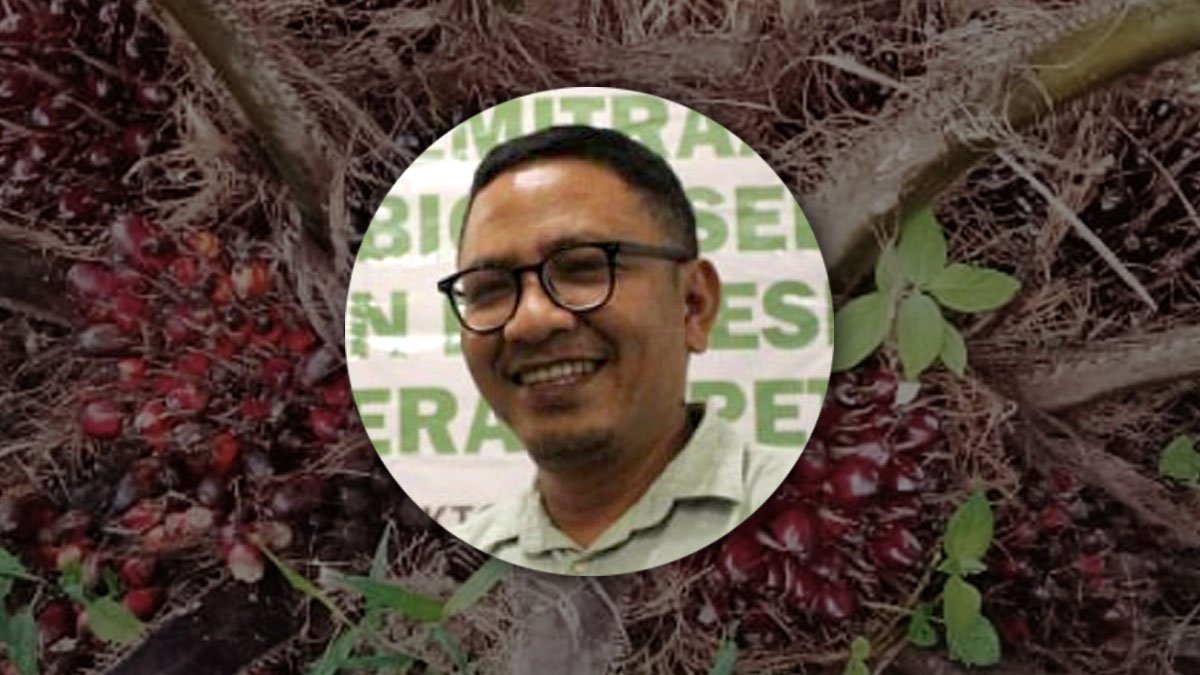
By Mansuetus Darto, S.IP., M.Si. — Chairman of POPSI; National Council Member of SPKS; Secretary of TaniBaik
Disclaimer: This article reflects the author’s personal views and is solely his responsibility.