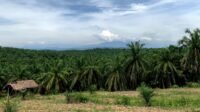
PALMOILMAGAZINE, JAKARTA — The government understandably hopes that palm oil harvested from seized plantations will remain marketable. The narrative of “state plantations for the state” has been positioned as the ultimate justification to ensure that these volumes continue flowing into the supply chain. However, if this expectation is pursued by forcing the market to absorb such palm oil, it should be treated as a serious warning sign. This approach carries high risk and could undermine the very foundation of Indonesia’s sustainable palm oil agenda.
The structural reality is clear. Agrinas Palma does not own palm oil mills to process fresh fruit bunches (FFB) from seized estates. Operations are conducted through third parties under operational cooperation schemes (KSO), while processing relies entirely on mills owned by other companies. This dependence creates implicit pressure on mills to accept palm fruit originating from disputed lands.
Yet global markets do not recognize the concept of a “state plantation” as commercial justification. The market recognizes only legal certainty, clear ownership, and compliance with sustainability standards. Mills may still be able to process the fruit. The real challenge emerges when the crude palm oil (CPO) must be sold. Most buyers today apply stringent procurement requirements, including NDPE commitments, traceability systems, and ISPO and RSPO compliance. Products carrying legal and reputational risk are increasingly rejected or only accepted at steep discounts.
Also Read: Environmental Intelligence: Indonesia’s New Path to Sustainable Palm Oil
There may be limited space for absorption in the domestic market, particularly for cooking oil and biodiesel. In the past, the government even designed ISPO primarily as a downstream compliance instrument, meaning that products destined for biodiesel and cooking oil were expected to meet ISPO standards. If this approach continues today without resolving the core legal issues of seized plantations, then entities managing millions of hectares of disputed land will face even greater difficulty marketing their output in a credible and sustainable way.
It is also important to recognize that most Indonesian palm oil mills are now bound by sustainability commitments. Even mills without formal certification face strong pressure from buyers to ensure ESG compliance throughout their supply chains. When compliant mills are encouraged—or worse, compelled—to accept palm fruit from disputed estates, the state is effectively transferring legal and reputational risks from problematic assets to companies that have invested in compliance. The market should not be coerced into bearing risks it did not create.
When sustainability-oriented mills refuse in order to protect their market access, the next risk becomes far more troubling. Palm oil sourced from seized estates, managed through KSO arrangements, without dedicated mills and without clear legal certainty, could increasingly be diverted into informal channels through traders and middlemen, at discounted prices and with minimal oversight. Should this occur, the state would not only fail to safeguard sustainability, but would also introduce a new market distortion that is far more difficult to control.
Also Read: GAPKI Calls for Stronger Palm Oil Export Governance, Citing Port Inefficiencies and Data Gaps
Forcing the market to absorb palm oil from disputed lands is not a solution. It is a near-certain recipe for damaging Indonesia’s credibility in sustainable palm oil in the eyes of the world. The real solution lies not in pressure, but in resolving legal status, strengthening governance, and restoring regulatory certainty. Without that, every ton of palm oil produced from disputed estates will continue to carry a burden of risk—not only for the industry, but for Indonesia’s global reputation. (*)
By Mansuetus Darto, Chairman of POPSI
Disclaimer: This article reflects the author’s personal views and is solely his responsibility.