
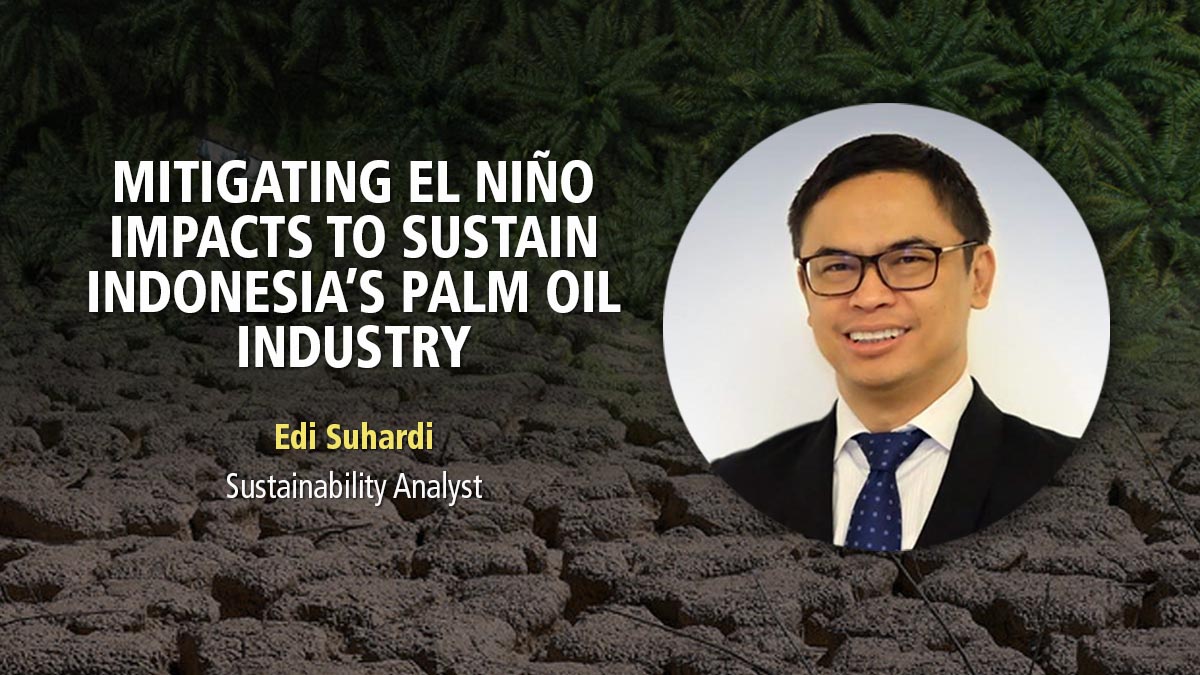
PALMOILMAGAZINE, JAKARTA — Indonesia’s palm oil sector is once again facing a major test of resilience as one of the country’s strategic industries. After years of navigating global geopolitical tensions, price volatility and domestic policy changes, the industry is now confronting another challenge: climate.
The El Niño phenomenon is projected to bring a prolonged dry season extending into early 2027, creating consequences that should not be underestimated.
The effects of drought are already being felt in plantation areas and could spread across broader social and economic dimensions, including public health and rural livelihoods. For the palm oil industry, the risks are multidimensional.
Also Read: Breaking the vicious cycle of forest fires and haze
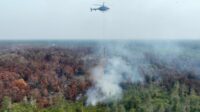
The threat of plantation fires is increasing, potentially reviving perceptions that palm oil is linked to forest and land fires. More importantly, prolonged water stress could trigger a systemic decline in national palm oil productivity.
For the crude palm oil (CPO) industry, climate is not merely a supporting factor but one of the key determinants of productivity.
Oil palm has a biological characteristic known as a lagged effect. Water stress caused by prolonged drought does not necessarily translate into an immediate decline in production during the dry season. Its effects may only become visible during flowering and fruit development, typically nine to 24 months later.
Also Read: Industry and Public Accountability in Efforts to Mitigate Forest and Land Fires
In other words, if El Niño intensifies in mid-2026, the resulting impact on national palm oil production could become increasingly visible throughout 2027.
This makes it essential for the government, industry and communities to assess potential drought impacts by examining historical patterns and mapping the fire risks that have typically accompanied El Niño cycles.
Such assessments should form the basis for policies designed to strengthen the resilience of both independent smallholders and plantation companies as climate-related risks become increasingly complex.
Also Read: Fair and Proportional Law Enforcement Is Essential in Tackling Forest and Land Fires
Lessons From Previous El Niño Cycles
Indonesia’s palm oil industry has repeatedly been tested by El Niño. Each cycle has presented different challenges while leaving important lessons for the future management of the sector.
The 1997–1998 El Niño was among the most severe episodes. Extreme weather, combined with land-clearing practices that were less regulated at the time, triggered widespread fires across Sumatra and Kalimantan.
Also Read: Super El Niño Threatens Malaysia Palm Oil Output in 2027, MPOC Sees Monsoon as Cushion
The consequences extended beyond environmental damage. Fresh fruit bunch (FFB) productivity reportedly declined by around 15–20% the following year.
The experience became an important turning point in the development of fire-prevention policies, including the adoption of a zero-burning policy, which remains a key principle of sustainable palm oil plantation management.
The next major El Niño episode again highlighted the risks associated with climate variability. In 2015, extensive peatland fires occurred, contributing to pressure on national CPO production, which declined by an estimated 3–5% in 2016.
Also Read: GAPKI Backs Inpres 11/2026, Calls for Stronger Collaboration to Prevent Forest and Land Fires
When El Niño returned in 2023, the industry’s mitigation capacity had improved significantly. Satellite-based monitoring, stronger interagency coordination and more consistent law enforcement helped reduce forest and land fire risks compared with earlier periods.
However, one problem remained: prolonged water stress contributed to stagnant national palm oil production growth throughout 2024.
The experience of these three El Niño cycles shows a consistent pattern. Whenever extreme drought occurs, national palm oil production comes under pressure, either directly or through a delayed biological impact.
Also Read: BMKG Warns El Niño to Keep Indonesia’s Palm Oil Regions Drier Until October 2026
Fire Risk and Industry Reputation
One of the most immediate risks that needs to be addressed is the potential increase in forest and land fires.
Heavy smoke can also reduce the amount of sunlight available for photosynthesis, disrupt fruit development and affect the effectiveness of natural pollination.
The problem is not purely ecological.
Also Read: BRIN Pushes Palm Oil Downstream Diversification Through Research and Innovation
A return of widespread haze could revive negative campaigns targeting Indonesia’s palm oil industry, particularly at a time when global sustainability regulations are becoming increasingly stringent.
In such circumstances, every hotspot represents more than a production risk. It can also become a threat to the reputation of Indonesia’s palm oil industry in international markets.
The Wider Economic Impact
The impact of the 2027 El Niño is unlikely to remain confined to plantations. It could extend to the broader macroeconomic level.
Independent smallholders, who account for approximately 40–41% of Indonesia’s total palm oil plantation area, are among the most vulnerable groups.
Also Read: GAPKI North Kalimantan Distributes Masks Amid Wildfire Haze in Bulungan
A decline in production would directly reduce household incomes in rural communities. At the national level, a reduction of CPO output by several million tons could also reduce export earnings worth tens of billions of US dollars.
Lower supply would normally support higher global CPO prices. However, the benefits of higher prices could be limited if export volumes decline while competing vegetable oils, such as soybean and rapeseed oil, become more abundant in the global market.
Progressive export levies and duties could further absorb part of the increase in international prices through fiscal mechanisms.
Also Read: The Missing Link in Indonesia’s Palm Oil Traceability
As a result, stronger global CPO prices would not necessarily translate into significant income gains for plantation companies or smallholders.
Three Policy Priorities
Given the strategic importance of palm oil to Indonesia’s economy, the government and industry stakeholders need to prepare mitigation measures that can reduce the impact of El Niño, prevent fires and protect national palm oil productivity.
At least three policy pillars deserve attention.
Also Read: Beyond Certification: The Next Chapter of Indonesia’s Sustainable Palm Oil
First, the government should conduct a deeper review of palm oil export levies and export duties.
If national production falls sharply because of El Niño, temporary flexibility or reductions in export-related charges should be considered.
Such measures could give companies greater room to maintain cash flow and preserve their ability to finance fire prevention, maintain plantation infrastructure and care for crops during critical periods.
Second, export certainty and smooth market access should form part of the strategy to maintain industry stability.
Export restrictions could undermine the confidence of international buyers while putting downward pressure on prices received by farmers.
The implementation of domestic supply obligations, or the Domestic Market Obligation (DMO), therefore needs to be reviewed and applied proportionally to maintain a balance between domestic requirements and the sustainability of export markets.
Third, the Plantation Fund Management Agency (BPDP) should consider establishing a dedicated emergency assistance mechanism for smallholders.
Support could be directed toward clean-water infrastructure in drought-prone plantation areas, fertilizer subsidies, stronger sustainable plantation practices and improved logistical capacity for village-level independent firefighting teams.
Such measures would strengthen smallholders’ ability to withstand increasingly severe climate pressures.
A Test of Industry Governance
Ultimately, the 2027 El Niño will not only test the resilience of oil palm plantations. It will also test the maturity of Indonesia’s palm oil governance.
Over recent years, the industry has demonstrated its commitment through various mitigation efforts, from stronger fire-prevention systems to improved conservation practices.
But the ability to withstand climate risks will not depend solely on the preparedness of plantation companies.
Macroeconomic policies—particularly those involving fiscal incentives, trade certainty and smallholder protection—will determine whether the palm oil industry can continue to serve as one of the pillars of Indonesia’s economy.
The challenge posed by El Niño 2027 is therefore not simply about maintaining production figures or protecting export volumes.
What is at stake is much broader: the livelihoods of millions of smallholder families, the economic stability of palm oil-producing regions and Indonesia’s position as the world’s largest vegetable oil producer.
Ultimately, mitigating the impact of El Niño is also about protecting Indonesia’s economic resilience as climate change makes weather patterns increasingly difficult to predict. (*)
Edi Suhardi
Sustainability Analyst