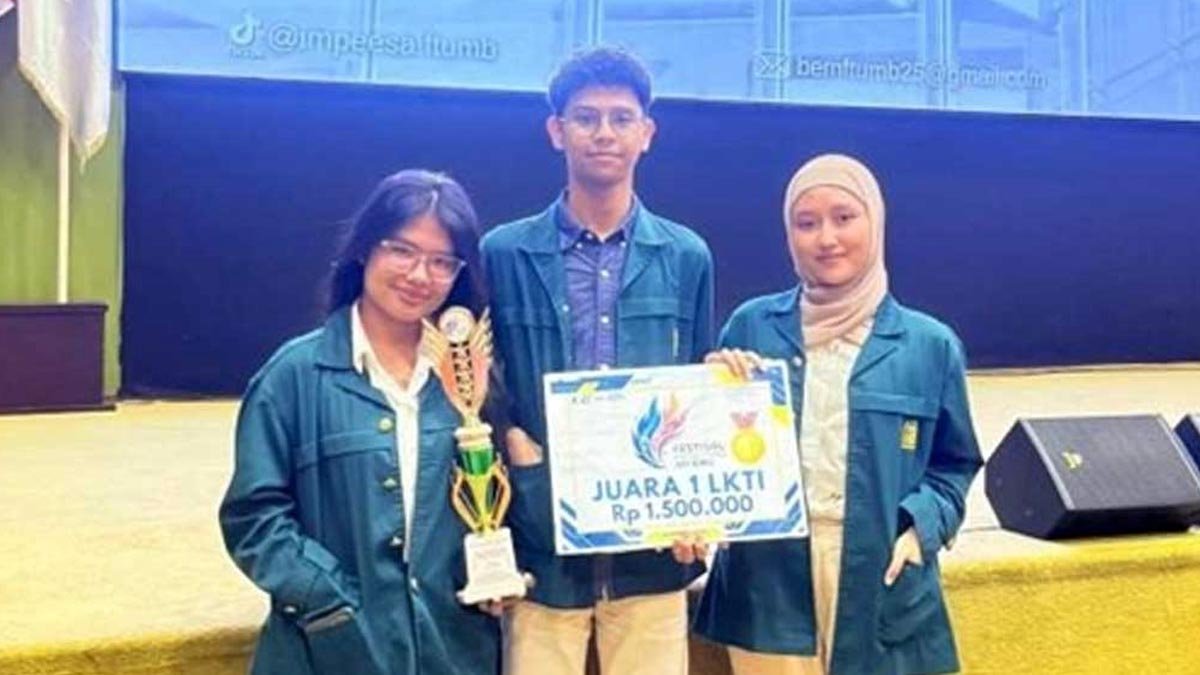
PALMOILMAGAZINE, JAKARTA — Amid growing environmental pressures, three students from the Bandung Institute of Technology (ITB) demonstrated that meaningful innovation can emerge from overlooked problems—like waste. The Althara Team, consisting of Agnes Ruth Savira, Maritza Kayla Zasky Malikha, and Naveed Muhammad Falah Brahmantika, successfully transformed palm oil mill effluent (POME) into a practical, eco-friendly liquid biofertilizer. Their scientific work secured them a spot at the 2025 Festival Engineering Api Biru (FEAB) in Jakarta.
Carrying the theme “Accelerating Indonesia’s Impact”, the team tackled one of the palm oil industry’s ongoing challenges: liquid waste from processing mills. Through a microbiological fermentation approach, they converted POME into a biofertilizer that not only enhances plant productivity but also provides natural pest protection.
One highlight from their early trials was the application on Momotaro tomatoes, a premium variety known for requiring high nutrient input. “We want to prove that waste is not the end of the production chain. With the right technology, waste becomes opportunity—for palm growers and horticulture farmers alike,” said Agnes, who developed the idea after a field visit to Mujagi Farm in Cianjur, as cited by Palmoilmagazine.com from ITB on Wednesday (26/11/2025).
Also Read:
The fermented fertilizer is also seen as a way to reduce reliance on chemical fertilizers and pesticides, offering farmers a greener and more economical alternative. Economically, the innovation opens opportunities for lower production costs, higher efficiency, and improved competitiveness of Indonesian horticulture—potentially supporting premium export markets.
Developing the project was not without challenges. The preparation coincided with the final exam period, forcing the team to manage their time with precision. Through intensive communication, clear task division, and strong internal support, they completed the scientific paper on schedule. “Our greatest strength is teamwork. That’s how ideas become reality,” they said.
Their multidisciplinary approach—combining biotechnology, microbiology, chemistry, agriculture, and environmental science—served as the backbone of the innovation. The result aligns with circular economy principles, linking the palm plantation value chain with horticultural production.
Their participation in FEAB 2025 marks the beginning, not the end, of their journey. The students hope to bring the technology to field-scale implementation and eventually commercialize palm oil waste–based biofertilizer for broader use among Indonesian farmers.
“The most important lesson is not to stop when challenges arise. Challenges create opportunities. We hope this experience inspires more students to collaborate and create real impact for society,” Agnes said.
The FEAB 2025 Final took place on July 7 in Jakarta, with the awards ceremony held on July 17. Through this innovation, the Althara Team not only achieved recognition but also proved that the future of Indonesian agriculture can be reshaped by the courage to turn waste into value. (P2)