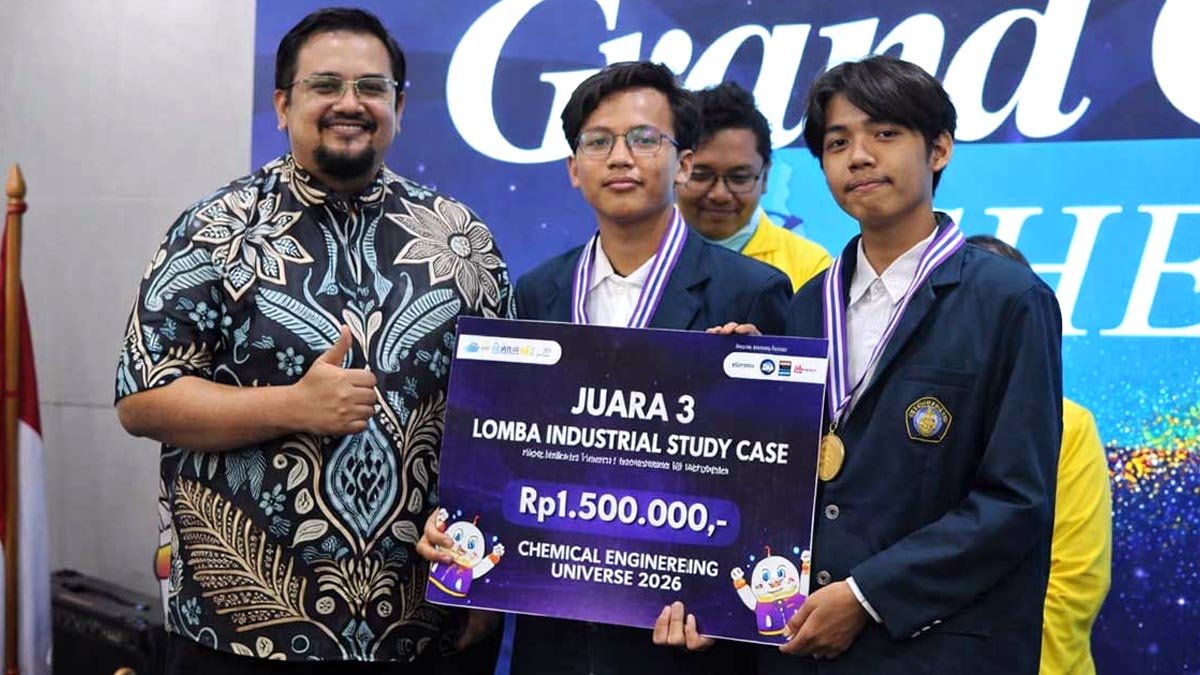
PALMOILMAGAZINE, JAKARTA – Students from the Chemical Engineering Department of Universitas Brawijaya (UB) have once again gained national recognition through an innovation focused on renewable energy derived from palm oil waste. The team “Perwira Agak Laen” secured third place at the Chemical Engineering Universe (CHEVERSE) 2026 competition, organized by the Chemical Engineering Student Association of Universitas Pertamina on February 14, 2026.
The team consisted of Ahmad Hisyam Shidqi and Kevin Ainal Rizki Fadillah, both Chemical Engineering students from the 2022 cohort. During the competition, they competed against teams from several leading Indonesian universities, including Universitas Indonesia, Institut Teknologi Bandung, and Universitas Gadjah Mada.
Under the supervision of Ir. Diah Agustina Puspitasari, S.T., M.T., Ph.D., the team presented a research project focused on utilizing palm oil waste to support Indonesia’s energy transition. Their study was titled “Utilization of Oil Palm Empty Fruit Bunch (EFB) Waste into Bioethanol: Evaluation of the Simultaneous Saccharification and Fermentation (SSF) Method at Industrial Scale to Support Sustainability and Energy Optimization.”
Also Read: Global Tensions Push Palm Oil Shipping Costs Up 50%, GAPKI Says Export Demand Begins to Slow
The research explored the potential of converting oil palm empty fruit bunch (EFB) waste into bioethanol as an alternative fuel to support Indonesia’s E10 fuel blending mandate. The team conducted industrial process simulations using Aspen Plus V14 software to compare two bioethanol production methods: Simultaneous Saccharification and Fermentation (SSF) and Separate Hydrolysis and Fermentation (SHF).
“Our goal was to identify the most technically and economically efficient method so that converting palm oil waste into bioethanol could be implemented in real industrial operations,” Kevin said in a statement obtained by Palmoilmagazine.com on Monday (March 16, 2026).
The innovation developed by Hisyam and Kevin aligns closely with several Sustainable Development Goals (SDGs). Producing bioethanol from palm oil waste contributes to SDG 7 by supporting the development of affordable and clean energy, and SDG 9 through the application of industrial simulation technology to create more efficient manufacturing processes.
Also Read: KPBN CPO Price Falls to IDR 15,825/kg on March 17 as Malaysian Market Extends Decline
Furthermore, the research supports SDG 12 by applying circular economy principles, transforming palm oil biomass waste into higher-value products. It also contributes to SDG 13 by helping reduce greenhouse gas emissions through the use of bioethanol blends in transportation fuels. (P2)