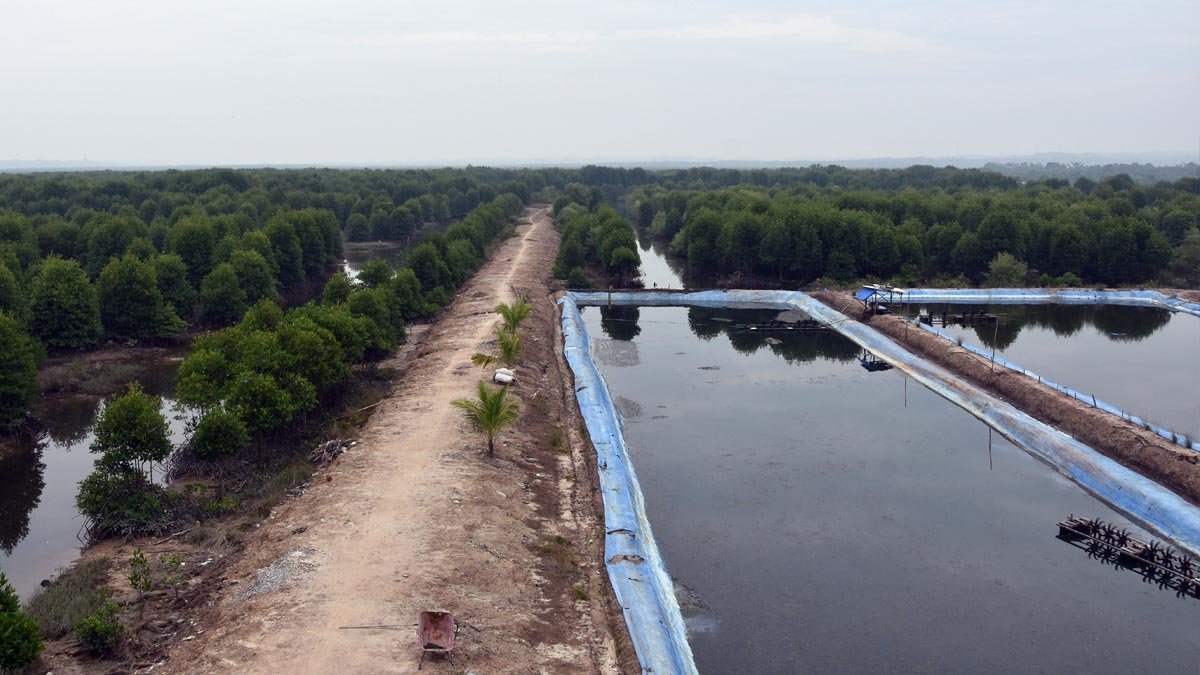
PALMOILMAGAZINE, BOGOR — IPB University has introduced a new technological innovation aimed at strengthening sustainability in Indonesia’s palm oil industry. The breakthrough, known as EC+, is an electrochemical-based system designed to treat palm oil mill effluent (POME) more efficiently and environmentally.
The technology was developed by Suprihatin, a professor from the Department of Agro-Industrial Technology at IPB’s Faculty of Agricultural Technology. It responds to the growing environmental challenges posed by the rapid expansion of palm oil mills across the country.
As production increases, so does the volume of wastewater. Each ton of fresh fruit bunches (FFB) processed can generate approximately 0.75 to 0.90 cubic meters of liquid waste. When calculated per ton of crude palm oil (CPO), this figure rises to around 3.33 cubic meters of effluent.
Also Read: Indonesia Struggles to Boost Palm Oil Yields Amid Genetic and Disease Risks
This wastewater contains pollutants such as total suspended solids (TSS), organic matter, oil and grease, and nutrients, all of which can harm the environment if not properly treated.
“Until now, palm oil mill effluent has generally been treated using conventional anaerobic–aerobic pond systems. However, this approach still has limitations in terms of effectiveness and efficiency,” said Prof. Suprihatin in a written statement, as quoted by Palmoilmagazine.com on Tuesday (March 17, 2026).
Traditionally, palm oil mills rely on anaerobic–aerobic pond systems for wastewater treatment. However, according to Suprihatin, these conventional approaches still face limitations in both efficiency and effectiveness.
Also Read: Rising CPO Prices Seen Cushioning Cost Pressures for SD Guthrie Amid Energy Volatility
To address these challenges, the EC+ process applies electrocoagulation, using a direct electric current to release aluminum ions (Al³⁺) from the anode. These ions destabilize colloidal particles and form aluminum hydroxide flocs that bind contaminants, enabling their removal from the wastewater.
The technology has gained national recognition, being selected among the “117 Indonesia Innovations 2025” by the Business Innovation Center.
In practical terms, EC+ is capable of significantly reducing TSS, chemical oxygen demand (COD), biological oxygen demand (BOD), color, oil and grease, as well as nutrients such as phosphate. The treated water can reach a quality suitable for reuse.
Also Read: Riau Independent Smallholder FFB Prices Climb to IDR3,842/kg in Late March 2026
“This process effectively removes TSS, COD, BOD, color, oils, and fats, as well as nutrients such as phosphates. The wastewater can be purified and made suitable for reuse,” she explained.
Beyond its technical performance, EC+ also offers environmental and economic advantages. The process does not require additional chemical inputs such as alum, reducing the risk of chemical residues. Operational costs can be cut by up to 50 percent compared to conventional chemical coagulation methods, while energy consumption remains relatively low at around 9.80 kWh per cubic meter of wastewater.
The system is also flexible, allowing for modular design and operation in both continuous and batch modes. Notably, the sludge generated can be repurposed as organic fertilizer or soil conditioner.
Also Read: Alleged POME Fraud in Indonesia Raises Red Flags Across Global Biofuel Supply Chains
Suprihatin emphasized that EC+ has strong potential to support circular economy practices within the palm oil sector. Treated water can be reused for cleaning factory equipment or irrigating plantation areas, while sludge can be combined with biochar derived from empty fruit bunch pyrolysis to enhance soil fertility.
He concluded that EC+ could become a key component in establishing closed-loop systems for water and nutrient cycles, reducing reliance on synthetic fertilizers and advancing the industry toward a zero-waste model.
With this innovation, IPB aims to provide a practical solution that not only addresses environmental challenges but also creates added value and accelerates the transition toward a more sustainable palm oil industry. (P2)