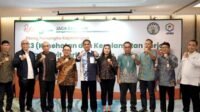
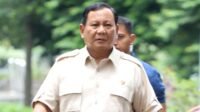
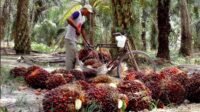
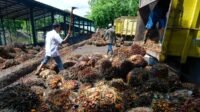
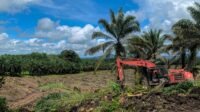
PALMOILMAGAZINE, MEDAN — The Indonesian House of Representatives (DPR RI) Commission VI conducted a specific working visit to PTPN IV PalmCo, a key subholding under Holding Perkebunan PTPN III (Persero), as part of efforts to strengthen collaboration in accelerating the transformation of Indonesia’s palm oil industry. The visit, held at the Grand Mercure Hotel Medan, became a platform for PalmCo to showcase its achievements in digital transformation, receiving praise from legislators and government officials alike.
Prof. Dr. H.A.M. Nurdin Halid, Chair of the DPR RI Commission VI delegation, emphasized the strategic importance of the palm oil sector in the national economy. He noted that the industry employs around 16.5 million workers and is a major contributor to state revenues.
“Indonesia’s CPO production has reached 48.16 million tons, a 3.8% increase from last year. Demand for palm-based derivatives, including biodiesel and other biofuels, continues to grow annually,” he stated, as quoted by Palmoilmagazine.com from PTPN Holding’s official site.
Also Read: Ministry of Industry and PTPN IV Join Forces to Boost Palm Oil Talent at SMK-SMTI Pontianak
Nurdin commended PalmCo’s transformation initiatives, especially in the context of global challenges such as price volatility and sustainability pressures from importing countries.
Similarly, Commission VI member Drs. H. Mulyadi, M.M.A., applauded PalmCo’s tech-driven approach, calling it a strategic step toward national food and energy security.
“We witnessed firsthand how PalmCo is building new strengths through digital transformation. This is a concrete move toward smart plantations and national self-reliance,” he noted.
Firnando H. Ganinduto, B.A., another member of Commission VI, specifically highlighted PalmCo’s use of digital systems PalmCo Business Cockpit and AgroView, which allow precise and transparent plantation monitoring even from afar.
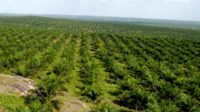
PalmCo Business Cockpit delivers real-time data on field conditions, crop productivity, and unit performance. AgroView utilizes satellite imagery and drones to comprehensively track crop growth and health across plantations.
“We’re able to monitor plantations in detail without being physically present. I hope PalmCo continues to integrate this technology into its operations,” Firnando added.
From the government side, Faturohman, Assistant Deputy for Plantation and Forestry Industry at the Ministry of State-Owned Enterprises, stated that PTPN Group is currently in an expansion phase following its 2023 restructuring. He emphasized PalmCo’s vital role, contributing 70% of the group’s total revenue.
“With around 618,000 hectares of managed nucleus estates, PalmCo is now one of the largest palm oil companies globally,” Faturohman explained.
Denaldy Mulino Mauna, President Director of Holding Perkebunan PTPN III (Persero), expressed appreciation for DPR RI’s support in strengthening the palm oil industry. He shared that the group is targeting a 7.5% Return on Assets (ROA) by 2029, in response to a performance challenge issued by the President of Indonesia.
“We’re focusing on more efficient asset management. It’s an ambitious goal, but we’re committed to meeting it,” he said.
Meanwhile, Jatmiko Santosa, President Director of PTPN IV PalmCo, underlined the company’s focus on productivity and efficiency amid global pressures. PalmCo’s current CPO productivity stands at 4.6 tons per hectare, a notable figure in the industry. He also emphasized the importance of the Smallholder Palm Oil Replanting Program (PSR), with a target of 60,000 hectares for this year.
“Digital transformation is our core strategy for enabling fast and accurate decision-making. We’re applying technologies like AI, IoT, and real-time dashboards across operations,” said Jatmiko.
He also reiterated PalmCo’s commitment not just to operational efficiency, but also to the downstream development of renewable energy, including biodiesel and value-added palm waste products.
“Our focus is twofold: accelerating Next Gen Operations and PSR to boost productivity, and pushing downstream innovations in renewable energy. This is our commitment to a more impactful and sustainable palm oil industry,” Jatmiko concluded. (P3)