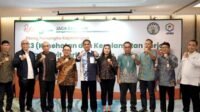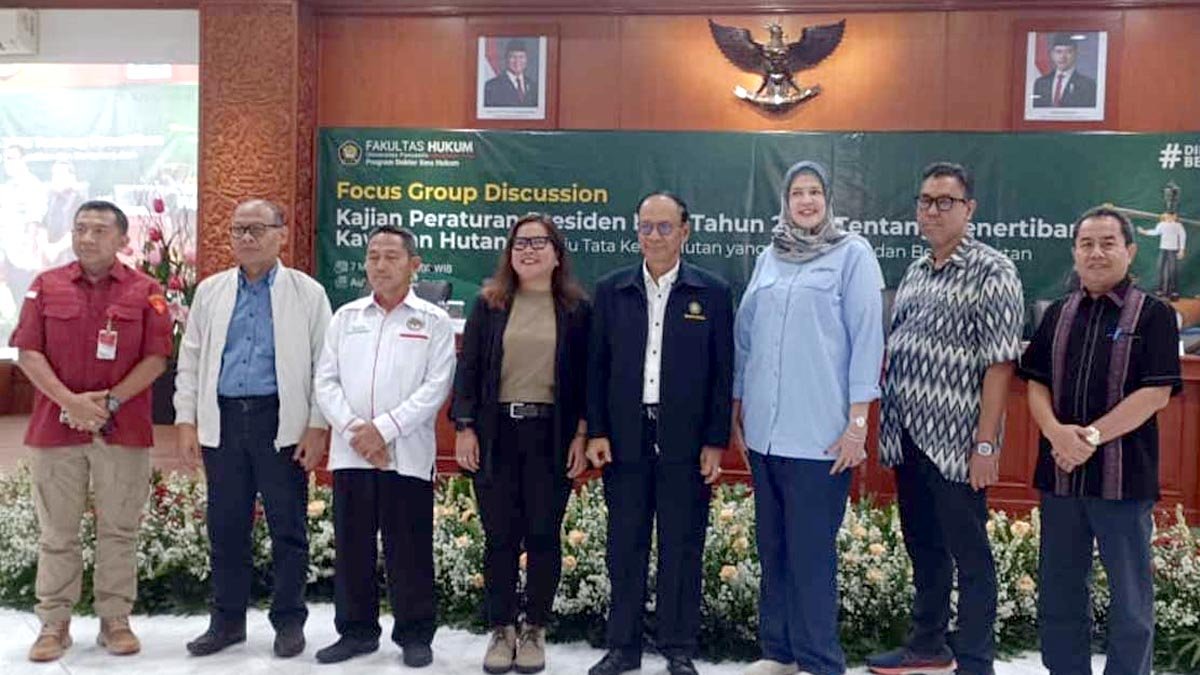
PALMOILMAGAZINE, DEPOK – Amid the debate surrounding Presidential Regulation (Perpres) No. 5 of 2025, voices from the grassroots have begun to emerge. From the Nusantara Hall at the Faculty of Law, Pancasila University in Depok, West Java, stakeholders in the palm oil industry—particularly smallholders and independent farmers—are voicing both hope and concern over a regulation that aims to organize forest areas, yet may disrupt a sector that sustains millions of rural livelihoods.
Ardito Muwardi, Coordinator I at the Deputy Attorney General for Special Crimes (Jampidsus) and a member of the Task Force for Forest Area Regulation (Satgas PKH), is a key figure in this policy’s implementation. According to Ardito, the regulation seeks to clarify the legal status of forest areas and optimize their use. Data from the Ministry of Environment and Forestry (KLHK) shows that thousands of hectares fall into a legal grey area due to past irregularities in land release processes.
“Articles 110A and 110B of the Job Creation Law provide the legal basis for clarifying the status of landholders,” Ardito stated during a Focus Group Discussion (FGD) on the Presidential Regulation, attended by Palmoilmagazine.com on Wednesday (May 7, 2025). The outcomes of these clarifications could result in land being reclaimed by the state if found to be in violation of regulations or deemed not legally possessed.
Also Read:
To date, Satgas PKH, supported by the Indonesian military (TNI), has verified over 620,000 hectares of land, with around 399,000 hectares still undergoing verification. Of this, 221,800 hectares have already been handed over to PT Agrinas, while another 216,900 hectares are set for handover in a second phase. Plans are also in place to reclaim around 75,000 hectares across regions such as Aceh, Kalimantan, and Sumatra.
However, behind these firm government steps, there are growing concerns from the farming community. Setiyono, Chairman of Aspekpir Indonesia, warned that the policy must not become an additional burden for smallholders. He emphasized that smallholder plantations are not just land, but the product of decades of hard work and a legacy dating back to the PIR-Trans program of 1979.
“Back then, we walked tens of kilometers to clear land and join the PIR-Trans scheme. Plasma farmers were a success story of government policy,” he recalled. Now, after decades of toil, their lands are suddenly being labeled as forest areas.
He argued that many independent farmers developed their plantations with limited resources, often using whatever seedlings were available, yet still managed to drive local economic growth. It’s disheartening, he said, when even certified and government-supported lands are suddenly reclassified as forest, ignoring their historical and socio-economic value.
Setiyono also highlighted the pressure coming from the European Union’s policies on palm oil, which have disproportionately affected Indonesian farmers. “The EU protects its farmers—why don’t we? This is about national priorities,” he asserted.
He warned that the government’s ambitious target of producing 100 million tons of CPO by 2045 will be difficult to achieve without resolving land status uncertainties. Young people are increasingly reluctant to enter a sector fraught with legal ambiguity.
As a bold solution, Setiyono proposed merging the Ministry of Agriculture and the Ministry of Forestry to align agricultural development with forest conservation. “Right now, it feels like a tug-of-war—one ministry wants to develop, the other to protect. Just merge them so there’s a unified vision,” he said.
Amid the regulatory confusion and bureaucratic friction, smallholders like Setiyono only seek one thing: certainty. From these lands, they earn a living, send their children to school, and build a future. If the nation wants palm oil to remain a backbone of energy and export, it must begin with clarity—are these lands truly theirs, or are they merely temporary occupants beneath the shadow of a forest boundary? (P2)