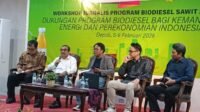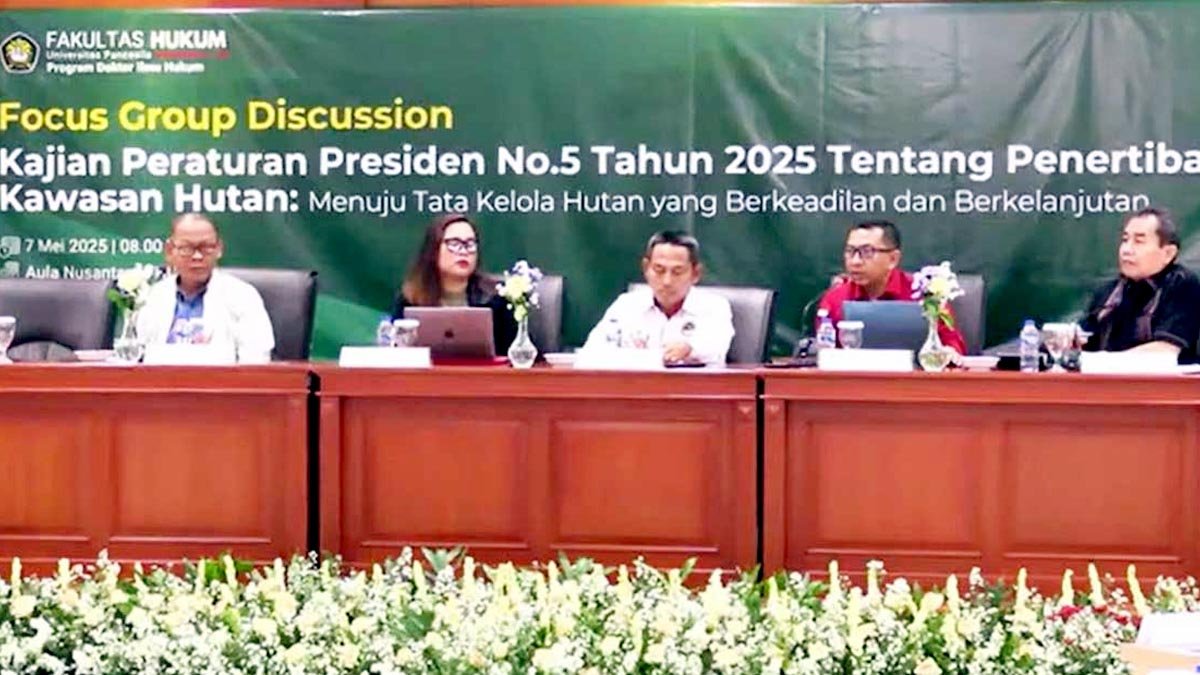
PALMOILMAGAZINE, JAKARTA – Amid public debate surrounding Presidential Regulation (Perpres) No. 5 of 2025 on Forest Area Structuring, Universitas Pancasila has taken a proactive step. Through its Doctoral Program in Law at the Faculty of Law (PDIH FH), the university hosted a Focus Group Discussion (FGD) titled “Towards Equitable and Sustainable Forest Governance”, on Wednesday, May 7, 2025, at the Nusantara Hall, Faculty of Law, Universitas Pancasila, Jakarta. The event was covered by Palmoilmagazine.com.
The discussion was lively and inclusive. Academics, government officials, environmental activists, farmers, and representatives of Indigenous communities came together to find common ground on a regulation that, while well-intentioned in addressing long-standing land issues, poses potential risks of inequality.
Dean of the Faculty of Law, Eddy Pratomo, opened the session by emphasizing that this regulation is a continuation of the Job Creation Law, aimed at resolving overlapping land designations in forest areas. “We must not forget the principles of social and ecological justice as mandated by the Constitution, Constitutional Court rulings, and Forestry Law,” he stated.
Also Read:
Eddy stressed the importance of the FGD as a platform for diverse voices. “Our goal is clear: to produce tangible outcomes such as mapping out key issues and offering strategic recommendations. Universitas Pancasila is ready to contribute to more just and participatory policy reformulation,” he added.
From a law enforcement perspective, Ardito Muwardi, Coordinator I of the Deputy Attorney General for Special Crimes, explained the formation of the Forest Area Structuring Task Force (Satgas PKH). According to him, this task force represents a swift governmental response to the decades-old problem of overlapping forest designations with other sectors, such as plantations and mining.
“It’s been 79 years and the issue remains unresolved. Now is the time to act decisively—yet carefully, with input from all stakeholders to ensure fairness,” Ardito remarked.
As of April 2025, the task force has verified 620,000 hectares of land. About 221,000 hectares have been handed over to PT Agrinas, with plans to reach one million hectares across six provinces in the next phase.
However, not all responses were favorable. Setiyono, Chairman of Aspekpir Indonesia, voiced the growing concerns among oil palm farmers. “Our lands have been certified since the PIR-Trans era. Suddenly being labeled as forest areas shocked us. Oil palm is our livelihood,” he said solemnly.
He urged the government not to sacrifice smallholder farmers in the name of bureaucratic order—especially when their land rights have long been recognized by the state.
Forestry law academic Sadino offered a sharp perspective. He pointed out that forest area disputes cannot be separated from the history of the 1982 Forest Land Use Consensus (TGHK), which often conflicted with older local and customary maps.
“The designation of forest areas is an administrative act. It must be based on a legitimate spatial planning process, with clear boundaries,” he emphasized. He cited examples of land rights such as SHM (Freehold Title), HGU (Cultivation Rights), and HGB (Building Rights) that must be acknowledged and protected by the state.
Sadino also reminded the audience that the role of the task force should go beyond reclassification. “Before any forest area is formalized, the rights of affected communities must be resolved. Administrative decisions should not spark new conflicts,” he concluded.
The discussion at Universitas Pancasila went beyond academic debate—it marked a critical reminder that any restructuring of forest policy must be rooted in public voice and ecological justice. (P2)