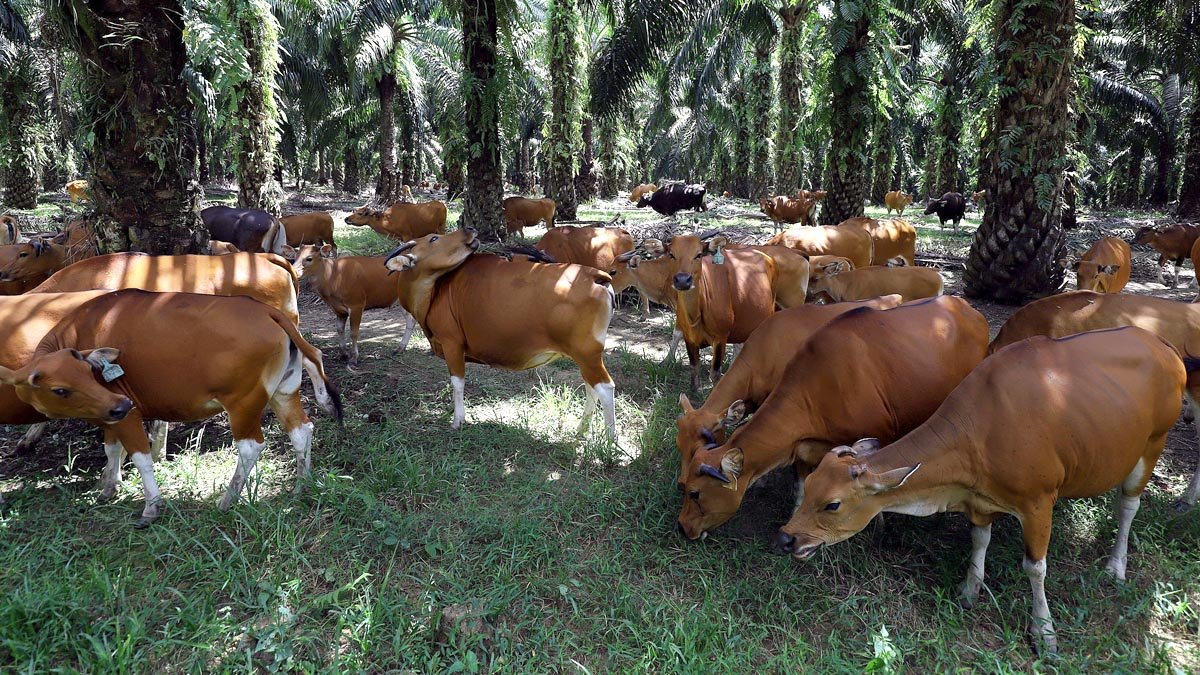
PALMOILMAGAZINE, JAKARTA — The government has reaffirmed the obligation of palm oil plantation companies to facilitate the development of surrounding community plantations (FPKMS) through productive business partnerships, with a stronger emphasis on the palm oil–cattle integration system (SISKA). The policy is outlined in Circular Letter No. 1598/SE/KB.410/E/11/2025 issued by the Directorate General of Plantations.
The circular, reviewed by Palmoilmagazine.com on Friday (19/12/2025), responds to on-the-ground challenges—particularly the limited availability of community-owned land to meet the 20% FPKMS requirement of total plantation business permit areas, as stipulated under Minister of Agriculture Regulation No. 18/2021.
Under the circular, companies are granted flexibility to fulfill FPKMS obligations through alternative partnership schemes. “The ministerial regulation provides room for companies to meet FPKMS obligations through other forms of partnership, one of which is productive business activities via the Palm Oil–Cattle Integration System (SISKA),” the document states.
Also Read: Palm Oil Production and Exports Strengthen in October 2025, Biodiesel Fuels Domestic Demand
The Directorate General of Plantations considers SISKA an efficient and sustainable business model. Beyond improving the livelihoods of communities around plantations, the scheme aligns with the government’s broader agenda to achieve national food self-sufficiency.
However, the success of SISKA hinges on sustainable feed availability. To that end, the government underscores the strategic use of palm oil by-products, particularly palm kernel meal (PKM). The circular stresses that “reinforcing the obligation of palm oil plantation companies and palm oil mills to prioritize PKM allocation for SISKA is essential to ensure optimal implementation.”
The circular also clarifies its purpose and scope: “This Circular Letter serves as guidance for plantation companies and palm oil mills in fulfilling FPKMS obligations through SISKA, guidance on PKM allocation, and a reference for governors and regents/mayors in conducting supervision and oversight.”
Also Read: MPOC Projects CPO Prices to Stay Range-Bound in January 2026 as High Inventories Weigh
The primary objective is to ensure that FPKMS implementation through SISKA and PKM allocation is sustainable, measurable, and impactful. “This Circular aims to ensure that FPKMS obligations through SISKA and/or PKM allocation are carried out in a sustainable and measurable manner, contributing significantly to the government’s food self-sufficiency program,” the document adds.
In terms of implementation, plantation companies and palm oil mills that have yet to meet their FPKMS obligations are required to do so promptly in accordance with prevailing regulations. FPKMS implementation through SISKA must follow procedures for calculating and determining the Optimum Production Value (NOP) of beef cattle investments, taking into account the economic value of livestock populations and infrastructure handed over to communities.
Companies are also mandated to ensure feed availability by allocating PKM. The circular explicitly states that “plantation companies and palm oil mills must allocate PKM as a feed source for SISKA under the FPKMS partnership scheme and as feed material for areas surrounding company operations.”
As part of oversight and accountability measures, companies must prepare and report SISKA business plans, progress on FPKMS realization—including livestock population and investment value—and the realization of PKM allocation to the relevant licensing authorities. All data must also be uploaded to the Plantation Licensing Information System (SIPERIBUN).
With the issuance of this circular, the government expects palm oil–cattle integration to move beyond regulatory compliance, becoming a key driver of community welfare improvement and a pillar in strengthening Indonesia’s national food security. (P2)