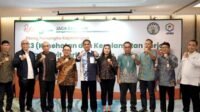
PALMOILMAGAZINE, JAKARTA – During the Earth Day commemoration on April 22, 2024, Wahana Lingkungan Hidup Indonesia (WALHI) and the Ford Foundation in Indonesia engaged in discussions with various media outlets. The focus was on promoting the Ekonomi Nusantara model, which advocates for a restorative economic approach empowering local communities to sustainably manage natural resources, aiming to restore threatened ecosystems in Indonesia.
The discussion, held on April 29, centered on WALHI’s introduction of the Ekonomi Nusantara model. This initiative entails the development of a promotion network and the trade of products sourced from over 1.3 million hectares, involving more than 199,767 families across 28 provinces.
Zenzi Suhadi, Executive Director of WALHI, emphasized the urgency of transitioning from exploitative capitalist economies to ones that benefit both nature and people.
Also Read: Ford Foundation Backs BRWA in Indigenous Territory Registration Management
Earth Day was taken as a significant moment to deal with the climate crisis that happened for environmental exploitation and did not care about ecology, social aspects that wanted to develop the economy only. In this context, Ekonomi Nusantara could be the solution to solve the social-economic gap, and maintain natural diversity.
Zenzi also explained that the main principle in Ekonomi Nusantara would be to support economic practices in the local area that would be sustainable and balanced with a new ecosystem where the local communities produce commodities from their own regions,” he said in the official statement to Palmoilmagazine.com, Wednesday (1/5/2024).
The wheel of economy in Ekonomi Nusantara, he continued, would be from acknowledgement and protection to wilayah kelola rakyat (WKR). WKR is taken as the mechanism of integrated and participative regional cultivation that would reinforce the sovereignty of masyarakat adat dan komunitas lokal (MAKL) on natural resource cultivation.
Meanwhile, Farah Sofa, Program Officer, Natural Resources and Climate Change, Ford Foundation Indonesia, supported the Ekonomi Nusantara model that WALHI proposed. This would be the same with the vision of the Ford Foundation to fight for social fairness by noticing climate crisis mitigation.
By implementing Ekonomi Nusantara, the local people should gain economic independence while being harmonious with nature. The model could be the real sample to create a sustainable and harmonious economy with nature, and prioritize the welfare of the indigenous people. (T3)