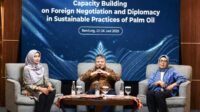
PALMOILMAGAZINE, JAKARTA — The urgency of implementing sustainable palm oil governance is growing, particularly amid heightened scrutiny over the industry’s environmental footprint. Bayu Krisnamurthi, Professor of Agribusiness Policy at IPB University, said sustainability is no longer optional but essential to reducing long-term risks.
In a written statement issued in Jakarta on Wednesday, Bayu stressed that the core issue in converting forest areas into oil palm plantations is not merely whether such activities are permitted, but how the process is carried out and how plantations are managed afterward.
“The key factor in converting forests into oil palm plantations lies in the process itself and, subsequently, in how the plantations are managed so that benefits can be optimized while associated risks are minimized,” he said, as quoted by Palmoilmagazine.com from Antara on Friday (December 12, 2025).
Also Read:
Oil Palm Is Not a Forest, but It Still Has Ecological Value
Bayu acknowledged the long-standing debate over the role of oil palm within ecosystems. He emphasized that while oil palm plantations are not tropical natural forests, the crop—given its strategic importance—still provides certain ecological functions that should not be dismissed.
“This requires viewing oil palm proportionally as a strategic commodity that delivers substantial economic benefits, while also having clear ecological limits,” he said.
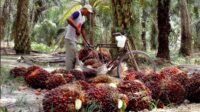
The former Deputy Minister of Trade (2011–2014) noted that oil palm trees can grow for decades and absorb carbon dioxide through photosynthesis. They also store carbon in their trunks, biomass litter, and fruit. However, he cautioned that their ecological capacity cannot be equated with that of tropical forests, which have multilayered structures and far more complex biodiversity.
“Oil palm plantations are not the same as natural forests in terms of biodiversity, ecological capacity, or hydrological functions,” Bayu asserted.
Also Read: Pakistan and Indonesia Deepen Ties as Palm Oil Trade Anchors Bilateral Relations
Palm Oil’s Economic Contribution Remains Vital
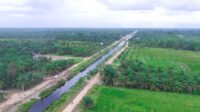
At the same time, Bayu underlined that the economic value of palm oil for communities and the state cannot be sidelined. The industry, he said, is a backbone of the national economy, with plantation areas exceeding 16 million hectares and employment reaching an estimated 16–20 million people, both directly and indirectly.
Indonesia’s crude palm oil (CPO) output of more than 50 million tonnes per year has positioned the country as the world’s largest producer and exporter of palm oil.
Data from the Indonesian Palm Oil Association (GAPKI) show that combined CPO and PKO production in 2024 reached 52.762 million tonnes, down 3.80% from 54.844 million tonnes in 2023. Domestic consumption in December 2024 stood at 2.187 million tonnes, up from 2.030 million tonnes in November.
Also Read: Planters Push Productivity Drive to Strengthen Indonesia’s Palm Oil Output
On the export front, palm oil exports in 2024 were valued at USD 27.76 billion (IDR 440 trillion), an 8.44% decline from USD 30.32 billion (IDR 463 trillion) recorded in 2023.
Bayu called for a balanced approach, where economic gains go hand in hand with respect for ecological limits. Sustainability, he said, can only be achieved through prudent management, robust regulations, and consistent oversight.
Given palm oil’s status as a strategic national commodity, Bayu concluded that the key challenge ahead is ensuring the industry continues to deliver substantial economic benefits without compromising environmental integrity. (P2)