PALMOILMAGAZINE, YOGYAKARTA – Deforestation should not be simplistically equated with oil palm development. Instead, the issue must be understood proportionally, grounded in scientific definitions, historical context, and empirical field data. This was emphasized by Professor of Forestry at IPB University, Prof. Yanto Santosa, during the National Palm Oil Seminar held by UPN Veteran Yogyakarta on Thursday (22/1/2026).
In his presentation, Prof. Yanto reminded participants that the term deforestation is often used loosely, despite having clear definitions in both international and national frameworks.
“Since 1990, the FAO and the World Bank have defined deforestation as the loss of forest cover, whether permanent or temporary,” he said.
He explained that forest cover is not merely a collection of trees, but vegetation with specific composition and density that enables forest ecosystem functions—ranging from microclimate regulation and water management to wildlife habitat.
In Indonesia’s regulatory framework, Ministry of Forestry Regulation No. 30/2009 defines deforestation as the permanent conversion of forested areas into non-forested land as a result of human activities.
Understanding Forests Beyond ‘Green Land’
Prof. Yanto also underlined the importance of correctly understanding what constitutes a “forest.” Referring to FAO standards (2010), forest is defined as land larger than 0.5 hectares, with trees higher than five meters and canopy cover exceeding 10 percent, or land capable of reaching those thresholds.
FAO further clarifies that forests do not include land predominantly used for agriculture or settlements.
Under Indonesian law, Law No. 41/1999 defines forest as an ecosystem unit in the form of land dominated by trees along with its natural environment, forming an inseparable ecological system.
Also Read: Thriving on Marginal Land, IPB Professor Highlights Palm Oil’s Strategic Role for Indonesia
According to Prof. Yanto, clarity of definition is essential so discussions on palm oil do not fall into generalization or stigma.
Historical Evidence: Land Conversion Predates Palm Oil
Forest cover change and land-use dynamics in Indonesia, he said, cannot be separated from the country’s long development history.
He cited historical records showing that plantation clearing in East Sumatra (now North Sumatra) began as early as 1863, pioneered by Nienhuys. At that time, the dominant crop was not oil palm, but tobacco, which was highly demanded by European markets.
“This shows that large-scale plantation land clearing existed long before palm oil developed as it has today,” he said.
Also Read: Indonesia Maps 3.32 Million Hectares of Oil Palm Inside Forest Areas, Figure Nears 4 Million
Prof. Yanto outlined several major drivers behind forest conversion in Indonesia. One was the transmigration policy, which began during the Dutch colonial era between 1905 and 1940 and resumed after 1969. Between 1969 and 2000, around 3.05 million households were relocated, involving land clearing of approximately 8.94 million hectares.
Another factor was the policy of utilizing Production Forests through forest concession rights (HPH) with planned logging systems since the early 1970s. Between 1985 and 1997, forest degradation reached around 6.7 million hectares in Sumatra and 8.5 million hectares in Kalimantan.
He also pointed to land productivity policies since the late 1980s that opened space—particularly on degraded land—for oil palm plantations and industrial timber estates.
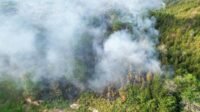
Forest fires, which occur almost annually, have also been a significant contributor. The massive 1982–1983 fires in East Kalimantan damaged around 3.6 million hectares of forest. In 2015, burned areas were reported at more than 261,000 hectares, with estimated losses of Rp221 trillion.
Legal Deforestation and Spatial Planning
Prof. Yanto further explained that under Indonesia’s legal system, the reclassification of forest areas into non-forest zones is possible through spatial planning mechanisms.
Law No. 24/1992 on national spatial planning provides a legal pathway for changing land designation, provided it receives approval from the national legislature.
“National and regional spatial planning reflects state sovereignty in allocating land for various purposes,” he stressed.
However, Law No. 41/1999 mandates that forest areas in each province must not fall below 30 percent.
Does Palm Oil Always Reduce Biodiversity?
Addressing a question frequently raised in public debates, Prof. Yanto examined whether oil palm plantations inevitably reduce biodiversity.
Based on comparative biodiversity studies, oil palm plantations are known to host various wildlife taxa, including mammals, birds, amphibians, and reptiles.
He noted that converting secondary forests into oil palm plantations generally reduces mammal species diversity. However, in other taxa, diversity can increase. Meanwhile, conversion from non-forest land into oil palm plantations tends to increase biodiversity across most taxa.
Another accusation often directed at oil palm is that plantations excessively absorb water and dry up water sources.
Prof. Yanto referred to a field study by Safitri et al. (2018) in Central Kalimantan, which measured oil palm root water uptake at an average of 3.07 to 3.7 millimeters per day.
According to him, oil palm cannot absorb water beyond the soil depth of its root zone. Claims that oil palm “dries up lakes” or “extremely depletes groundwater” therefore need to be reassessed scientifically and contextually.
Palm Oil and Flood Risk: The Role of Dead Fronds
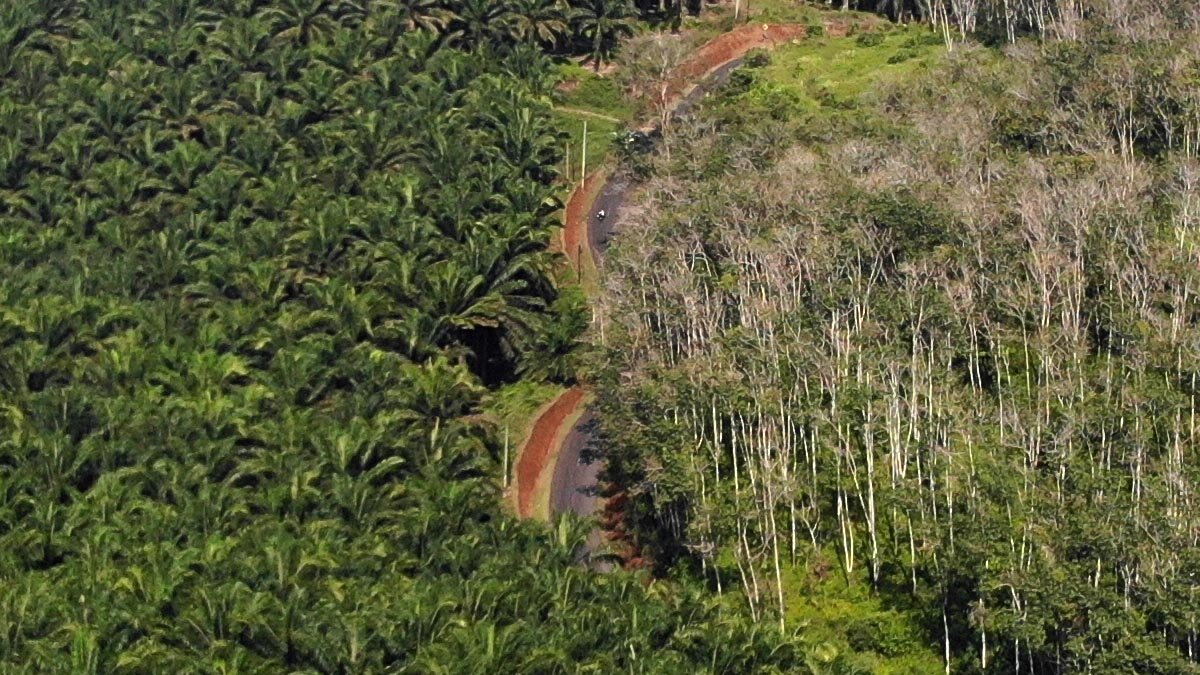
Prof. Yanto also addressed claims that oil palm plantations cause flooding. In practice, he explained, plantations are divided into several management zones: active rows, dead frond rows, and palm circles.
Because active and dead frond rows alternate along planting lines, each roughly represents about half of plantation area.
Citing Selamet (2015), he said infiltration capacity in dead frond rows is very high, reaching 32.13 cm per hour, compared to only 9.42 cm per hour in active rows.
During rainfall, water tends to flow and infiltrate into dead frond rows, significantly reducing surface runoff and standing water inside plantations.
“Therefore, the presence of dead frond rows must be factored into water management in oil palm estates,” he said.
Closing his presentation, Prof. Yanto urged public discourse on palm oil to move beyond black-and-white narratives and toward data-driven and scientifically grounded frameworks.
Deforestation, spatial planning, and palm oil sustainability, he said, must be understood within the broader context of development history, state policy, and on-the-ground management practices.
“If we want to be fair, we must start with accurate definitions, strong evidence, and measurable indicators,” he concluded. (P2)