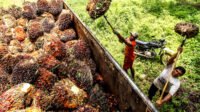
PALMOILMAGAZINE, KAPUAS HULU – The rapid expansion of oil palm plantations in Kapuas Hulu Regency, West Kalimantan, is placing increasing pressure on areas of high ecological and social value. Field findings released by LinkAR Borneo indicate that operations by PT Equator Sumber Rezeki (PT ESR), a subsidiary of First Borneo Group, are allegedly generating serious environmental and social problems, ranging from deforestation and peatland threats to escalating village-level conflicts.
PT ESR holds a Plantation Business Permit (IUP) covering approximately 16,867 hectares in Batang Lupar District. Although administratively classified as Other Land Use Areas (APL), the concession lies within a strategic ecological corridor connecting Betung Kerihun National Park and Danau Sentarum National Park. This corridor plays a critical role as an ecosystem buffer zone, a wildlife movement pathway, and a living space for Indigenous Dayak communities who have relied on forest resources for generations.
“This corridor is not only an ecological space, but also a living space for Indigenous peoples. Forest clearing here risks disrupting wildlife connectivity and narrowing community-managed areas,” the LinkAR Borneo Research Team said in a statement quoted by Palmoilmagazine.com on Wednesday (January 28, 2026).
Monitoring conducted between October and December 2025, the group said, shows PT ESR’s operations are allegedly not only triggering ecological damage, but also deepening social conflicts and neglecting the rights of Indigenous and local communities.
Throughout 2025, deforestation linked to PT ESR was recorded at 973.79 hectares, consisting of 825.063 hectares in Sungai Senunuk Village and 148.72 hectares in Sungai Setulang Village. The land clearing reportedly took place within high conservation value landscapes that function as buffer zones for two major national parks. The operations also reportedly targeted peat ecosystems, which are vital for carbon storage, water regulation, and climate change mitigation.
“Deforestation throughout 2025 shows extremely serious pressure on high conservation value landscapes, especially when clearing targets peatlands and national park buffer zones,” the research team stated.
Also Read: GAPKI and ILO Strengthen Responsible Business and Human Rights Due Diligence in Palm Oil Sector
As of December 2025, total forest loss was said to have reached 2,868.57 hectares, with 1,892 hectares — around 66% — located within orangutan habitat based on Population and Habitat Viability Analysis (PHVA) data. Cumulatively, from 2024 to November 2025, total forest destruction allegedly reached 3,063 hectares — equivalent to nearly 4,400 football fields — with about 65% classified as habitat of the Bornean orangutan (Pongo pygmaeus).
Field investigations also confirmed at least 10 orangutan nests in forest areas of Labian Village, indicating the concession remains an active wildlife habitat. Forest fragmentation is feared to sever ecosystem connectivity and intensify human–wildlife conflict.
“The presence of orangutan nests proves the area is still active habitat. Fragmentation of the corridor will accelerate the biodiversity crisis and increase the risk of conflict between humans and wildlife,” the LinkAR Borneo team emphasized.
Also Read: KPBN Inacom CPO Climbs 1.19% on Wednesday (28/1), Global Vegetable Oil Rally Lifts Market
At the village level, land clearing has reportedly taken place in Sungai Senunuk and Setulang. In Sungai Senunuk, some residents who released individually claimed land reportedly received compensation of around IDR 3.5 million per hectare, while compensation for communal land varied between IDR 11 million and IDR 20 million per household through hamlet heads. This scheme is said to have created information gaps and differing perceptions over land status. In Setulang, cleared areas were reportedly used to establish the Belida Estate as a nursery and early planting site.
Opposition to PT ESR has also emerged in several other villages, including Labian and Labian Ira’ang, driven by concerns over the loss of living space, environmental degradation, and limited consultation. In Mensiau Village, some residents reportedly rejected the project due to its potential impact on forest buffer zones within a licensed social forestry area.
The situation on the ground has also reportedly triggered horizontal conflict in Ngaung Keruh Hamlet. The Dayak Iban Menua Ngaung Keruh Indigenous community, which has been formally recognized through a Regent’s Decree and customary forest designation, highlighted alleged individual claims over communal land accompanied by offers of employment, plasma schemes, and land compensation.
Communities also questioned the weak implementation of the Free, Prior and Informed Consent (FPIC/PADIATAPA) principle. From a legal standpoint, PT ESR is reported to only hold an IUP and has not yet secured a Right-to-Cultivate title (HGU).
“Without proper FPIC and in the absence of an HGU, land clearing activities should be reviewed to prevent worsening conflicts and ecological damage,” the LinkAR Borneo Research Team concluded.
The group has issued several recommendations, including an immediate moratorium on land clearing, permit evaluation, independent environmental and social audits, protection of Indigenous rights, full FPIC implementation, and firm law enforcement. (P2)