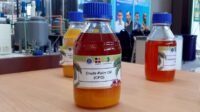

PALMOILMAGAZINE, JAKARTA — Indonesia’s palm oil industry has achieved another significant milestone on the global stage. The International Civil Aviation Organization (ICAO) has officially recognized Palm Oil Mill Effluent (POME), the liquid waste generated from palm oil processing, as an approved feedstock for Sustainable Aviation Fuel (SAF). The decision is documented in the “CORSIA Default Life Cycle Emissions Values for CORSIA Eligible Fuels,” an international reference that guides the development of low-emission aviation fuels.
The endorsement followed a year-long technical evaluation. Two scientific institutions—Hasselt University and the Joint Research Centre (JRC) of the European Commission—conducted full verification of the data and methodologies submitted by Indonesia. Their assessment resulted in a Life Cycle Assessment (LCA) value of 18.1 gCO₂e/MJ for POME, significantly lower than fossil jet fuel. This figure now becomes a default value that SAF producers worldwide can adopt directly.
A Long Path Marked by Indonesian Diplomacy and Scientific Rigor
Indonesia’s effort to secure POME’s recognition as SAF feedstock began in November 2024. The Ministry of Transportation and the Ministry of Foreign Affairs led the initiative, supported by the Indonesia Palm Oil Strategic Studies (IPOSS) and PT Tripatra as the technical partner.
The process was far from simple. It involved extensive field data collection from multiple palm oil mills, drafting technical papers for ICAO’s Working Group 5, and conducting intensive discussions with member states. Indonesia emphasized that POME is a residual by-product with zero Indirect Land Use Change (ILUC) burden, making it fully compliant with sustainability criteria for the HEFA pathway.
Also Read:
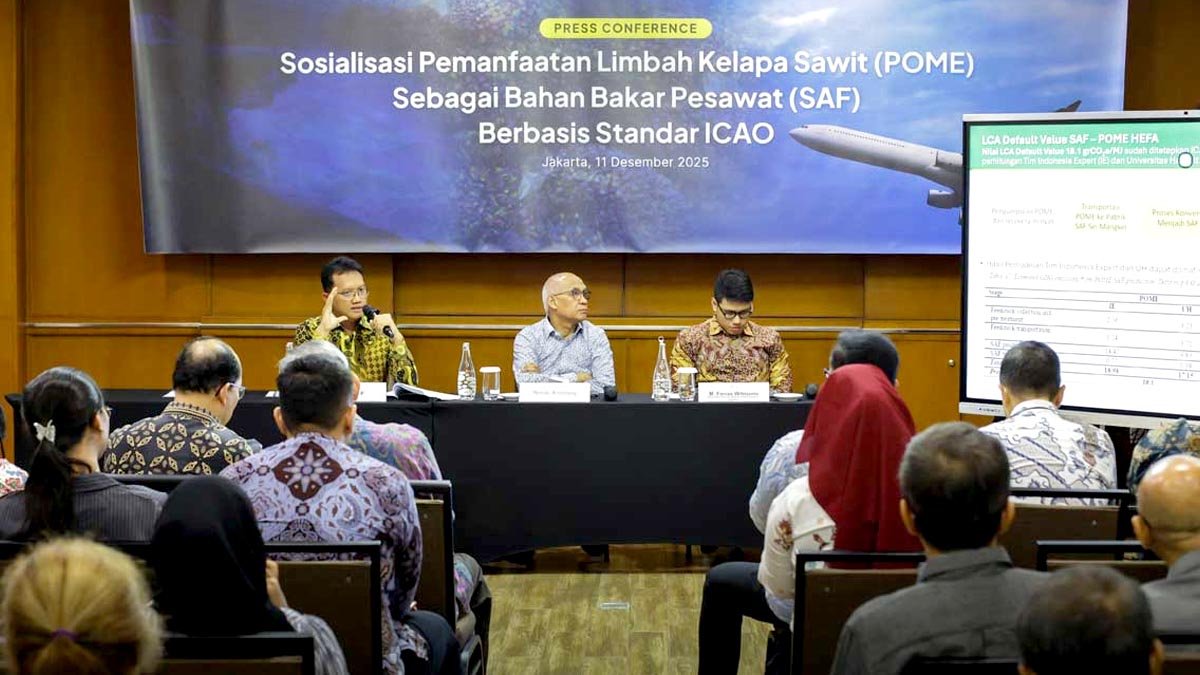
Sokhib Al Rokhman, Director of Airworthiness and Aircraft Operation at the Ministry of Transportation, said the ICAO approval provides a scientific foundation to accelerate Indonesia’s SAF roadmap. “With this default value, emissions calculations become simpler and can be applied directly by producers in Indonesia,” he noted during a press conference attended by Palmoilmagazine.com on Thursday (11/12/2025) in Jakarta.
IPOSS Supervisory Board member Sofyan Djalil called the inclusion of POME in ICAO’s documentation a major breakthrough. “POME has long been viewed merely as waste, and now it is recognized as a viable aviation fuel feedstock that meets sustainability criteria,” he said.
A similar view was shared by Ary Aprianto, Director of Socio-Cultural Affairs and Strategic Partnerships at the Ministry of Foreign Affairs, who stressed that the recognition was the result of strong data harmonization and scientific validation. “POME has undergone methodical evaluation by international institutions and meets all ICAO requirements as SAF feedstock,” he affirmed.
Wendy Aritenang, Indonesia’s representative to the SCSEG–CAEP ICAO, added that the field measurements aligned closely with ICAO’s technical standards. “The LCA range we submitted matched ICAO’s evaluation, enabling POME to be accepted as a certified feedstock.”
PT Tripatra, the lead technical partner, reported that POME measurements across Indonesia fell between 17.5 and 18.8 gCO₂e/MJ, averaging out to the official value of 18.1 gCO₂e/MJ. “This value has been fully verified and reflects actual in-field conditions,” said Tripatra’s Faras Wibisono.
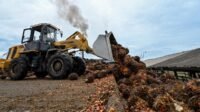
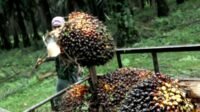
IPOSS also highlighted Indonesia’s vast POME potential. With annual fresh fruit bunch (FFB) production reaching about 250 million tons, POME oil output could reach 2.5 million tons if a 1% recovery rate is achieved.
However, experts underscored that feedstock availability must be supported by robust governance. “A clear traceability system is essential to maintain feedstock quality, including establishing a specific HS code for POME,” said Dimas H.P of IPOSS. (P2)