PALMOILMAGAZINE, JAKARTA — Hopes for justice from Indigenous communities and civil society groups were dashed as Indonesia’s Constitutional Court (MK) rejected a formal judicial review of the Law on Conservation of Biological Natural Resources and Their Ecosystems (UU KSDAHE). The case, filed under No. 132/PUU-XXII/2024, was brought by the Indigenous Peoples Alliance of the Archipelago (AMAN), WALHI, KIARA, and Indigenous representative Mikael Ane from Ngkiong, Manggarai, East Nusa Tenggara.
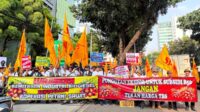
The ruling was met with disappointment and concern among activists, who viewed the Court’s decision as a serious setback for Indigenous rights, particularly in environmental and natural resource legislation.
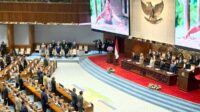
The Court acknowledged that only 4 of the 22 legislative meetings related to the law were open to the public—while key drafting and harmonization meetings remained closed. Despite this, MK deemed the process lawful, citing the availability of meeting minutes. However, court evidence revealed that 20 of these records were not publicly accessible.
Also Read: Palm Oil Company PT Banyu Kahuripan Indonesia Fined IDR 282 Billion for Environmental Damage
Civil society groups challenged this claim, arguing that the lack of transparency significantly hindered meaningful participation—especially from Indigenous communities whose input was largely ignored in the final law.
“Legal but Not Legitimate”
“We respect the Court’s ruling, but we maintain that Indigenous participation in this legislative process was neither full nor meaningful,” said Cindy Julianty, Executive Coordinator of the Working Group ICCAs Indonesia.
She pointed out that inaccessible meeting documents and minimal explanations regarding controversial articles reflected a lack of genuine effort to involve affected communities. “We will continue to monitor the implementation of this law,” she asserted in a statement on Saturday (19 July 2025).
AMAN Secretary General Rukka Sombolinggi echoed this sentiment, calling the ruling a blow to Indigenous-State relations. “This law may be legally valid, but it lacks legitimacy in the eyes of Indigenous peoples,” she said. “Only two of 21 meetings were open. Our voices were dismissed. That’s not a fair process.”
Critics also highlighted inconsistencies in the Court’s reasoning. While rejecting the review, MK simultaneously encouraged lawmakers to utilize digital platforms to increase public participation in the future.
“This sends a mixed message,” said Teo Reffelsen, WALHI’s Legal and Advocacy Manager. “It acknowledges the importance of participation while condoning a closed-door legislative process.”
Similarly, KIARA Secretary General Susan Herawati lamented the ruling as another blow to transparency in environmental lawmaking. “This betrays the hopes of coastal and small island communities who’ve long protected biodiversity. They were never genuinely included,” she said.
Dissenting Opinions Highlight Constitutional Breach
Amid the disappointment, two Constitutional Justices—Suhartoyo and Saldi Isra—issued a dissenting opinion, stating that the closed process violated the principle of openness required under the Constitution.
“Meaningful participation is impossible when laws are drafted behind closed doors,” they wrote, arguing that the process was sufficiently flawed to warrant declaring the law unconstitutional.
Their opinion urged the Court to partially or fully grant the petition. “This is not just a matter of procedure—it’s about whether the State listens to those most affected by its laws,” said Saldi Isra.
The ruling reflects deeper tensions between formal legal compliance and substantive justice and highlights the urgent need for legislative reform in Indonesia.
“The government and parliament must overhaul how laws are drafted—especially those impacting the environment and Indigenous rights. These communities are not passive recipients of policy—they are legal subjects whose voices matter,” said Syamsul Alam Agus, legal counsel for the petitioners. (P2)