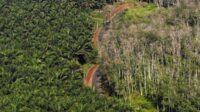
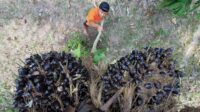
PALMOILMAGAZINE, JAKARTA — The Center for Natural Resources Law Studies and Advocacy (PUSTAKA ALAM) has revealed discrepancies between the claims made by the Forest Area Enforcement Task Force (Satgas PKH) and actual field conditions regarding the government’s palm oil land reacquisition program.
As of October 1, 2025, Satgas PKH claimed to have successfully reclaimed 3.4 million hectares of forest land, with approximately 1.5 million hectares handed over to PT Agrinas Palma Nusantara. However, PUSTAKA ALAM’s findings suggest that these figures do not accurately reflect the on-the-ground reality.
PUSTAKA ALAM Director Muhamad Zainal Arifin, S.H., M.H., pointed to data presented during a working meeting between Commission VI of the Indonesian House of Representatives (DPR RI) and PT Agrinas Palma Nusantara on September 23, 2025, which painted a different picture. Of the 833,413 hectares reportedly transferred to Agrinas during phases I–III, only 61% were actually planted with oil palm, while the remaining 39% consisted of idle or vacant land.
Also Read:
“These findings should serve as a wake-up call for the government to review Satgas PKH’s reports. Not all areas claimed as reclaimed are active palm plantations. In fact, Agrinas itself admitted before the DPR that many of Satgas’s data sets are inaccurate,” Zainal told Palmoilmagazine.com on Thursday (October 16, 2025).
Idle Lands and Data Inaccuracy
PUSTAKA ALAM’s review of the Phase IV land handover from Satgas PKH to PT Agrinas Palma Nusantara found that much of the 674,178 hectares transferred were not productive plantations.
For example, in Central Kalimantan, PT AKL was reported to have transferred 8,696 hectares, yet only 2.33 hectares were planted with oil palm. Similar discrepancies were found for PT KHS (1,357 hectares transferred, 15 hectares planted) and PT ISA (1,156 hectares transferred, 8.89 hectares planted). In Central Sulawesi, PT KSG’s 1,452-hectare claim corresponded to only 8 hectares of oil palm.
Zainal argued that Satgas PKH’s figures do not reflect actual conditions on the ground.
“If such data are presented to the President, it means he is being misled by numbers that do not mirror reality. Many of the so-called reclaimed lands are actually scrubland, wetlands, or even areas with high conservation value (HCV),” he asserted.
Between Statistics and Reality
According to PUSTAKA ALAM, the data gap suggests two possible explanations. First, a portion of the lands claimed by Satgas PKH may not be active plantations. Under Article 110B(1) of the Omnibus Law, violations apply only to converted land uses. This means that idle or unplanted lands cannot legally be used as the basis for reclamation, and administrative sanctions should only apply to active business operations.
Second, there may be signs of data inflation to meet Satgas performance targets. In several meeting records, PUSTAKA ALAM found cases where companies were reportedly asked to relinquish lands that were not theirs—violating the nemo plus juris principle, which states that one cannot transfer rights to property they do not own.
“The state should set an example in upholding this legal principle, not undermine it for the sake of statistical achievements,” Zainal added.
He also highlighted that several of the reclaimed areas were still under valid land-use permits (HGU) officially issued by the National Land Agency (BPN).
“As long as the HGU remains valid, the state cannot simply seize certified land. This mirrors the 1959 Bremen Tobacco Case, where Indonesia was sued for asset expropriation without compensation,” he explained.
Implications for National Policy
PUSTAKA ALAM warned that Satgas PKH’s inaccurate data could have serious implications for public policy and national economic calculations. One concern involves administrative fines imposed on companies—some of which have been charged based on inflated land area figures rather than actual violations.
Ironically, other agencies that use more accurate figures could be accused of “reducing potential state revenue” or even face corruption allegations.
“We are in an absurd situation where Satgas data are treated as the only truth. Agencies using factual data are instead accused of wrongdoing,” Zainal said.
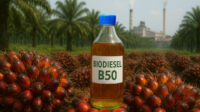
He emphasized that overstated data could distort national policy directions, including CPO production targets, B50 biodiesel programs, and the calculation of state assets and non-tax revenues (PNBP).
“The government must be cautious. Decisions based on flawed data risk leading to policy mismanagement. Therefore, Satgas PKH’s data and performance must be thoroughly evaluated to ensure that forest governance is fair, transparent, and genuinely effective—not merely a performance showcase,” Zainal concluded. (P2)