PALMOILMAGAZINE, BOGOR — The government’s plan to seize millions of hectares of problematic oil palm plantations in 2026 has drawn renewed scrutiny from civil society groups, with Sawit Watch urging greater transparency, worker protection, and a stronger commitment to environmental restoration.
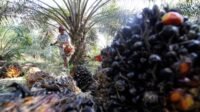
President Prabowo Subianto recently stated that the state is targeting the seizure of an additional 4 to 5 million hectares of oil palm land deemed to be in violation of regulations. The plan follows action by the Forest Area Control Task Force (Satgas PKH), which in 2025 took over control of around 4 million hectares.
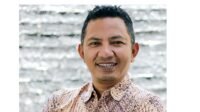
Responding to the announcement, Achmad Surambo, Executive Director of Sawit Watch, questioned the data underpinning the new targets.
“We are paying serious attention to the President’s statement, especially regarding the data being used as a reference,” Surambo told Palmoilmagazine.com on Friday (9 January 2026). “Previous government data indicated around 3.3 million hectares of oil palm plantations were located within forest areas and in violation of regulations. If the 2026 seizure target reaches 4 to 5 million hectares, then where is this new figure coming from?”
He called on the government to publicly disclose the list of corporations included in the enforcement drive. Without transparency, he warned, the seizure process risks becoming a closed-door negotiation space and could wrongly target smallholder plantations, which should instead be addressed through agrarian reform mechanisms.
Beyond data transparency, Sawit Watch also highlighted the lack of a clear ecological recovery agenda following the seizures. Although millions of hectares have already been taken over by the state, environmental restoration has yet to become a central focus. This is despite ecosystem recovery being one of Satgas PKH’s core mandates, alongside the collection of administrative fines and the reclamation of forest areas.
Also Read: West Papua Tightens Rules: Indigenous Approval Mandatory for Any Oil Palm Forest Release
“Enforcement must not stop at transferring assets from private companies to state-owned enterprises,” Surambo stressed. “Seized land located in protected or conservation forests must be restored. Maintaining oil palm monoculture on such land only perpetuates environmental damage under a different banner.”
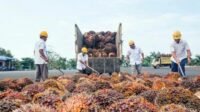
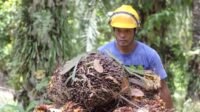
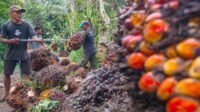
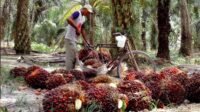
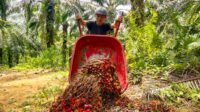
Labor issues are also a growing concern. Behind the millions of hectares seized are hundreds of thousands of plantation workers whose livelihoods are directly affected. Transitions in management from private firms to state-owned enterprises have often been accompanied by problems related to wages, employment status, and access to social security.
“The state must ensure that asset seizures do not strip workers of their rights,” Surambo said. “Many problematic plantations rely on casual laborers and women workers without formal contracts. The government should set an example as a responsible employer by guaranteeing employment status, social security coverage, and proper protective equipment.”
Also Read: Papua Shifts Former Palm Oil Areas to Cocoa, Governor Reaffirms No New Palm Permits
Sawit Watch has also received reports of rising tensions on the ground following the transfer of seized land to PT Agrinas Palma Nusantara. Without thorough verification of overlaps with customary territories or smallholder plots, the handover process risks fueling new agrarian conflicts.
For this reason, Surambo urged the government to halt security- or military-style approaches in safeguarding seized land. He emphasized the importance of applying the Free, Prior, and Informed Consent (FPIC) principle so that state management of seized plantations leads to fair solutions, including possible redistribution to local communities.
“Fundamentally, we support the President’s efforts to close revenue leakages in the palm oil sector,” he concluded. “But rescuing state finances must not come at the expense of workers’ rights, the marginalization of indigenous communities, or the neglect of environmental recovery.” (P2)