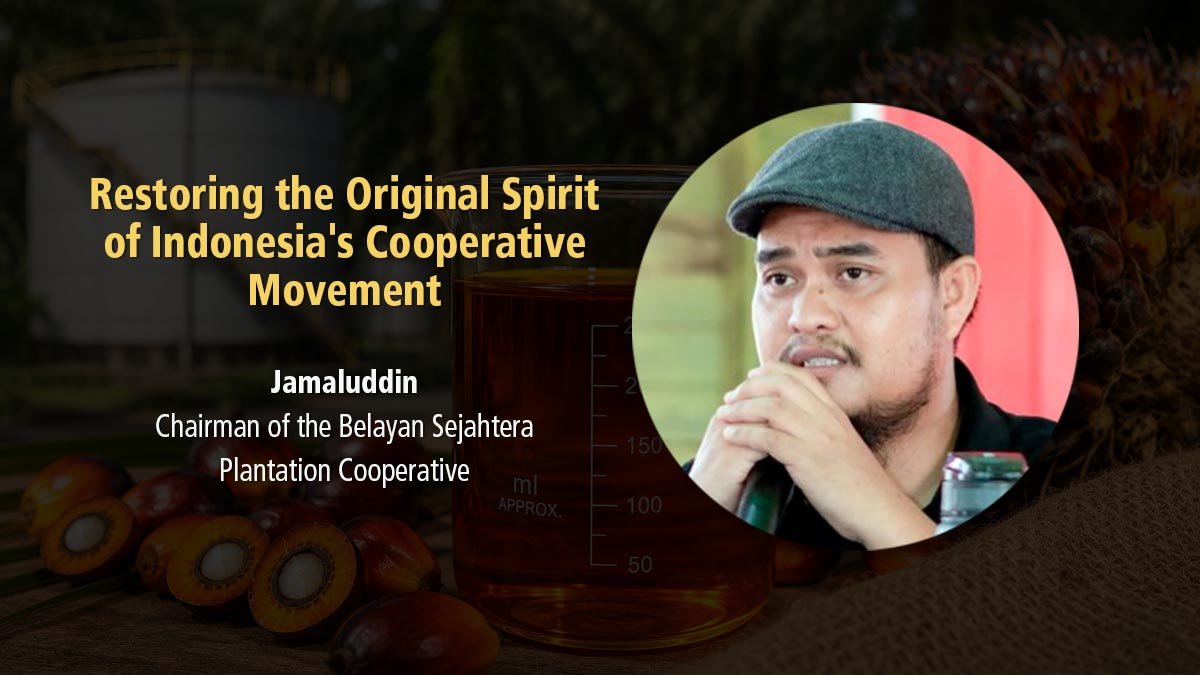
A Message to Cooperative Members and Leaders Across Indonesia
Criticism of government policy and corporate practices should not distract the cooperative movement from its own responsibilities.
No cooperative becomes strong simply because it enjoys favourable public policy or government protection. Its greatest source of strength has always been—and will always remain—its members.
Members are not customers.
They are owners.
This distinction carries important obligations. Members should understand the financial condition of their cooperative, read annual reports, participate actively in general meetings, elect capable leaders, and monitor how collective assets are managed.
It is not enough for members to demand better prices, easier access to credit, improved services, or larger patronage dividends. They must also contribute to safeguarding the institution itself.
A cooperative begins to lose its identity when members participate only at the moment benefits are distributed while remaining absent from its governance.
At the same time, limited member participation should never become an excuse for weak transparency.
Cooperative leaders must respond to declining engagement through education, communication, and openness—not by concentrating decision-making in the hands of a few.
As cooperatives grow larger and more sophisticated, so too does their responsibility to explain their business performance, investment decisions, contractual arrangements, operational risks, and use of surplus revenues to the membership.
The annual general meeting should never become a ceremonial exercise designed merely to approve reports that have already been decided elsewhere.
It is the highest governing authority within a cooperative.
If strategic decisions are effectively made in advance by management or the board while members are expected only to ratify them, the cooperative may continue to exist legally, but its economic democracy has already been weakened.
Cooperative leaders throughout Indonesia must also embrace a higher standard of professionalism.
Modern cooperatives require accurate accounting systems, competent management, measurable business objectives, effective risk management, and skilled employees capable of operating increasingly complex organizations.
Professionalism, however, should not be confused with adopting the values of investor-owned corporations.
Private companies primarily exist to maximize returns for shareholders.
Cooperatives exist to expand the economic capabilities of their members.
That difference should be reflected in everyday business decisions.
An agricultural input unit should not encourage farmers to purchase as many products as possible merely to increase sales. Instead, it should help members use fertilizers, seeds, and other inputs efficiently to improve productivity while reducing unnecessary costs.
Similarly, a cooperative lending unit should not profit from members’ financial hardship. Its purpose is to strengthen productive economic activity, provide affordable capital, and prevent members from falling into cycles of unsustainable debt.
A cooperative-owned retail store should not seek to eliminate neighbourhood shops through aggressive competition. Rather, it should strengthen local distribution networks and reinforce the broader village economy.
The same principles apply to the management of cooperative assets.
Heavy equipment, transport vehicles, financing programmes, and commercial opportunities must never be allocated according to personal relationships or political influence. They should be governed by transparent rules that are clearly understood, fairly implemented, and open to member oversight.
Ironically, the greatest risks often emerge when a cooperative becomes successful.
As assets expand, leaders gain influence, professional managers accumulate specialized knowledge, and ordinary members may become increasingly content to remain passive beneficiaries rather than active owners.
At that point, a cooperative may continue to belong to its members in legal terms while, in practice, control becomes concentrated among a small group of individuals.
This is precisely the outcome the cooperative movement was created to prevent.
A cooperative does not belong to its chairperson, its board, or its management.
Leadership is a public trust.
It is a responsibility to steward collective economic power—not a privilege to control it.
Rethinking the State’s Role: A Policy Agenda for Strengthening Cooperatives
The solution is not for the government to withdraw its support for cooperatives.
Rather, it is to reconsider how and where that support should be directed.
Success should no longer be measured primarily by the number of cooperatives registered or the quantity of legal entities established. Those indicators reveal little about whether a cooperative is economically viable, democratically governed, or capable of improving the welfare of its members.
Instead, policymakers should begin by identifying cooperatives that are already functioning effectively—those with active memberships, productive enterprises, established markets, and sound governance—and provide targeted support to strengthen them further. Cooperatives that remain weak should receive institutional assistance to improve their performance, while new cooperatives should be established only where genuine community demand clearly exists.
Public support should also reflect the different stages of cooperative development.
Newly established cooperatives require organizational education, leadership development, business planning, and assessments of local economic potential. Cooperatives that have already developed viable markets need access to working capital, appropriate technologies, management training, and stronger commercial capabilities. More mature organizations require investment that enables them to expand into processing industries, value-added production, and downstream markets.
A differentiated approach would produce far more sustainable outcomes than applying a single institutional model to every village regardless of its economic conditions.
For independent oil palm smallholder cooperatives, one priority deserves particular attention: Indonesian Sustainable Palm Oil (ISPO) certification.
The government cannot continue establishing increasingly demanding sustainability standards while expecting farmers alone to finance compliance.
Land legalization, plantation mapping, internal control systems, certification audits, technical assistance, and capacity building should all become integral components of public support. These investments should not be viewed merely as regulatory costs but as long-term investments in Indonesia’s competitiveness, environmental governance, and rural development.
Supporting ISPO implementation would strengthen not only compliance but also farmers’ ability to participate more effectively in domestic and international markets.
Equally important is the state’s responsibility to ensure that partnerships between cooperatives and private companies operate on fair and balanced terms.
If the government is not yet in a position to help farmer cooperatives establish their own processing facilities or participate directly in downstream industries, it should at least ensure that independent smallholders are not left negotiating alone within supply chains dominated by much larger corporate actors.
Partnerships should extend beyond simple purchasing agreements.
They should distribute both opportunities and responsibilities more equitably.
Companies that benefit from sustainably produced palm oil should also contribute to the costs of maintaining sustainability. They should support farmer organizations in meeting certification requirements, invest in long-term commercial relationships, and share responsibility for improving governance throughout the supply chain.
Government’s role is therefore not confined to issuing regulations.
Its most important responsibility is to create conditions under which unequal economic actors can negotiate on more balanced terms.
A truly enabling state does not replace cooperatives or control them.
Nor does it leave farmers to navigate increasingly complex markets without support.
Instead, it provides the institutional foundations that allow cooperative enterprises to become stronger, more competitive, and more democratic.
Ultimately, the future of Indonesia’s cooperative movement depends not on the number of organizations created through administrative programmes, but on the capacity of existing cooperatives to evolve into resilient economic institutions capable of generating lasting prosperity for their members.