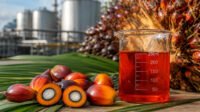


PALMOILMAGAZINE, JAKARTA – Indonesia’s trade balance remained in surplus in April 2026, extending a remarkable streak of positive trade performance that has continued uninterrupted for 72 consecutive months since May 2020. Despite a relatively modest monthly surplus, palm oil and its derivative products once again emerged as the country’s largest foreign exchange earner, playing a critical role in supporting national trade performance.
Minister of Trade, Budi Santoso, reported that Indonesia recorded a trade surplus of US$90 million in April 2026. The achievement was supported by a non-oil and gas surplus of US$3.53 billion, which offset a US$3.44 billion deficit in the oil and gas sector.
On a cumulative basis, Indonesia posted a trade surplus of US$5.64 billion during January–April 2026, driven by a US$14.16 billion non-oil and gas surplus despite an oil and gas deficit of US$8.52 billion.
Although still positive, the surplus was lower than the US$11.07 billion recorded during the same period last year, reflecting changing global market dynamics and commodity price movements.
Palm Oil Remains the Largest Contributor
According to data from the Ministry of Trade, the category of animal and vegetable fats and oils (HS 15)—dominated by palm oil and downstream palm-based products—generated the largest trade surplus among all commodity groups during the first four months of 2026, reaching US$11.71 billion.
The contribution significantly exceeded that of mineral fuels (HS 27), which generated a surplus of US$8.34 billion, and iron and steel (HS 72), which contributed US$5.71 billion.
Also Read: KPBN CPO Price Jumps 1.15% as Malaysian Futures Continue Uptrend
Meanwhile, Indonesia’s largest trade deficits were recorded in machinery and mechanical equipment (HS 84) at US$9.87 billion, followed by electrical machinery and equipment (HS 85) at US$4.95 billion, and plastics and plastic products (HS 39) at US$2.80 billion.
From a country perspective, the United States remained Indonesia’s largest source of non-oil trade surplus, contributing US$6.81 billion, followed by India with US$4.44 billion and the Philippines with US$2.77 billion. Conversely, Indonesia continued to post its largest trade deficit with China, amounting to US$8.03 billion.
Budi Santoso noted that the government continues to strengthen export market diversification strategies while accelerating downstream industrial development to reduce dependence on global commodity price fluctuations.
Also Read: Indonesia’s palm oil export reform risks leaving sustainability outside the gate
Palm Oil Exports Surge Nearly 39%
Indonesia’s total exports reached US$25.30 billion in April 2026, increasing 12.32% month-on-month and 21.98% year-on-year.
The strong performance was largely supported by non-oil and gas exports, which rose 13.66% from March, while oil and gas exports declined 9.81% during the same period.
Among the strongest-performing export categories was animal and vegetable fats and oils (HS 15), which recorded a substantial 38.71% monthly increase. Other major gainers included coffee, tea, and spices (+54.44%), tobacco products (+43.49%), wood and wood products (+40.91%), and machinery and mechanical equipment (+37.26%).
Demand from several export destinations also surged. Imports of Indonesian products by the United Arab Emirates jumped 305.21% compared to the previous month, while exports to South Africa rose 288.40% and exports to Belgium increased 117.84%.
Manufacturing Sector Drives Export Growth
During January–April 2026, Indonesia’s total exports reached US$92.15 billion, representing an increase of 5.48% compared to the same period in 2025.
Non-oil and gas exports grew 6.28% to US$87.74 billion, while oil and gas exports contracted 8.30% to US$4.41 billion.
The Trade Minister attributed much of the export growth to the manufacturing sector, which expanded 9.78% year-on-year. Key products posting strong growth included nickel and nickel products (+63.99%), aluminum and aluminum products (+55.30%), organic chemicals (+30.86%), copper products (+25.34%), and tin products (+24.62%).
According to the minister, rising global demand combined with stronger international commodity prices helped boost the export performance of Indonesia’s manufacturing industries.
In contrast, exports from the agricultural sector declined 26.27%, while mining and other sectors fell 8.44% compared to the same period last year.
Also Read: Indonesia Customs Ready to Enforce New Export Controls for Palm Oil, Coal, and Ferroalloys
Africa and Middle East Offer New Growth Opportunities
Several non-traditional export markets delivered impressive growth during the first four months of 2026. Exports to Egypt increased 42.74%, followed by Spain (+33.18%), South Africa (+23.13%), Hong Kong (+21.31%), and China (+20.58%).
In addition, countries in Central Asia, including Uzbekistan, Tajikistan, and Turkmenistan, as well as markets across North Africa and Southern Africa, recorded growing demand for Indonesian products.
Also Read: Indonesia and EU Fast-Track IEU-CEPA Ratification, Target Early 2027 Implementation
The expanding demand from these regions presents significant opportunities for Indonesia’s export-oriented industries, including the palm oil sector, to diversify market access, strengthen global competitiveness, and reinforce Indonesia’s position as one of the world’s leading commodity exporters. (P2)