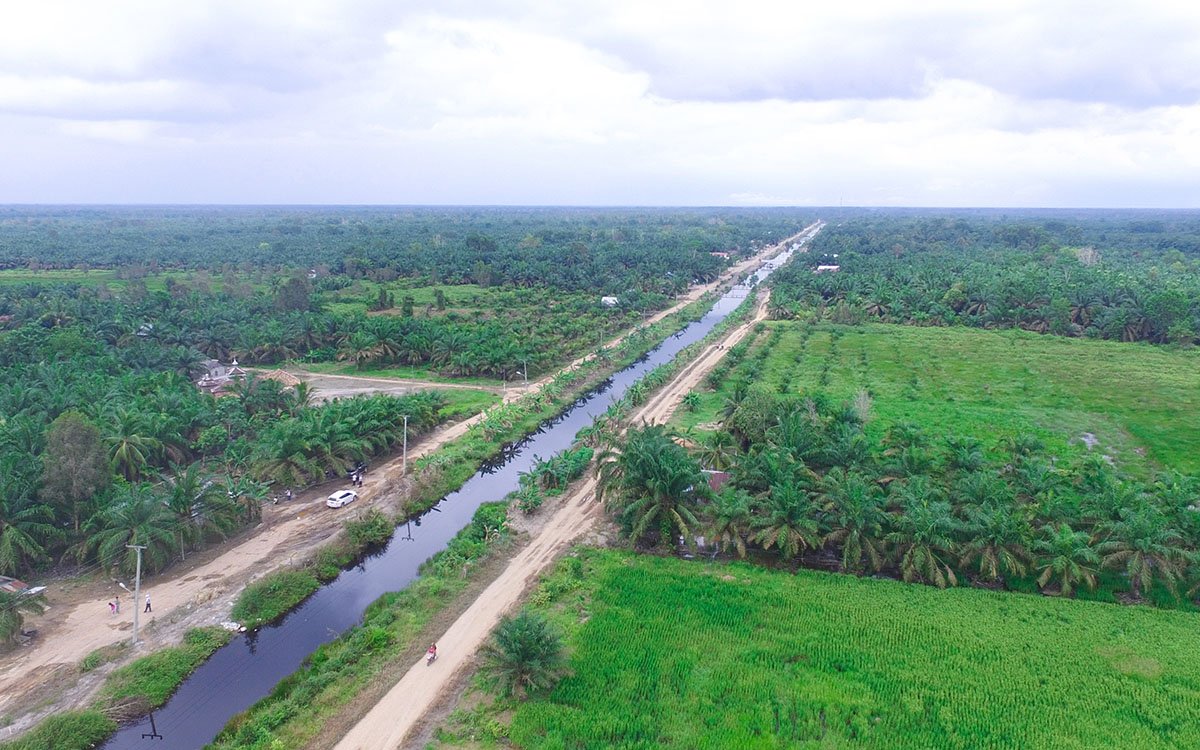
PALMOILMAGAZINE, JAKARTA – Indonesia’s Meteorology, Climatology, and Geophysics Agency (BMKG) has projected that most of the country’s key oil palm-growing regions will experience low to moderate rainfall between August and October 2026, raising concerns over water availability for plantations during the peak dry season. The outlook is largely influenced by the ongoing El Niño phenomenon, which continues to suppress rainfall across many of Indonesia’s agricultural areas.
According to BMKG’s Climate Information Bulletin for Oil Palm Plantations, Indonesia—accounting for approximately 57% of global palm oil production—remains highly dependent on favorable weather conditions. Oil palm productivity is closely tied to rainfall distribution and adequate soil moisture throughout the growing cycle.
As one of Indonesia’s most strategic agricultural commodities, oil palm (Elaeis guineensis) produces both Crude Palm Oil (CPO) and Palm Kernel Oil (PKO). Beyond its significant contribution to export earnings, the sector supports millions of jobs and plays a vital role in rural economies across Sumatra, Kalimantan, Sulawesi, and Papua.
Also Read: BMKG Warns of Potential Drought in Key Palm Oil Regions as Moderate Rainfall Dominates Indonesia
El Niño Persists Despite Warm Indonesian Seas
BMKG’s June 2026 climate observations indicate that the Indian Ocean Dipole (IOD) remains in a neutral phase, with a Dipole Mode Index (DMI) of -0.38. However, sea surface temperature anomalies in the Niño 3.4 region reached +1.56°C, confirming that El Niño conditions remain active.
Meanwhile, sea surface temperatures around Indonesia continue to be relatively warm, particularly across the southern Indian Ocean off Java, the Timor Sea, Makassar Strait, Sulawesi Sea, Banda Sea, Arafura Sea, and waters north of Papua. Although these warmer waters continue supplying atmospheric moisture, BMKG noted that they have not been sufficient to offset El Niño’s drying effect on rainfall formation.
Also Read: Can Indonesia’s Oil Palm Residues Power the Future of Aviation?
Most Palm Oil Regions Expected to Receive Low Rainfall
BMKG forecasts that low rainfall will dominate much of Indonesia throughout August and September, before conditions gradually improve in October.
In August 2026, approximately 71.55% of Indonesia is expected to receive low rainfall, while 28.31% will experience moderate rainfall. Only 0.14% of the country is projected to receive high to very high rainfall.
Conditions are expected to become even drier in September, when low-rainfall areas could expand to 77.46% of the country. Moderate rainfall is projected to cover 21.26%, while only 1.28% of regions may experience high rainfall.
Also Read: Indonesia Develops 83 Superior Palm Oil Varieties to Boost Productivity and Climate Resilience
By October, rainfall distribution is expected to become more balanced, with 52.33% of Indonesia forecast to receive moderate rainfall, 42.20% low rainfall, and 5.47% potentially experiencing high to very high rainfall.
Across Indonesia’s palm oil-producing regions, rainfall during the August–October period is generally expected to remain within the low-to-moderate category, highlighting the importance of water conservation and effective plantation management.
Also Read: ASEAN’s Young Leaders Demand Justice at the Heart of Climate Action
Rainfall Likely to Stay Below Normal
In addition to reduced rainfall totals, BMKG expects rainfall during the August–October period to remain below the long-term climatological average across most of Indonesia.
Approximately 86.08% of the country is forecast to experience below-normal rainfall in August, increasing to 87.61% in September before easing slightly to 81.24% in October.
Within the country’s major palm oil belt, below-normal rainfall is anticipated across parts of Aceh, southern Riau, Jambi, West Kalimantan, Central Kalimantan, East Kalimantan, and South Kalimantan.
Also Read: Science-Driven Collaboration Urged to Address Climate-Linked Disasters in Sumatra
Soil Moisture Remains Adequate but Is Beginning to Decline
BMKG’s June 2026 assessment indicates that soil moisture levels across much of Indonesia remain generally adequate, with soil water content exceeding 60% in many areas.
However, several regions have already shifted into the moderate category, where soil moisture has fallen below 60%, including parts of Sumatra, Java, Kalimantan, Sulawesi, Bali, Nusa Tenggara, Maluku, and Papua.
Some locations have also entered the low soil moisture category, with water availability dropping below 40% due to rainfall deficits exceeding evapotranspiration.
Also Read: KPBN CPO Tender Withdraws at IDR 15,768/Kg, Malaysia Palm Oil Futures Reach 15-Week High
Most palm-growing areas in Aceh, Riau, Jambi, West Kalimantan, Central Kalimantan, East Kalimantan, and South Kalimantan still maintain adequate soil moisture. Nevertheless, BMKG identified several districts—including Pelalawan, Kuantan Singingi, Indragiri Hulu, East Kutai, Kutai Kartanegara, Banjar, Barito Kuala, and parts of Aceh—where soil moisture has already declined to moderate or low levels.
Given the forecast, BMKG urged plantation companies and independent smallholders to strengthen drought preparedness by improving water management systems, conserving soil moisture, and closely monitoring climate developments throughout the dry season. These preventive measures are considered essential to sustaining palm oil productivity through the remainder of 2026. (P2)