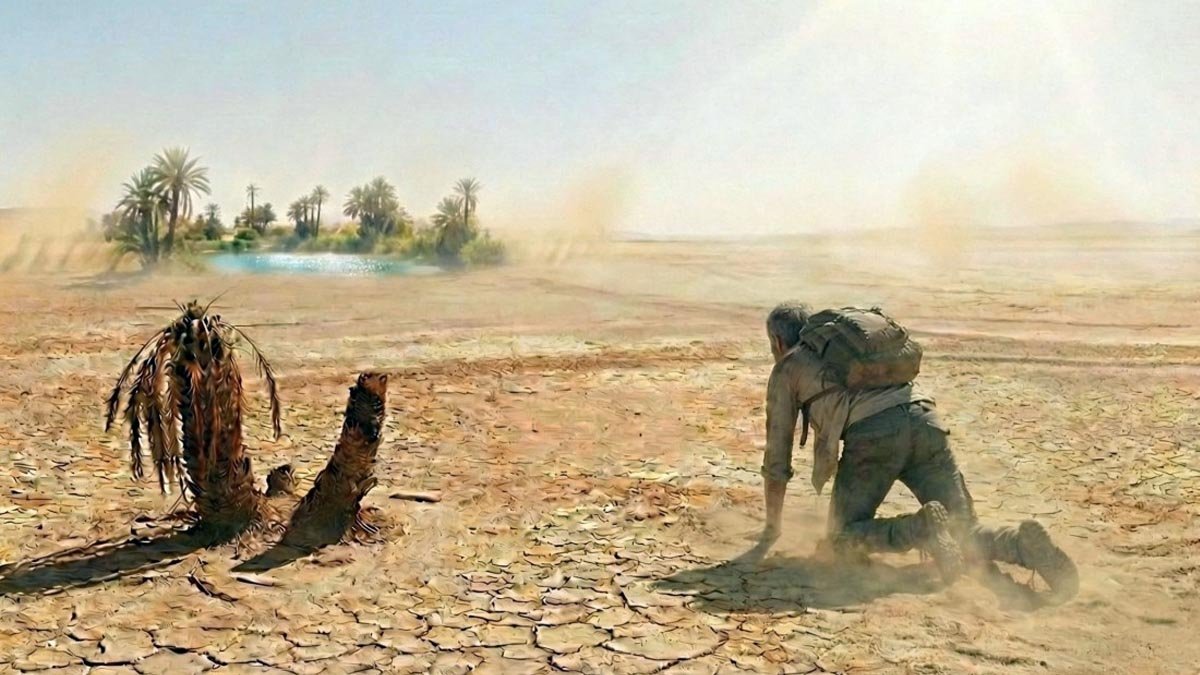
PALMOILMAGAZINE, JAKARTA — Imagine being stranded in the desert. Your mouth is dry, your head light, your steps unsteady. Then, in the distance, you see water, palm trees, a pool, shade. You walk toward it, faster now, certain that relief is near. But as you approach, it dissolves. It was a fatamorgana, a mirage so convincing it looks real, yet never materializes. For many producing countries, local communities, and even regulators, this is what “sustainable palm oil” increasingly feels like.
A promise that always stays just out of reach
For years, sustainability in palm oil has been presented as an achievable destination. Follow the rules. Meet the criteria. Pass the audit. Tick the boxes. The industry, we are told, can grow while protecting forests, respecting people, and complying with the law.
The promise is seductive because it suggests that complexity can be managed through procedures. That deep political and ecological problems can be solved through technical systems. That the market, if given the right tools, will regulate itself.
And yet, when you walk closer, when you leave conference halls and dashboards and look at the ground itself, the promise often fades. Deforestation still occurs. Land conflicts remain unresolved for years. Plantations continue to operate in legally contested areas.
Also Read: Indonesia Allocates 15.6 Million Kiloliters of Biodiesel for 2026, B40 Mandate Moves Forward
Smallholders struggle to survive while being asked to comply with ever more detailed requirements. The oasis looks real: from far away.
When sustainability becomes a narrative, not an outcome
Sustainability frameworks have undoubtedly changed behavior. Some practices improved. Some fires were prevented. Some forests were spared. These gains should not be dismissed. But over time, sustainability also became something else: a narrative of reassurance.
Reassurance for consumers anxious about environmental damage.
Reassurance for investors managing reputational risk.
Reassurance for governments that prefer technical fixes over structural reform.
Also Read: RSPO–FONAP Reciprocal Membership Marks New Phase of Sustainable Palm Oil Collaboration in Europe
The danger of narratives is not that they are false, but that they can become self-contained. Success is measured by compliance with the system, not by what actually happens beyond it. When sustainability is judged by paperwork rather than lived reality, the mirage strengthens.
The problem sustainability could not absorb
The most uncomfortable moments arrive when sustainability meets power. Recent years have shown that even in sectors wrapped in sustainability language, basic governance failures persist. Corruption cases linked to market access. Court decisions questioned and reversed. Large-scale enforcement actions revealing plantations operating in areas they should never have entered.
These are not side issues. They strike at the core of what sustainability claims to represent.
Also Read: Minister Amran: Pupuk Kaltim Revamp Boosts Efficiency by 16%, Strengthens Indonesia’s Food Security
You cannot meaningfully speak of sustainability where legality itself is unresolved. You cannot audit your way around weak rule of law. You cannot label away structural incentives that reward expansion, rent-seeking, or silence.
Yet sustainability systems were often asked to do exactly that: to compensate for governance gaps they were never designed to fix.
When the market changes the rules
Now, the global market is shifting again. Major consuming regions are no longer satisfied with assurances. They demand proof. Coordinates. Evidence. Legal clarity down to the plot of land. The burden of risk is pushed ever further upstream, toward producers and farmers who had little role in designing the original systems.
This moment is revealing. It suggests an implicit admission that earlier approaches were not enough. That voluntary mechanisms soothed concerns but did not eliminate them. That the oasis many believed in was, at least in part, an optical effect.
For those on the ground, the message feels contradictory: first, “Follow these systems.” then, “These systems are insufficient.” The traveler keeps walking, still thirsty.
The quiet cost of the mirage
The greatest cost of a fatamorgana is not disappointment. It is delay. As long as the oasis appears reachable, people keep moving toward it. They do not look for other routes. They do not question the map. They invest time, money, and trust into a direction that may never deliver water.
In palm oil, this delay has consequences. Forests continue to shrink at the margins. Conflicts harden as communities wait for resolution that never comes. Smallholders are asked to meet standards without being given the security needed to do so.
Meanwhile, the story of sustainability remains intact, polished, repeated, and exported.
A harder question we avoid asking
None of this means sustainability should be abandoned. That would be reckless. But it does mean the conversation needs to mature. Sustainability cannot remain a substitute for governance. It cannot be reduced to a label that absorbs contradictions. It cannot continue pretending that technical systems alone can correct political realities.
So the question is no longer whether palm oil can be sustainable in theory. The question is more uncomfortable and more honest: Is sustainable palm oil, as it is practiced today, a real destination? Or is it a fatamorgana, convincing from a distance, comforting to believe in, but structurally unable to quench the thirst it promises to satisfy?
If the answer is the latter, then the task ahead is not to polish the mirage but to finally change the terrain that creates it. (*)
Author: Dr. M. Windrawan Inantha, Doctor in Sustainable Development Management
Strategic Advisor for Sustainable Development. CECT Sustainability, Universitas Trisakti.
Disclaimer: This article reflects the personal views of the author and is solely his responsibility.