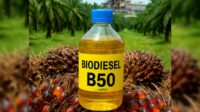

PALMOILMAGAZINE, JAKARTA — Indonesia’s plan to raise its biodiesel blending mandate to B50 should not be assessed solely in terms of energy security. The government must also consider its potential implications for state revenue, palm oil export performance and environmental sustainability, an economist and public policy expert has said.
The warning was delivered by Achmad Nur Hidayat, an economist and public policy expert at UPN Veteran Jakarta, during the 22nd Indonesian Palm Oil Conference (IPOC) 2026 and 2027 Price Outlook in Bali on Thursday (Nov. 12, 2026).
Achmad said the expansion of the biodiesel programme could have far-reaching consequences across several interconnected sectors. He urged the government to avoid a fragmented policy approach that focuses primarily on meeting energy security targets without adequately assessing the broader economic and environmental implications.
Also Read: Indonesia Prepares B50 Biodiesel Framework as Infrastructure and Financing Take Centre Stage
One key issue is the potential impact on exports. If demand for palm oil as biodiesel feedstock increases while production remains relatively unchanged, supplies available for overseas markets could come under pressure.
Achmad cited a potential 10% reduction in exports as one scenario that warrants further examination. He questioned which sectors would ultimately bear the cost if the government proceeded with the policy without adjusting its broader approach.
He also highlighted the risk of El Niño affecting oil palm production. Adverse weather conditions could influence fresh fruit bunch (FFB) availability and, in turn, the supply of crude palm oil (CPO) for biodiesel production. Biodiesel planning, he said, should therefore account for possible fluctuations in plantation output.
Also Read: DSI to Launch Palm Oil Export System on January 1, 2027, with Single-Digit Dollar Service Fee
Achmad argued that discussions on the B50 policy should involve a wider range of government ministries and industry stakeholders, rather than being led solely by the Ministry of Energy and Mineral Resources (ESDM). The policy’s implications extend beyond the energy sector to include trade, public finances, plantations and the environment.
He called for a comprehensive policy framework that balances three key considerations: energy security, fiscal sustainability, and social and environmental protection.
On the plantation side, rising demand for palm oil as biodiesel feedstock must also be considered alongside production strategies and land-use policies. Continued growth in feedstock requirements could create pressure to expand plantation areas if productivity improvements and existing supply are insufficient.
Also Read: Oil World: Global Palm Oil Exports to Fall by Up to 3.5 Million Tons in 2027 as Prices Rise
The government, Achmad said, needs to ensure that efforts to strengthen energy security do not create additional environmental challenges. Palm oil and biodiesel policies should be designed to balance competing interests and account for their wider consequences.
He therefore urged the government to conduct a thorough impact assessment before implementing the policy. Taking preventive measures in advance, he said, would be preferable to responding only after problems emerge.
Ultimately, the success of Indonesia’s biodiesel programme should not be measured solely by the increase in its energy mix. Its ability to maintain export performance, manage fiscal costs, protect social interests and safeguard environmental sustainability should also form part of the assessment of the country’s palm oil policy. (P2)