
The RSPO Annual Roundtable 2026 brought together global stakeholders to address Indonesia’s forest fires, strengthen market confidence in sustainable palm oil exports, and expand independent smallholder access to international buyers.
PALMOILMAGAZINE, JAKARTA — The Roundtable on Sustainable Palm Oil (RSPO) Annual Conference 2026 brought together global stakeholders to mobilize concrete action towards a more sustainable palm oil industry, reaffirming the organization’s commitment to delivering measurable environmental and social progress amid shifting geopolitical conditions and evolving global market dynamics.
Three major issues featured prominently at the conference: Indonesia’s forest and land fire crisis, the country’s planned Single Export Gate mechanism, and the inclusion of independent smallholders in global sustainable palm oil supply chains.
Also Read: RSPO Upholds Accountability while Addressing Indonesia’s Fire Crisis at RT2026
Indonesia’s Fire Crisis: RSPO-Certified Concessions Record Lower Fire Impact
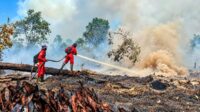
The RSPO’s flagship conference took place during a challenging period for Indonesia. Amid one of the strongest El Niño events in history, forest and land fires affected more than 1.9 million hectares across the country between January and September 2026, according to satellite analysis by Nusantara Atlas.
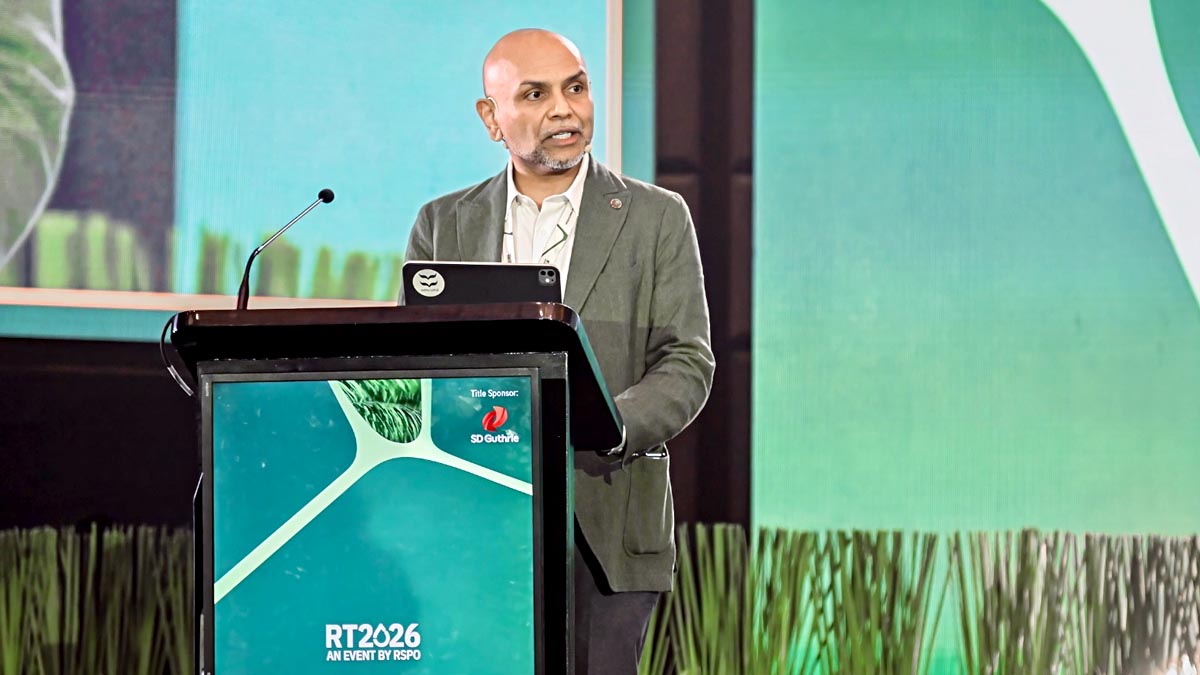
In his keynote address, RSPO Chief Executive Officer (CEO) Joseph D’Cruz responded to public criticism of the palm oil sector while recognizing the efforts of RSPO members working on the front lines to contain fires in Sumatra and Kalimantan.
Also Read: RSPO Strengthens Fire Monitoring in Indonesia with Satellite Data and Independent Audits
“We are not an industry that hides from public scrutiny. We are a partnership that holds ourselves to higher standards of monitoring than any external party monitoring us,” D’Cruz said.
Presenting preliminary satellite monitoring data from Nusantara Atlas covering January–September 2026, Dr. David Gaveau, founder of TheTreeMap, reported that approximately 14,500 hectares of land within RSPO-certified concessions had been burned or affected by fires.
“When we examine fires within RSPO-certified concession areas and cross-check the data with RSPO, we find 14,500 hectares of land burned or affected by fires within these concessions. This represents approximately 0.8% of the total 1.9 million hectares burned across Indonesia in 2026,” Gaveau explained.
Also Read: RSPO Says Most Indonesia Land Fires in 2026 Occurred Outside Palm Oil Concessions
D’Cruz added that RSPO would investigate any concession showing an unusual pattern of fire incidents. He also noted that the analysis had identified no burned areas within land belonging to RSPO-certified independent smallholders.
“To date, there is no data or evidence indicating that RSPO-certified units have deliberately started fires,” he said.
D’Cruz also urged RSPO members to communicate more actively using available data, facts and evidence to demonstrate the industry’s progress and accountability.
Also Read: Belayan Sejahtera Cooperative Mobilises Independent Smallholders to Prevent and Fight Forest Fires
“We must all demonstrate our willingness to defend what we have built. When we remain silent, we allow the worst actors to define our industry, undermine two decades of hard work, and allow a system supporting millions of livelihoods to be dismissed by those who have never truly understood it,” he said.
Connecting Independent Smallholders with Global Buyers
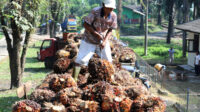
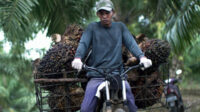
Rural livelihoods are particularly evident among smallholders, who account for nearly half of Indonesia’s total palm oil production. Indonesia is also home to 77% of the world’s RSPO-certified independent smallholders.
At RT2026, the organization recognized 45 newly certified independent smallholder groups from Colombia, Indonesia, Malaysia, Peru and Thailand that had successfully completed their initial RSPO certification.
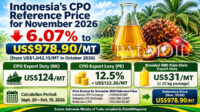
Also Read: Indonesia Cuts November 2026 CPO Reference Price 6.07% to US$978.90/MT, Sets Export Duty at US$124
The conference also hosted the RSPO Independent Smallholder Business Matching event, connecting prospective credit buyers with independent smallholders from different parts of the world.
RSPO recognized leading corporate members for their tangible support of independent smallholders through purchases of RSPO Credits between November 2025 and September 2026. The recognized companies included Kao Corporation, Nestlé S.A. and Unilever PLC.
The organization also acknowledged first-time major buyers, including Lakeland Dairies Co-operative Society Limited and Pitak Palm Oil Company Limited.
The initiative highlights the importance of linking independent smallholder certification with commercial opportunities, enabling producers to participate more effectively in global sustainable palm oil markets.

Indonesia’s Single Export Gateway and Its Implications for Sustainable Palm Oil
Indonesia’s Single Export Gate initiative represents one of the most significant developments in the country’s palm oil sector, with the potential to reshape its position in global commodity export markets.
In 2026, Danantara Indonesia, the government’s investment management agency, established PT Danantara Sumberdaya Indonesia (DSI) to oversee and manage exports of strategic commodities.
Also Read: DSI Strengthens Indonesia’s Strategic Commodity Export Ecosystem Through Pilot Platform
During a Special Dialogue at RT2026, DSI Chief Executive Officer Luke Mahony discussed how the new export framework could complement sustainable palm oil initiatives and strengthen international market confidence.
“We welcome this dialogue with RSPO because sustainability and market access must go hand in hand. DSI’s mandate is clear: we are here to facilitate, not obstruct. Our role is to uphold industry standards, simplify regulatory compliance and strengthen global confidence in Indonesian palm oil,” Mahony said.
DSI aims to improve transparency and credibility in Indonesia’s commodity markets by leveraging existing ecosystem data and integrating it with market realities. These include sustainability considerations from the RSPO perspective, as well as supply, pricing and production information.
Also Read: Zero Tolerance For Fires: RSPO Reinforces Strict Zero-Burning Standards
Under DSI’s intermediary model, scheduled for launch in January 2027, buyers and sellers will retain their existing business relationships, while DSI will work to safeguard export continuity and maintain supply chain traceability.
The initiative is expected to create a framework in which export governance, sustainability standards and international market access can operate alongside one another, supporting Indonesia’s efforts to strengthen the global competitiveness of its palm oil industry. (P3)