
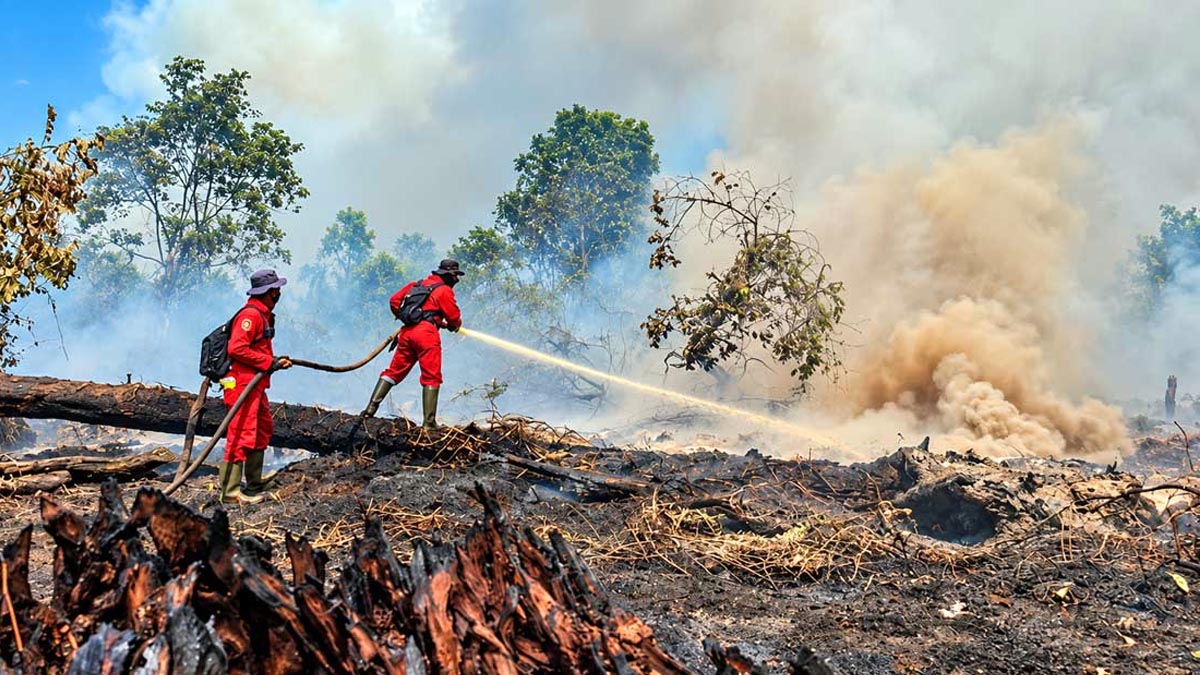
Effective wildfire prevention in South Sumatra requires more than firefighting, with peatland water management, spatial governance, stronger oversight and shared accountability emerging as key priorities.
PALMOILMAGAZINE, PALEMBANG — Forest and land fires in South Sumatra cannot be addressed effectively through firefighting alone once flames have already spread. Strengthening spatial governance, restoring peatland hydrology, improving monitoring and ensuring accountability across stakeholders are critical to reducing the risk of recurring fires.
South Sumatra palm oil observer H. Rudi Arpian, M.Si., said fire management should focus on addressing the underlying causes rather than relying primarily on indicators such as the number of hotspots, burned area or firefighting capacity.
Also Read: PTPN IV PalmCo Steps Up Kalimantan Fire Response With Water, Masks and 594 Safety Units
South Sumatra encompasses a diverse landscape used for oil palm and rubber plantations, forests, agriculture, mining and peatlands. Such complexity requires transparent land governance, particularly in clarifying permits, boundaries and community land rights.
Rudi said overlapping land claims and weak oversight could complicate both fire prevention and the determination of responsibility when fires occur. Environmental compliance and permits in high-risk areas therefore need to be assessed objectively and based on reliable data.
He also cautioned against attributing fires to a single commodity.
“Fire management should assess land-use governance, land-clearing practices, peatland management and compliance with environmental regulations,” Rudi said.
Peatland Water Management Is Critical to Fire Prevention
One of the major challenges facing South Sumatra is the extensive peatland landscape, particularly in Ogan Komering Ilir (OKI), Banyuasin and Musi Banyuasin districts.
Peat becomes highly vulnerable to fire when prolonged dry conditions or uncontrolled drainage reduce moisture levels. Fires can also spread through organic material beneath the surface, making them difficult to detect and extinguish completely.
As a result, aerial firefighting and surface water spraying may not always be sufficient. Fire crews must ensure that underground sources of combustion have been fully extinguished to prevent fires from reigniting.
Rudi said greater emphasis should therefore be placed on prevention through effective water management.
Monitoring groundwater levels, maintaining canal blocks and providing reservoirs, pumps and reliable water sources should form part of preparedness measures in fire-prone peatland areas.
Also Read: GAPKI Strengthens Forest and Land Fire Prevention, Expands Monitoring Around Palm Oil Concessions
For plantation companies operating on peatlands, responsibility should also extend beyond individual plantation boundaries and take into account the broader hydrological conditions of the surrounding landscape.
Fire Prevention Must Continue Year-Round
Rudi said preparedness should not begin only when the dry season approaches.
Risk mapping, field inspections, firefighting infrastructure and interagency coordination should be prepared during the rainy season, allowing authorities and stakeholders to address vulnerabilities before fire risks intensify.
Also Read: Indonesian Smallholders Step Up Fire Patrols as Land Fires Spread
Provincial and district governments, forestry agencies, regional disaster management agencies (BPBD), Manggala Agni, law enforcement agencies, universities, communities and plantation companies all have a role to play in establishing an integrated prevention system.
Satellite-detected hotspots should also be verified on the ground.
A hotspot is an early indication requiring further investigation, Rudi said, and should not automatically be treated as definitive evidence that a fire has occurred or that a particular party is responsible.
Also Read: RSPO Calls for Coordinated Response to Indonesia Fires to Protect Communities and Wildlife
Community participation is another important component of fire prevention. Villagers living around forests, peatlands and plantations can help identify environmental changes and detect smoke or potential fires at an early stage.
To strengthen this role, governments should provide communities with training, equipment and effective reporting channels.
Oil palm smallholders also need assistance in adopting zero-burning land management practices, ensuring that fire-prevention policies can be implemented effectively at the field level.
Also Read: North Sumatra FFB Prices Reach IDR 3,744.09/kg as CPO Reference Price Tops IDR 15,111
Law Enforcement and Environmental Compliance
Rudi said addressing forest and land fires requires coordination across jurisdictions because fires and smoke pollution can extend beyond village, district and concession boundaries.
He called for risk-based evaluations of permits and environmental compliance, peatland hydrological restoration, year-round firefighting preparedness and greater transparency regarding fire incidents and enforcement actions.
Also Read: Jambi FFB Price Rises to IDR 3,679.34/kg for Oct. 23–29, 2026
Law enforcement, he added, should be conducted fairly and based on evidence, without distinguishing between smallholders and large-scale businesses.
The effectiveness of fire-prevention policies should also be measured through tangible indicators, including reductions in burned areas, improved peat moisture levels, stronger community preparedness and lower exposure to smoke pollution.
Rudi stressed that preventing forest and land fires should not be framed as being in conflict with oil palm development.
Also Read: PTPN IV PalmCo Targets 759,000 Tons of CPO Exports in 2027, Expands Asian Markets
Instead, responsible land governance is essential to ensuring that economic activities can continue while protecting the environment and public safety.
“Every year, we should not only focus on putting out fires, but also on fixing the causes behind them,” Rudi said, emphasizing the need for stronger spatial governance and year-round fire prevention in South Sumatra. (P2)