

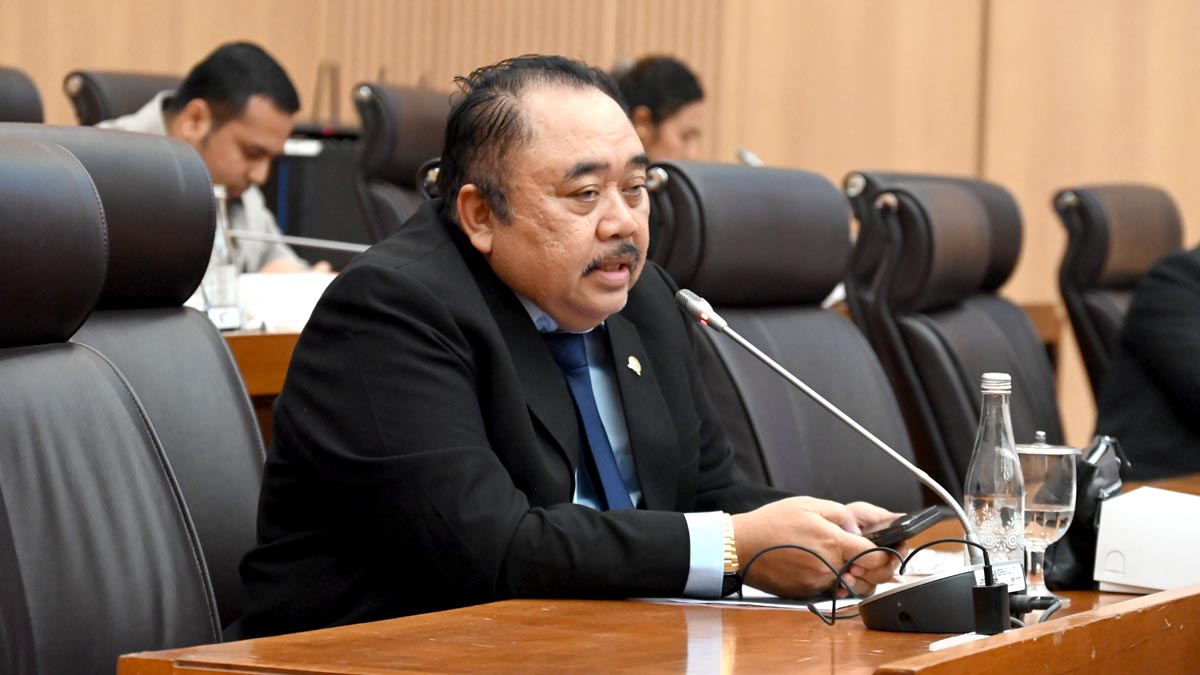
PKS lawmaker urges the government to strengthen BPDP governance, rebalance funding priorities and accelerate enforcement of legally binding environmental rulings worth an estimated IDR 6.1 trillion.
PALMOILMAGAZINE, JAKARTA — Governance of Indonesia’s palm oil plantation fund has come under renewed scrutiny, with a lawmaker urging the government to review fund disbursements while accelerating enforcement of final court rulings related to forest and land fires, or karhutla.
Ateng Sutisna, a member of House of Representatives Commission XII from the Prosperous Justice Party (PKS), said public financing for the palm oil industry must go hand in hand with stronger environmental law enforcement.
Also Read: Indonesian Lawmaker Urges Palm Oil to Become a Major Source of Energy
The government, he said, must ensure that plantation funds deliver tangible benefits to the industry and smallholders while also ensuring that environmental restoration obligations ordered by the courts are effectively implemented.
“The state must be able to explain how tens of trillions of rupiah can be disbursed to support the industry while environmental obligations ordered by the courts still face obstacles. Fund disbursement must be accompanied by firm action to enforce accountability,” Ateng said, according to the PKS faction’s website on Wednesday (Oct. 28, 2026).
Biodiesel, Smallholder Replanting Funding Under Review
Ateng also highlighted the expansion of the mandate of the Palm Oil Plantation Fund Management Agency (BPDPKS) into the Plantation Fund Management Agency, or Badan Pengelola Dana Perkebunan (BPDP), under Presidential Regulation No. 132 of 2024.
The broader mandate, he said, requires stronger transparency, accountability and a clear focus on benefits for smallholders and environmental sustainability.
Also Read: Indonesia’s GAPPKES MIKEMINO Urges Greater Smallholder Role in National Biodiesel Supply Chain
One area that warrants review is the composition of fund utilization, particularly the scale of biodiesel financing compared with programs that directly support smallholder plantations.
According to the BPDPKS 2024 Performance Report, biodiesel financing payments reached IDR 28.81 trillion. Meanwhile, cumulative disbursements under the Smallholder Palm Oil Replanting Program, or Peremajaan Sawit Rakyat (PSR), reached IDR 12.87 trillion through the end of 2025, benefiting around 180,000 smallholders.
Ateng acknowledged the strategic role of biodiesel in strengthening Indonesia’s energy security, but said the scale of biodiesel financing should not become the sole measure of the success of plantation fund management.
“Biodiesel is important for energy security, but the success of palm oil policy cannot be measured only by the size of financing disbursements,” he said.
He called for an evaluation of fund effectiveness to ensure that benefits are distributed more proportionately, including through stronger PSR implementation and greater support for sustainable plantation practices.
IDR 6.1 Trillion in Karhutla Rulings Require Follow-Through
Beyond funding priorities, Ateng called on the government to accelerate enforcement of civil karhutla rulings that have obtained permanent legal force.
Citing Greenpeace’s compilation of cases through 2024, he said 18 civil karhutla rulings had become legally binding, with a combined value of around IDR 6.1 trillion.
Also Read: Is Palm Industry The Real Culprit Behind Forest and Land Fires?
The figure, however, does not necessarily represent the total outstanding obligations because some payments have already been made.
Ateng therefore urged the government to publish updated information on the outstanding obligations of each party found liable, payments already received by the state and the status of environmental restoration.
“Ministries must not stop after winning a lawsuit. The public needs to know whether the ruling has been executed, how much has been paid and whether the environment has been restored,” he said.
Also Read: South Sumatra Forest Fires Require Peatland Governance, Not Just Firefighting
Greater transparency, he said, would allow the public to assess whether court rulings are translating into meaningful environmental enforcement and restoration.
Ateng also stressed that collection of court-ordered obligations must follow applicable legal provisions while respecting the rights of third parties and the principles governing corporate liability.
Government Urged to Set 30-Day and 90-Day Targets
To accelerate implementation, Ateng proposed a timetable with measurable targets that can be monitored by the public.
Within 30 days, the government should publish a list of karhutla cases that have obtained permanent legal force, the parties found liable, the value of their obligations, payments received by the state, the status of environmental restoration and obstacles to enforcement.
Also Read: KPBN Inacom CPO Price Rises to IDR 15,100/kg on Oct. 28 as Rotterdam CPO Falls
Within 90 days, the government should report progress on asset tracing and enforcement measures in accordance with applicable procedural law, he said.
Ateng also proposed stronger coordination among ministries and agencies, including BPDP, the Ministry of Finance, the Ministry of Energy and Mineral Resources (ESDM), the Ministry of Environment/Environmental Control Agency (BPLH), and the Ministry of Forestry.
Such coordination would help establish an integrated system matching plantation fund beneficiaries with records of environmental compliance, administrative sanctions and relevant court rulings.
Also Read: Malaysia CPO Falls to RM4,687 on Oct. 28 as Rotterdam Drops US$20, KPBN Rises to IDR 15,100
An integrated monitoring system, he said, would enable the government to assess whether financial support is being provided to eligible parties while strengthening traceability across the palm oil supply chain.
He also called for plantation fund governance audits to cover environmental compliance among beneficiaries, raw material traceability, contributions to karhutla prevention, peatland restoration and support for smallholder replanting.
“The polluter-pays principle must be visible through the enforcement stage. The state must not move quickly when providing support to industry but slowly when collecting obligations for environmental damage. Government firmness must work in both directions: supporting compliant businesses while ensuring environmental obligations are fulfilled,” Ateng said.
The review of plantation fund management and faster enforcement of karhutla rulings, he added, should form part of broader efforts to strengthen governance of Indonesia’s palm oil industry.
Such measures would allow support for the industry’s competitiveness to advance alongside environmental protection, legal certainty and improved welfare for smallholders. (P2)