
PALMOILMAGAZINE, JAKARTA – Crude palm oil (CPO) futures on Bursa Malaysia Derivatives extended their downward trend on Wednesday (Nov. 18, 2026), falling more than 1% for a second consecutive trading session amid mounting pressure from global vegetable oil markets and concerns over export demand.
Market sentiment remained subdued due to several factors, including elevated palm oil inventories, declining prices of competing vegetable oils and limited signs of improvement in export demand.
According to Reuters, the most actively traded February 2027 CPO futures contract on Bursa Malaysia Derivatives Exchange settled at RM4,387 per tonne, down RM49, or approximately 1.1%, from the previous session. The closing price was equivalent to US$1,064.29 per tonne.
Also Read: KPBN Inacom CPO Price Falls to IDR 14,190/kg on Wednesday (Nov. 18), Rotterdam Market Weakens
Export performance also contributed to market concerns. Cargo surveyors estimated that Malaysian palm oil product shipments during Nov. 1–15, 2026, declined by approximately 1% to 3.9% compared with the corresponding period in the previous month.
The weaker shipment estimates reinforced concerns over near-term palm oil demand, particularly as inventories remained elevated.
Competing Vegetable Oil Prices Extend Market Pressure
The downward trend was not confined to palm oil, as other major vegetable oil markets also recorded losses, adding to the pressure on CPO futures.
On the Dalian Commodity Exchange, the most actively traded soybean oil contract fell 1.56%, while its palm oil contract declined more sharply by 3.02%.
Also Read: Indonesia-EU Trade Deal Could Boost Indonesian Palm Oil Access to European Market
Meanwhile, soybean oil futures on the Chicago Board of Trade (CBOT) dropped 1.58%.
The simultaneous declines across major vegetable oil markets suggest that the pressure on CPO extends beyond palm oil-specific fundamentals, reflecting broader weakness across the global edible oil sector.
In the energy market, crude oil prices also weakened following data indicating an increase in US crude oil and fuel inventories.
Also Read: MPOB Says Malaysia’s CPO Supply Remains Stable as El Niño Risks Build
However, losses in global oil prices were partly limited by geopolitical tensions between the United States and Iran, including attacks on vessels in the Strait of Hormuz.
Lower crude oil prices can reduce the relative attractiveness of palm oil as a biodiesel feedstock, as fossil fuel prices are among the factors influencing the competitiveness of vegetable oil-based bioenergy.
KPBN Inacom CPO Price Falls by IDR 300/kg
Weakness in international markets was also reflected in Indonesia’s domestic CPO trading through the tender mechanism operated by PT Kharisma Pemasaran Bersama Nusantara (KPBN) Inacom.
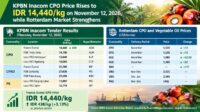
On Wednesday (Nov. 18, 2026), the highest CPO bid recorded by KPBN Inacom stood at IDR 14,190 per kg, down IDR 300 per kg, or approximately 2.07%, from the previous trading session on Tuesday (Nov. 17), when the reported price reached IDR 14,490 per kg.
Also Read: Indonesia Strengthens Fertilizer and Seed Industries to Sustain Food Self-Sufficiency
At Franco Belawan, the tender opened at IDR 14,300 per kg but ended in withdrawal (WD), with the highest bid reaching IDR 14,190 per kg.
A similar outcome occurred at Franco Dumai, where the opening price was IDR 14,300 per kg. The tender also ended in withdrawal, with the highest bid recorded at IDR 14,188 per kg.
Meanwhile, the FOB Talang Duku tender opened at IDR 14,050 per kg and ended in withdrawal, with the highest bid reaching IDR 13,883 per kg.
Also Read: Indonesia’s B50 Biodiesel Plan Faces Export, Fiscal and Environmental Risks, Expert Warns
The decline in KPBN Inacom’s tender bids reflects the pressure continuing to weigh on Indonesia’s domestic CPO market, in line with weaker palm oil prices on international exchanges.
Market participants will continue monitoring Malaysian export performance, movements in competing vegetable oil prices and developments in global energy markets as key factors shaping the direction of CPO prices in upcoming trading sessions. (P3)