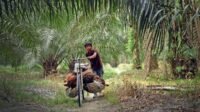
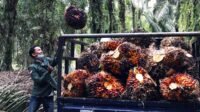
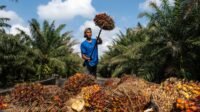
PALMOILMAGAZINE, KUTAI KARTANEGARA — Stepanus, an independent palm oil farmer from Long Beleh Modang Village, Kembang Janggut District, East Kalimantan, is facing a painful reality. On June 19, 2025, he received a formal letter from PT Rencana Mulia Baratama (RMB)—a coal mining company—demanding that he vacate the 5.26 hectares of land he has cultivated and cared for over the past twelve years.
The company claims that the land in question lies within its Forest Area Use Permit (IPPKH), referencing a permit issued by the Ministry of Forestry under Decree No. SK.130/Menhut-II/2013. PT RMB stated it intends to commence land clearing operations in the area soon.
Adding to the pressure, the company erected a large banner in the middle of Stepanus’ oil palm plantation, warning that occupying and managing land without permission in a designated forest area is a criminal offense under Indonesia’s Forestry Law No. 41 of 1999.
But for Stepanus, this land represents more than soil and trees—it’s his livelihood and life’s work.
“I’ve managed this land since 2004. First I planted rice, then oil palm in 2013. I cleared it myself, planted it myself, took care of it myself. I was never told this was company land or state forest. Now I’m just being told to leave through a letter and a banner? It doesn’t feel fair,” he told Palmoilmagazine.com on Monday (June 30, 2025).
Jamaluddin, Chairman of the Belayan Palm Farmers Forum (FPSB), condemned PT RMB’s approach. He criticized the company’s decision to issue an ultimatum without prior consultation, calling it a form of intimidation.
“This is not just a legal issue. It’s about fundamental human rights—the right to land, to livelihood, and to be heard. Issuing a letter and putting up a banner without dialogue is a unilateral and dehumanizing act,” Jamaluddin said.
He emphasized that farmers like Stepanus should not be equated with illegal encroachers.
“Stepanus has roots here. He’s not a newcomer exploiting land randomly—he’s a local resident whose life depends on this land. The government and companies must act with fairness and humanity,” he added.
Jamaluddin also referred to the United Nations Declaration on the Rights of Peasants and Other People Working in Rural Areas (UNDROP), which protects farmers from forced eviction and defends their right to land. He urged PT RMB to follow the UN Guiding Principles on Business and Human Rights (UNGPs), which call on companies to uphold human rights in all operations—even when they hold official permits.
FPSB is now calling on the local government, particularly the Forestry Agency and the Regent of Kutai Kartanegara, to intervene and mediate the dispute. They insist on creating a dialogue between the company and the farmers to find a mutually respectful solution.
“Mediation is crucial—not just to resolve this case, but to prevent future conflicts of the same kind,” Jamaluddin stated.
Stepanus’ case reopens a broader and long-standing issue in East Kalimantan: What happens to the thousands of smallholder farmers cultivating land that lacks formal legal certification? Many of these farmers live in legal limbo—working on land deemed illegal by the state, but which has been their only source of income for decades.
This conflict reveals the urgent need for land tenure clarity and policies that recognize and protect smallholder farmers, ensuring they are not the silent victims of development and corporate expansion.
Reported by: Jamal / East Kalimantan