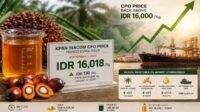
PALMOILMAGAZINE, JAKARTA — Indonesia’s crude palm oil (CPO) prices recorded a modest increase on Thursday (April 23, 2026), moving against the broader global trend where prices came under pressure.
Data from PT Kharisma Pemasaran Bersama Nusantara (KPBN) showed the highest CPO price was set at IDR 15,488/kg, up IDR 76/kg or about 0.49% compared to the previous day’s level of IDR 15,412/kg.
For Franco Dumai delivery, prices were also set at IDR 15,488/kg. Meanwhile, Loco Parindu opened at IDR 15,138/kg but ended in a withdrawal (WD), with the highest bid reaching IDR 14,963/kg.
Also Read: Earth Day 2026 Forum Challenges “Palm Oil Harms Environment” Narrative with Scientific Evidence
In contrast, global CPO trading on Bursa Malaysia Derivatives closed lower after posting gains for three consecutive sessions. The decline was driven by profit-taking, compounded by weaker palm olein prices in the Dalian market.
According to a report by Reuters, the benchmark July 2026 CPO contract fell by RM49 per ton, or about 1.06%, to RM4,579 per ton, equivalent to approximately US$1,155.44 per ton at the close.
Across other vegetable oil markets, the most active soyoil contract in Dalian edged up by around 0.09%, while its palm oil contract slipped by 0.05%. Meanwhile, soybean oil prices on the Chicago Board of Trade declined by about 0.2%.
Also Read: Indonesia Accelerates Palm Oil Downstreaming While Planning Major Plantation Expansion
CPO price movements remain closely tied to the broader vegetable oil complex, as palm oil competes directly with soybean oil and other edible oils in the global market. As a result, shifts in competing oils often serve as key drivers of price direction.
On the domestic front, market participants are also monitoring Indonesia’s biodiesel policy. The government plans to raise the mandatory palm-based biodiesel blend from 40% (B40) to 50% (B50) starting July 1, 2026. This move is expected to boost domestic CPO consumption and provide underlying support to prices.
Overall, the CPO market is currently navigating mixed signals, with external pressures weighing on prices while domestic policy support offers a potential upside to demand. (P2)