PALMOILMAGAZINE, JAKARTA – Global crude palm oil (CPO) prices traded in a narrow range on Thursday (April 16, 2026), as weak demand from key importing countries and expectations of rising global output continued to weigh on the market.
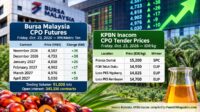
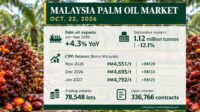
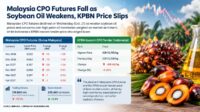
According to Reuters, the benchmark CPO futures contract for July 2026 delivery on Bursa Malaysia Derivatives slipped slightly by RM2 per ton, or about 0.04%, to RM4,495 per ton.
Market pressure was also evident from the export side. Cargo survey data showed Malaysia’s palm oil product exports for the April 1–15 period declined sharply, falling between 34.2% and 34.7% compared to the previous period. The drop signals softer global demand in the near term.
Also Read: India Cuts Palm Oil Imports by 19% in March as Buyers Hold Back Amid Price Surge
On the currency front, the Malaysian ringgit weakened marginally by 0.05% against the U.S. dollar on the day. However, on a weekly basis, the currency still posted a gain of around 0.20%, influencing the competitiveness of Malaysian CPO in international markets.
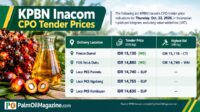
In Indonesia’s domestic market, CPO prices offered through PT Karisma Pemasaran Bersama Nusantara (KPBN) were recorded as withdrawn (WD), with the highest bid at Rp 15,167 per kilogram. This marked a decline of Rp 55 per kilogram, or about 0.36%, from Wednesday’s (April 15, 2026) level of Rp 15,222 per kilogram.
Despite prevailing pressures, supportive sentiment emerged from the energy market. Global crude oil prices rebounded after earlier declines, driven by uncertainty surrounding ongoing peace talks between United States and Iran, which could impact global energy supply.
Higher crude oil prices tend to support CPO, as the commodity serves as a key feedstock for biodiesel, making it more attractive when fossil fuel prices rise.
Across other vegetable oil markets, prices showed an upward trend. The most active soyoil contract on the Dalian exchange rose 0.57%, while palm oil futures gained 0.32%. Meanwhile, soyoil prices on the Chicago Board of Trade increased by 0.82%.
The combination of weak demand, currency fluctuations, and support from the energy market has kept CPO prices largely range-bound. Market participants are now awaiting stronger signals from both demand and supply sides to determine the next price direction. (P3)