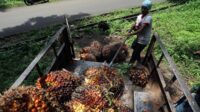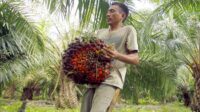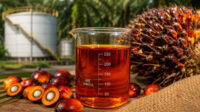
PALMOILMAGAZINE, JAKARTA – The Indonesian government has moved quickly to address recent volatility in fresh fruit bunch (FFB) prices for palm oil, which has affected several regions across the country. Deputy Minister of Agriculture Sudaryono stressed that the government would not allow prolonged uncertainty surrounding the new export policy to negatively impact smallholders or the national palm oil industry.
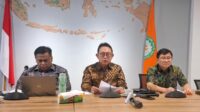
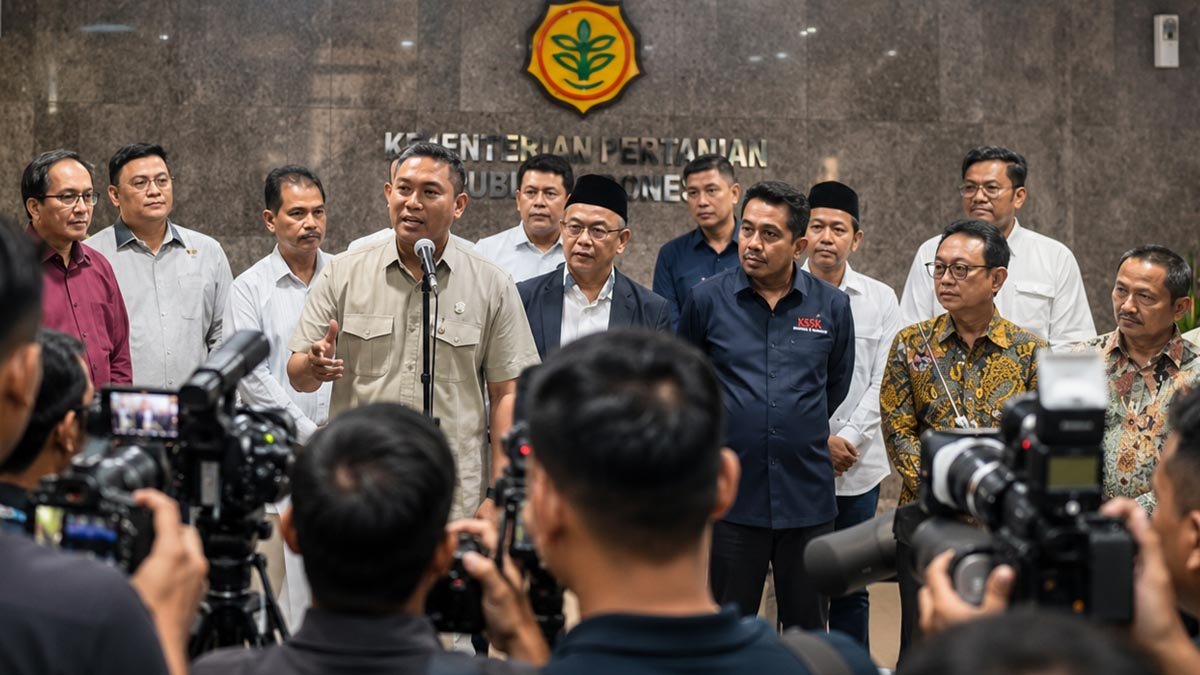
The swift response was demonstrated through a coordination meeting held at the Ministry of Agriculture on Tuesday (26/5/2026), involving the Gabungan Pengusaha Kelapa Sawit Indonesia (GAPKI), palm oil farmer associations, and the National Police Food Task Force.
The meeting was convened following growing concerns among businesses and market participants over the implementation of Indonesia’s one-stop natural resource export policy through PT Danantara Sumber Daya Indonesia (DSI), which had contributed to lower FFB purchasing prices at the farmer level.
Also Read: KPBN CPO Tender Remains Withdrawn on Monday (May 25), Highest Bid at IDR 12,333/kg
During the meeting, the government, industry players, farmer associations, and other stakeholders agreed on several strategic measures aimed at stabilizing FFB prices and ensuring a smooth implementation of the new export framework. At least five key points were highlighted during the discussions.
First, the government assessed that the current decline in FFB prices was largely driven by psychological market factors, including uncertainty, concern, and limited understanding of the new centralized export mechanism managed by PT DSI.
“The current bottleneck is mainly caused by concerns, uncertainty, and a lack of understanding regarding the new one-stop export policy mechanism,” Sudaryono said in a statement received by Palmoilmagazine.com on Tuesday (26/5).
Second, the government emphasized that PT DSI’s role is limited to managing and supervising natural resource export governance in a transparent, accountable, and responsible manner. Authorities also confirmed that the scheme would not impose additional fees or generate profits from export transactions.
“PT DSI does not take profits from transactions and does not impose any additional charges. Therefore, farmers and exporters should not worry because business activities will continue as usual,” he stressed.
Third, the government set a transition period for the implementation of the one-stop export policy from June 1 to August 31, 2026. During this period, export activities will continue normally while evaluations and gradual adjustments are carried out. Full implementation is scheduled to begin on January 1, 2027.
Also Read: Prabowo Highlights Palm Oil Export Leakages, Warns of Under-Invoicing Practices
“Starting September 1, companies that are ready may begin transitioning immediately. Full implementation is planned for January 1, 2027,” he explained.
Fourth, the government assured that downstream palm oil businesses, including refineries, exporters, and other industry operators, would continue operating normally throughout the transition process.
Fifth, the government expressed hope that after the clarification provided during the meeting, companies would adjust their FFB purchasing prices in line with regional crude palm oil (CPO) reference prices, allowing price stability at the farmer level to recover promptly.
Also Read: GAPKI Ensures Palm Oil Remains Strategic Amid a Changing World
Sudaryono added that the Ministry of Agriculture had identified 139 palm oil mills across Indonesia that had reduced FFB purchasing prices. The government has therefore urged companies to immediately realign prices with prevailing regional CPO benchmarks.
“We hope that after this clarification, business concerns will subside and FFB purchasing prices will return to normal in accordance with existing market mechanisms,” he said.
Chairman of the Indonesian Palm Oil Association (GAPKI), Eddy Martono, welcomed the government’s rapid response in addressing the decline in palm oil prices.
Also Read: Prabowo Pushes Indonesia to Set Global Palm Oil Prices Instead of Following Foreign Markets
“We would like to thank the Minister of Agriculture, particularly the Deputy Minister, for acting swiftly and decisively to address this issue. We hope the collapse in FFB prices can recover soon, and that corporations purchasing FFB continue to view palm oil farmers as an integral part of President Prabowo’s Asta Cita program and Indonesia’s broader national interest,” Eddy stated.
Meanwhile, Head of the National Police Food Task Force Ade Safri Simanjuntak reaffirmed the agency’s commitment to overseeing government policy implementation and enforcing the law should violations occur in FFB purchasing practices.
“We are committed to safeguarding government policies. If violations are found, whether related to unfair business competition or other criminal acts, firm and measured law enforcement action will be taken,” Ade Safri Simanjuntak said. (P3)